


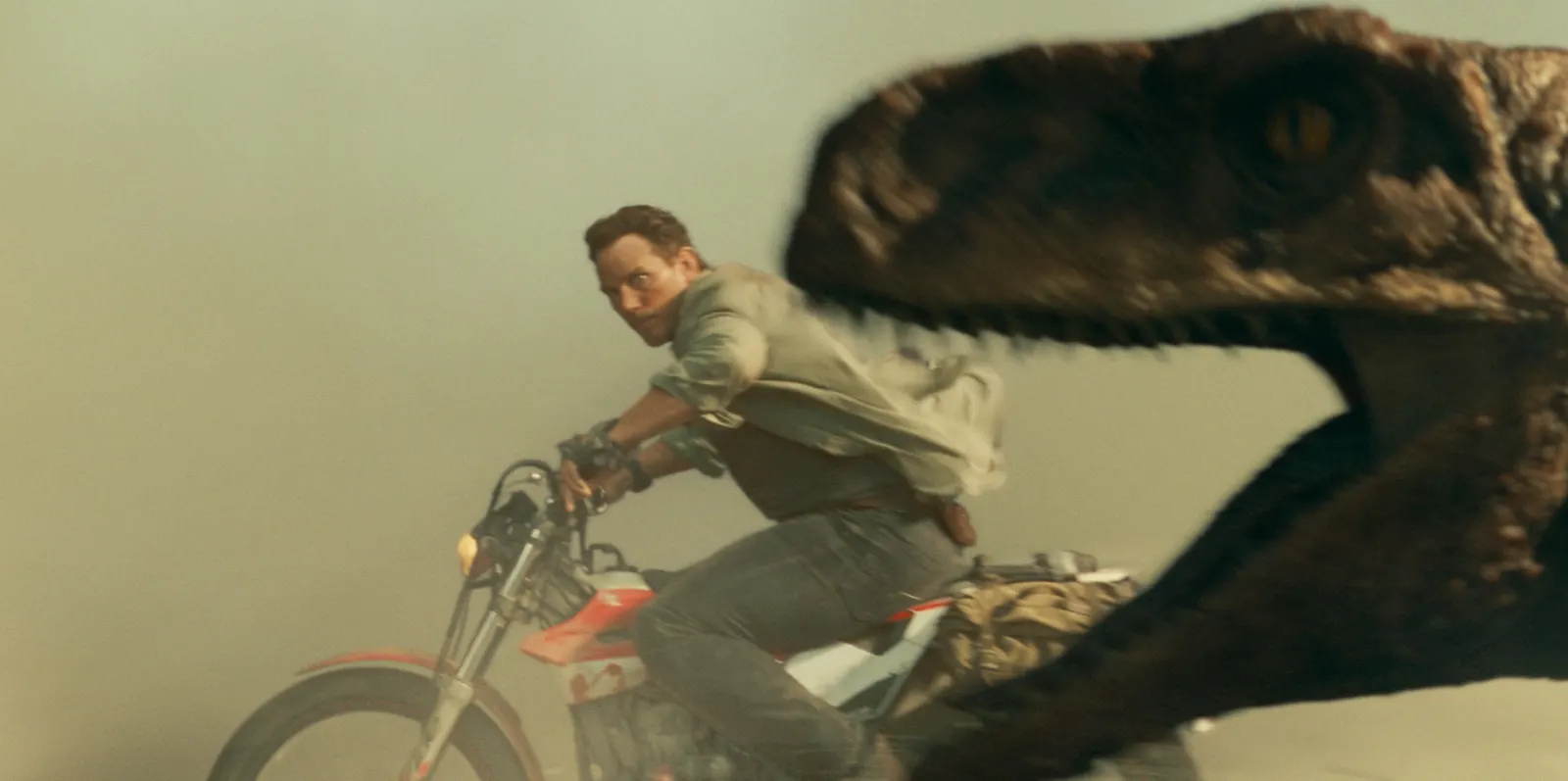

‘Jurassic World: Dominion’ had a monster budget.
© 2022 Universal Studios and Amblin Entertainment. All Rights Reserved.
Universal Pictures has revealed that 2022’s Jurassic World: Dominion went over budget with its total cost standing at $683.7 million by the end of last year cementing its status as the most-expensive film of all time based on publicly disclosed production costs.
Dominion brought the curtain down on the trilogy of Jurassic World movies headlined by Chris Pratt and Bryce Dallas Howard. It united them with Lara Dern, Jeff Goldblum and the late Sam Neill, the trio of stars from the first three films about reanimated dinosaurs. The reptiles were brought to life on screen by a herd of Hollywood’s finest visual effects houses led by Disney’s Industrial Light & Magic. It all came at a colossal cost.
In addition to its blockbuster pay packets and hefty visual effects bill, Dominion was burdened with expenses from filming at the height of the pandemic in 2020. As a result, the cast had to quarantine for five months at the plush Langley hotel while they filmed at nearby Pinewood Studios in the United Kingdom. The Langley is the former manor home of the third Duke of Marlborough and rooms typically cost more than $600 per night. It all added up.
The cost of movies made in the United States is usually a closely-guarded secret as studios combine their spending on all of them in their filings and don’t break them out individually. Movies made in the U.K. are a notable exception. A lucrative fiscal incentive scheme has made the country a hub for Hollywood film-makers and shines a spotlight on the cost of the movies made there.
Studios filming in the U.K. benefit from the government’s Audio-Visual Expenditure Credit which gives them a cash reimbursement of up to 25.5% of the money they spend in the country. It comes with a catch.
To qualify for the reimbursement, at least 10% of the core costs of the production need to relate to activities in the U.K. and in order to demonstrate this to the government, studios set up a separate Film Production Company (FPC) there for each picture. The FPCs have to file legally binding financial statements which reveal everything from the headcount and social security payments of the staff to the amount of reimbursement banked by the studio and the total cost of the production. It takes a bit of detective work to get to the bottom of it.
The FPCs usually have code names to keep the actual name of the production a secret when it advertises for casting calls and files permits to film on location. Tallying the code names with the productions they are responsible for requires deep industry knowledge which my colleague and I have built up over nearly 15 years of reporting. We are the only journalists worldwide who specialize in covering the financial statements of U.K. film production companies for national media and we have reported on them for more than 10 leading titles including The Times of London, The Guardian, The Daily Telegraph and The Independent.
Once the code name has been correctly tallied with the film, the financial statements of the relevant FPC can be consulted to reveal how much the movie cost to make. That’s because the terms of the reimbursement state that each FPC must be “responsible for pre-production, principal photography/shooting and post-production of the film; and for delivery of the completed film.” In summary, the FPC’s financial statements have to show the production’s entire costs, not just those incurred in the U.K. Studios aren’t allowed to hide costs in other companies as the terms also state “there can only be one FPC in relation to a film.”
‘Jurassic World: Dominion’ was filmed in the U.K.
© 2022 Universal Studios and Amblin Entertainment. All Rights Reserved.
The Universal subsidiary behind Dominion is called Arcadia Pictures which is named after the rescue ship that carries the dinosaurs to safety in 2018 prequel Jurassic World: Fallen Kingdom. As with all FPCs, its financial statements are filed in stages which started during pre-production and continued until long after the premiere to give the company time to ensure it has collected all of its bills and received the money for them.
It explains why costs are still being shown in Arcadia Pictures’ financial statements with the latest set released last week for the year to December 31, 2025. They show that during that period it incurred $24.9 million (£18.4 million) of costs bringing the total to $683.7 million (£531.7 million) which was higher than expected. The documents explain that “although the budget has been exceeded, the overage on budget is not deemed to be a risk.”
Dominion has smashed the spending of Star Wars: The Force Awakens, which was also filmed in the U.K. and was the previous record-holder with costs of $644.7 million (£456.5 million). No other single movie has disclosed higher costs than Dominion in publicly-available filings. Although Marvel’s Avengers: Endgame and Avengers: Infinity War together cost more at a total of $1.3 billion (£1 billion), they were made by the same Disney subsidiary so it isn’t possible to tell how much was spent on each one.
One of the biggest costs shown in the Arcadia Pictures filings is the pay to the crew which came to a total of $36.4 million (£27.5 million). As the movie was released back in 2022 the company hasn’t had any staff on its books since then. However, in 2020 they peaked at a monthly average of 454 people without even including freelancers, contractors and temporary staff as they aren’t listed as employees of British companies even though they often represent the majority of the workers on a film shoot.
Special effects represent a large part of the costs of the ‘Jurassic World’ movies.
© 2022 Universal Studios and Amblin Entertainment. All Rights Reserved.
Creating jobs is one of the reasons that the U.K. government has tempted studios to film in the country. In addition to hiring the crew, studios spend on services such as security, equipment hire, transport and catering. It pays off as the latest data from the British Film Institute (BFI) shows that every $1.32 (£1) of reimbursement handed to studios generated $10.97 (£8.30) of additional Gross Value Added (GVA) benefit for Britain’s economy in 2019. It helped the film incentive scheme generate a total of $10.2 billion (£7.7 billion) of GVA in 2019 so it is money well spent.
Dominion banked a blockbuster $131.4 million (£102.1 million) reimbursement which is understood to be the largest payment to a single movie since the U.K. introduced its film fiscal incentive scheme in 2007. It was also handed $3.7 million (£2.8 million) under the U.K.’s Coronavirus job retention scheme which helped to drive the net cost of Dominion down to $548.6 million. Then come the takings.
According to industry analyst Box Office Mojo, Dominion grossed $1 billion but Universal didn’t pocket all of this.
The amount that theaters pay to studios is known in the trade as a rental fee and an indication of the typical level comes from film industry consultant Stephen Follows who interviewed 1,235 film professionals in 2014 and concluded that, according to studios, theaters keep 49% of the takings on average.
This research lends weight to the widely-established 50-50 split which would put Universal’s share of Dominion’s spoils at approximately $500 million.
Deducting the $548.6 million net cost off this sum would leave Universal with an estimated $48.6 million loss on the box office. That’s only based on the theater takings and the production costs, the latter of which are shown in the FPC’s financial statements. It doesn’t include merchandise or home entertainment revenue as they go directly to the studio which also covers the marketing costs.
The negative bottom line isn’t a surprise as the bigger the budget, the harder it is to make a profit and budgets don’t come any bigger than Dominion’s. The deficit would have been even wider if it wasn’t for the $131.4 million magic touch from the U.K. government which explains why Universal returned to the country to film Jurassic World Rebirth, the sequel to Dominion which premiered in June last year.
It made a monster of a profit at the box office which more than compensated for the dark clouds left by Dominion. Yet another sequel is on the way and, given the benefit of filming in the U.K., it won’t be a surprise if that too ends up being made there.
Additional research by Chris Sylt















Leave a comment