


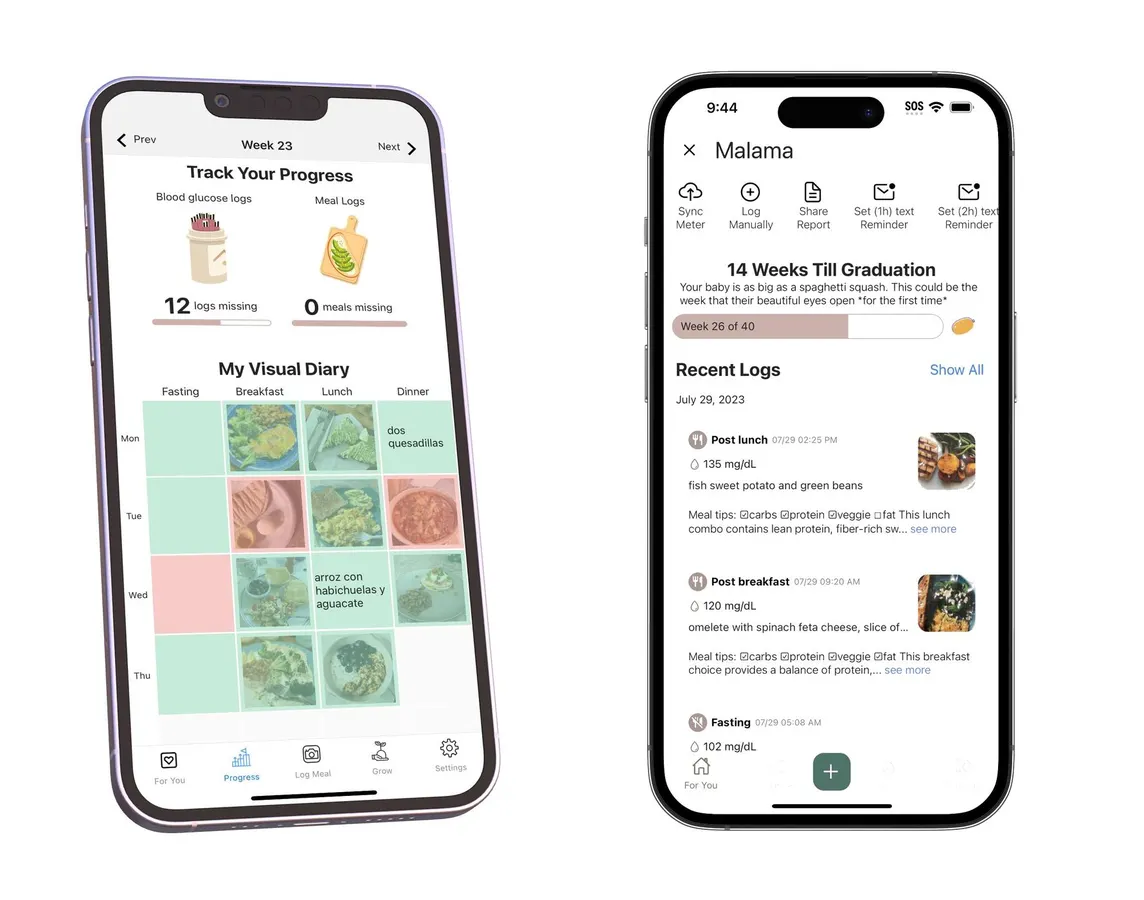

Malama Health’s free app tracks glucose, nutrition, and symptoms and connects women directly to their care team—available in every U.S. state and 20+ countries, in multiple languages.
Malama Health is a Medicaid-first maternal care startup delivering doula-led, tech-enabled support for high-risk pregnancies.
Mika Eddy still has the spreadsheet. Every line item. Every Explanation of Benefits. The total for her first pregnancy—an unmedicated vaginal delivery during Covid, while she was director of Clinical Product Innovation at UnitedHealthcare—came to just over $100,000 billed, and $20,000 out of pocket. Her third pregnancy, at Kaiser, cost $150.
That gap, tracked by a healthcare executive who understood every billing code and still couldn’t escape the damage, is the founding document of Malama Health.
In March 2026, the Y Combinator-backed maternal care startup closed a $9.2 million seed round led by Acumen America, targeting the 42% of U.S. births covered by Medicaid—a population most digital health companies have never seriously tried to serve. If Eddy’s model holds, she may have found the shortest path between a maternal mortality crisis and a market hiding in plain sight.
The Insider Who Saw The Gap From Both Sides
Malama Health co-founders Orlando Liand, CTO and Mika Eddy, CEO
Malama Health is a Medicaid-first maternal care startup delivering doula-led, tech-enabled support for high-risk pregnancies.
Eddy’s grandmother was an OB-GYN who had fled a revolution and built a practice in rural Japan. Her father was a doctor. She joined United specifically to gain the payer perspective—the one piece of the system she knew any real solution would require. “I knew that the solution I envisioned couldn’t be built at a large institution like United,” she notes.
During her first pregnancy, she was diagnosed with gestational diabetes, a condition affecting roughly 8% of U.S. pregnancies and carries a 50% lifetime risk of progressing to Type 2 diabetes—a disease that accounts for one in four U.S. healthcare dollars.
She was simultaneously sitting in on United’s Medicaid meetings, following twin NICU babies through claims data, and noting exactly where the system dropped women. The professional and the personal collided, and she started building.
What Never Existed—And What Malama Built From Scratch
When Eddy began shadowing maternal-fetal medicine physicians at Stanford, they told her that every existing diabetes management product was adapted from Type 1 or Type 2 tools and none of them worked for pregnancy.
Pregnant women can’t simply cut carbs. The nutritional calculus changes entirely when you’re growing a baby or breastfeeding after a C-section. No purpose-built infrastructure existed for gestational diabetes management, and no infrastructure for what happens between appointments.
The standard American prenatal journey is eight visits, episodic, with a single six-week postpartum appointment. Only 30% of Medicaid-insured women ever attend that follow-up appointment.
Providers told Eddy they “almost don’t want to know” a patient’s elevated postpartum risk because they felt powerless to act on it. The gap between knowing and doing wasn’t clinical; it was structural. “We’re not supplementing the healthcare system,” Eddy adds. “We’re really showing what it should have always looked like.”
What A Doula-Care Navigator Actually Does
Malama’s answer is its Doula-Care Navigator model. These aren’t referral partners or gig workers. They are W-2 employees, trained in both doula support and social determinants navigation, embedded in the communities they serve. They attend births, conduct home visits, and escalate clinical signals in real time through a HIPAA-compliant dashboard with Epic integration—and they also help women find car seats, book pediatricians, and locate WIC sites with supplies in stock.
As of April 2026, more than half of U.S. states provide Medicaid coverage for doula services, up from just two states in 2018. The policy wave is real, and Malama is positioned directly in front of it.
A Rare Evidence Base For A Seed-Stage Company
Most seed-stage digital health companies don’t run randomized controlled trials. Malama did. Tufts Medical Center conducted an RCT beginning in 2023, finding that women using only the Malama app showed a 40% difference in postpartum glucose tolerance compared to standard care. “We saw pregnancy as this golden window of opportunity to intervene and instill healthier behaviors,” Eddy points out.
Patient-reported outcomes from more than 2,300 women show a 45% decrease in preterm births, a 19% decrease in NICU admissions, and a 13% decrease in C-sections against high-risk benchmarks.
The NIH awarded a $2.4 million Fast Track SBIR grant for a Phase 2 RCT on postpartum Type 2 diabetes prevention—a signal that the evidence is strong enough to fund at scale.
The Market—And Why Everyone Else Went The Other Way
When Eddy pitched investors on a Medicaid-first model, the pushback was predictable: “Why are you limiting yourself?” She calls her strategy “the Robin Hood move”—raise from Silicon Valley,then build for the population Silicon Valley has ignored.
What looked like a constraint is emerging as a moat.
The competitive field for Medicaid maternity care is remarkably thin. Maven Clinic and Oula Health built for employers. Pomelo Care acquired The Doula Network but operates a lighter-touch model. Nadia Care raised $12 million in 2026 for hybrid in-home and virtual care. None built an employed, quality-controlled doula workforce trained on a proprietary technology platform.
The $9.2 million round—led by Acumen America with Wisdom Ventures, Capital F, and Coyote Ventures—embeds a $2.3 million NIH grant and more than $900,000 in California state funding, a capital stack that signals unusual alignment across federal, state, and private stakeholders.
Malama is in-network with Medicaid plans in California, Texas, and Colorado. The app has reached 50,000 users across all 50 states. Centers for Medicare & Medicaid Services’ Transforming Maternal Health model, running through 2034, explicitly calls for doula expansion, remote monitoring for gestational diabetes, and postpartum continuity—the policy architecture Malama was built to inhabit.
“Medicaid is the largest payer of maternity care in the U.S., and it’s still failing the women who need it most,” observes Margaret Coblentz, co-Founder and GP of Capital F. “Mika brings something rare: deep healthcare expertise and firsthand knowledge of exactly what’s broken. Doula-led care is the future of maternal health. Malama is building the infrastructure to make that future real.”
The Hard Parts—And What Comes Next
Building for Medicaid women means building for a population where trust is both essential and fragile. Ten minutes of server downtime at 2 a.m. produced a flood of panicked app reviews from women for whom Malama was their only continuous support system. A doula who didn’t meet quality standards had to be let go—exposing the irreducible tension between community embeddedness and clinical accountability.
What comes next is more states, more doulas, and deeper alternative payment model negotiations with health plans. The average pre-pregnancy Body Mass Index of women entering Malama’s platform is 35.7. One-third screen positive for food insecurity. This is not a niche population. This is the clinical reality of nearly half of American births—and it has been largely invisible to the companies best positioned to address it.
“Mika is one of the rare founders who understands both the realities and the gaps in our healthcare system, especially for those insured by Medicaid,” says Vivek Murthy, former U.S. Surgeon General and Senior Venture Partner at Wisdom Ventures. “Malama Health is building the infrastructure maternal care has been missing for decades.”
The $100,000 spreadsheet is still on Eddy’s computer. The system that generated it hasn’t changed. What has changed is that someone who can read every line of it has spent four years building the alternative—for the women who never had a spreadsheet, a director title, or a second chance.















Leave a comment