


It’s time again for the quadrennial question: Can this be the World Cup that finally converts U.S. sports fans to soccer fanatics?

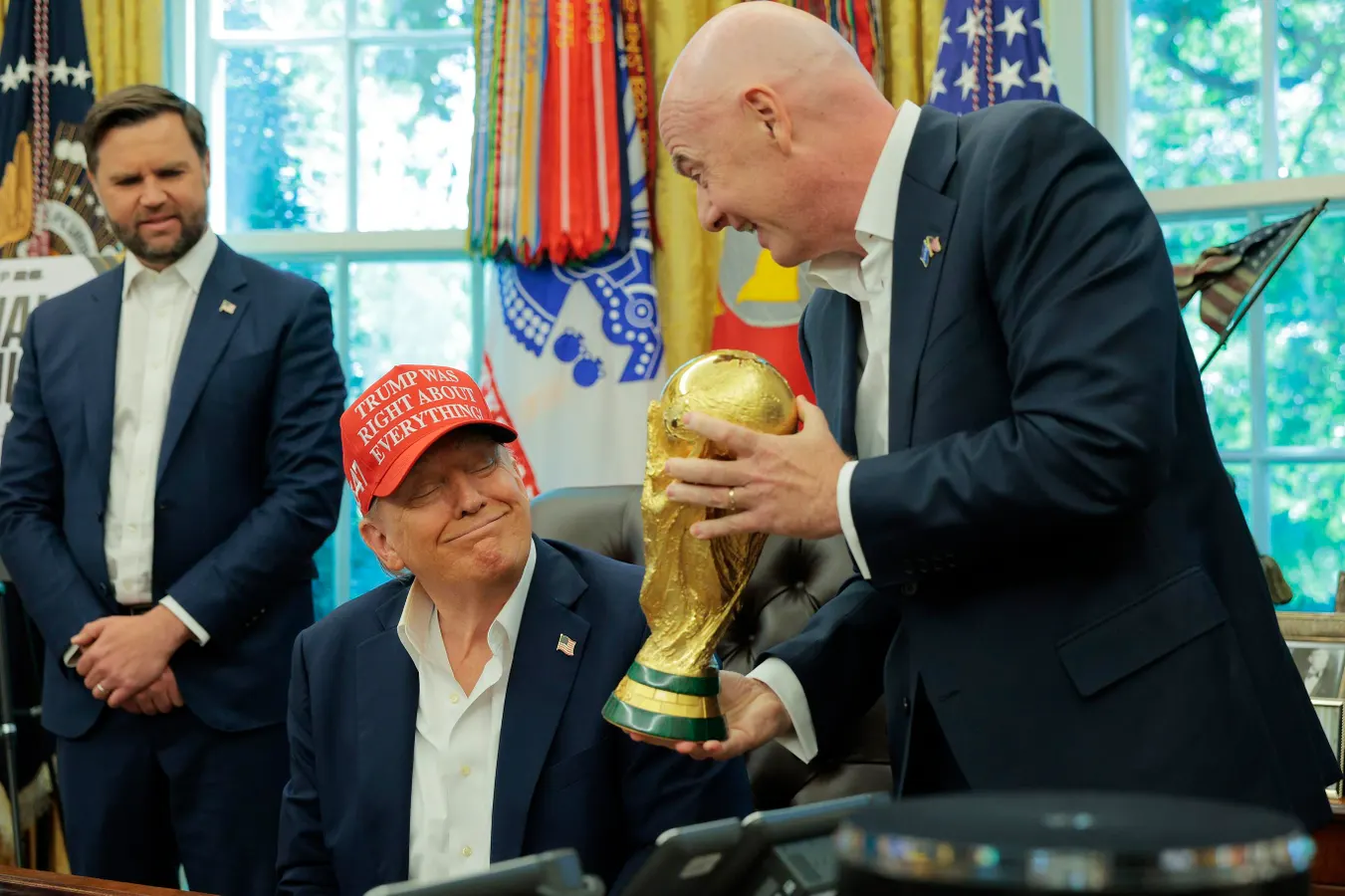
WASHINGTON, DC – AUGUST 22: FIFA President Gianni Infantino shows U.S. President Donald Trump the World Cup Trophy in the Oval Office as Vice President JD Vance looks on August 22, 2025 in Washington, DC. Trump announced the FIFA World Cup 2026 draw will take place at The Kennedy Center. (Photo by Chip Somodevilla/Getty Images)
Getty Images
In 2026, the answer might be yes, or at least closer than ever. For the first time since 1994, the FIFA World Cup is being played on (North) American soil, and polling suggests an attitude shift. According to Numerator research, nearly a third of U.S. adults now plan to watch the 2026 tournament, up from 26% in January. YouGov data shows that 43% of U.S. sports fans cite hosting the tournament as a key reason they plan to tune in, which is the single biggest driver of viewership intent. And Nielsen reported in October that 37% of the general population expects their interest in soccer to grow over the next 18 months.
But pretournament enthusiasm and sustained fandom are different things. Before speculating on how this year will be different, it’s important to unpack why the world’s most popular sport has failed to capture and hold American audiences.
Why Soccer Never Became America’s Favorite Sport
NFL football is and has been the dominant U.S. television draw since the late 20th century. Even in our era of media fragmentation and atomized taste, American football consistently dominates the ratings, surviving along with election nights as one of our last durable media events. The Super Bowl remains the apotheosis of American ritualized mass viewing. In February 2025, 127.7 million viewers tuned in to watch the Philadelphia Eagles crush the Kansas City Chiefs, making it the most-watched single telecast in American history. Super Bowl LX, played this past February, hit a 15-minute peak of 137.8 million viewers during the second quarter.
By contrast, 25.8 million U.S. viewers tuned into the 2022 World Cup Final between Argentina and France, arguably the most thrilling championship match ever. That makes it the most-watched men’s soccer match in U.S. history, with ratings slightly ahead of the World Series and NBA Finals. Yet it represents less than a quarter of the Super Bowl’s domestic audience, and a fraction of the nearly 600 million who watched around the world.
How Television Helped Football Beat Soccer In The United States
The root cause of America’s pigskin preference goes back to the 1950s, when TV sets moved from niche tech to household appliances. The cathode ray tube transported games from arenas to living rooms and, over the ensuing decades, elevated sports into the sacred, shared, and lucrative spectacle they are today.
Unlike most of the rest of the world, 20th century U.S. television was financed primarily by advertising revenue. Television elsewhere largely followed a public broadcasting model. Even today, less than 35% of the BBC’s income is from advertising; the rest comes from mandatory licensing fees paid by individuals, households, pubs, and bookmakers who use its services.
The revenue model of American broadcasting relies on sponsors who pay for ad time during frequent, short commercial breaks. Episodic sports like baseball and football fit that format. Soccer, by contrast, is continuous, and the flow of action rarely stops throughout each 45-minute half. In fact, managing the unrelenting pace and subsequent fatigue is part of a soccer team’s strategy, with player running around seven miles each match. No commercial breaks hurt broadcasters’ bottom lines. Commercials in the midst of play hurt viewers’ experience, and artificial breaks undermine the game itself.
Attempts by the Columbia Broadcast System (CBS) to format soccer for American audiences, in the 1960s and 1970s, largely failed because of this economic bind. One month into the inaugural season, head referee Peter Rhodes admitted and later recanted manufacturing fouls at the behest of CBS to allow for commercial breaks. CBS denied those charges as well as claims it told players to fake injuries so the network could run ads. Soccer fans and casual viewers called foul. Subsequently the upstart leagues struggled to maintain viewership even when they poached the world’s greatest soccer players.
In 1975, an audience of 10 million tried to watch Pele’s debut for the New York Cosmos but missed seeing his assist live because CBS was on commercial break and his only goal because the broadcasters were replaying an earlier foul. The bottom line: as sports colonized American culture through television in the second half of the 20th century, U.S. audiences fell in love with football largely because it fit and was on TV, while soccer cemented its global dominance everywhere else.
That lost momentum created an interest deficit that U.S. soccer has been struggling to close. It was further compounded by a reputation, crystalized in the 1980s, that soccer was boring (read: low scores and ties) and, because Americans didn’t play it as well as foreigners, it was a foreign sport and, thus, un-American. A “boring,” anti-commercial, un-American product was ratings poison in Reagan’s America. And that simplistic reputation persists in our popular imagination to this day.
Why Many American Sports Fans Still Find Soccer Boring
As U.S. interest in soccer waned, its interest in football soared, buoyed by the commercial friendly structure and concussive collisions brought to life on television. The evermore elaborate spectacle itself became an expression of a nation and way of life poised to win the Cold War. In his seminal analysis of the Super Bowl, media scholar Michael Real wrote “If one wanted to create from scratch a sport that reflected the sexual, racial, and organizational priorities of American social structure, it is doubtful that one could improve on football.” By the end of the 20th century, football had replaced baseball as America’s pastime.
American football was braggadociously everything that soccer wasn’t. To quote Real again, it is “an aggressive, strictly regulated team game fought between males who use both violence and technology to gain control of property for the economic gain of individuals within a nationalistic entertainment context.” By contrast, soccer is less technological, less violent, less specialized, less overtly masculine, with lower scoring, and (worst of all) ties.
What Gen Z Sports Fans Think About Soccer And The World Cup
That boring, un-American, anti-commercial caricature calcified into received wisdom by the 1990s and has proven surprisingly durable. But does it still hold? To find out, I conducted focus groups at Rowan University’s Center for Sports Communication & Social Impact with Gen Z sports fans, the generation that will ultimately determine whether American soccer finally crosses over.
The findings complicate the conventional narrative. Younger fans are genuinely excited about the World Cup, consistent with the October Nielsen data showing soccer fandom skewing highest among Millennials and Gen Zers. But that enthusiasm can be fleeting, particularly if the U.S. Men’s team exits early. And when asked whether they would continue watching after the tournament, all but the committed soccer fans (a group that is growing) reverted to familiar complaints about low scores and ties.
When we dug deeper though we found their issue wasn’t simply less scoring. It was fewer lead changes. What American sports fans find electrifying is the possibility and manifestation of drastic change. These are the miraculous comebacks, when a football team is down 21 points at halftime and somehow wins.
Soccer’s low-scoring structure makes such reversals rare and appear, at least numerically, less parabolic. A team can go up 1-nil on a lucky goal and then spend 80 minutes in a defensive siege to win. Such a scenario can feel tense, to say the least, but the scoring is static. Statistically there is less back-and-forth, and less opportunity for the catastrophic collapses and monster comebacks that American sports fans equate to “excitement.”
In-game lead swings and generational team mobility are rarer in soccer, particularly FIFA soccer, where the same powerhouses tend to dominate every World Cup. Culturally this runs counter to the social mobility of the American Dream. Practically too it affects an important draw for younger sports fans: betting.
For better and more likely worse, young American sports fans bet, a lot. Their behavior has reshaped American sports consumption since the Supreme Court’s 2018 Murphy v. NCAA ruling opened the door to legalized wagering nationwide. Football’s scoring frequency and its discrete, predictable structure and exhaustive statistics map neatly onto in-game prop bets. Soccer’s continuous flow and low scoring make it a harder sell for the live betting experience that American sports media has increasingly built its engagement model around.
This perception of soccer as low-stakes and low-drama remains a cultural construct rooted in American socioeconomic mythology, the ideal of self-determination, the dream of social mobility, the belief that any deficit can be overcome, and that David can defeat Goliath. That narrative is performed on any given Sunday across the NFL season. It plays out less reliably on the professional pitches across Europe and South America.
Can MLS Turn World Cup Excitement Into Long-Term Fandom?
So, will 2026 change things? There are reasons for optimism beyond the hosting advantage. For its 23rd World Cup, FIFA expanded the draw to 48 teams, instead of the traditional 32. That doesn’t just swell the number of matches played from 64 to 104, it also means that weaker teams may advance further than in previous tournaments. FIFA ranks Team USA 17th in the world, setting the stage for the kind of Cinderella story American audiences (and broadcasters) covet. Do you believe in miracles?
Issues around commercial breaks have been addressed, if not resolved, through creative advertising strategies and streaming platforms that should endure beyond the World Cup. And just to be safe, FIFA mandated “hydration breaks” at the midpoints of each half to protect athletes from North American summer heat. Despite the protestations of soccer purists, these artificial interruptions will allow broadcasters to cut to commercials. If that weren’t American enough, the Championship match is plus-sizing halftime to accommodate a Super Bowl style musical extravaganza.
Domestically, Major League Soccer (MLS) has expanded to 30 teams, with average attendance around 22,000 per match. Premier League viewership in the U.S. grew 5% last year with games averaging 535,000 TV viewers per Premier League broadcast, according to NBC. And, of course, the U.S. Women’s national team continues to dominate soccer, and it’s finally receiving some of the compensation it deserves.
But what will happen to domestic soccer fandom after the final whistle on July 19? For futbol to take root the fandom must be bolstered by Team USA’s success followed by an improvement in the quality and competition of Major League Soccer, according to Brian Monihan, former President of NBC Sports Philadelphia. Essentially, men’s soccer in America should aspire to the level of excellence of women’s soccer in America on the international and the national stage.
Despite steady attendance, MLS currently ranks 10th in the world (three behind England’s number two league), according to Global Football Rankings. It’s a minor league despite its name. In fact, 68% of avid U.S. soccer fans prefer international leagues, according to L.E.K. Consulting. As much as Premier League viewing has grown, the time and cultural differences are too great for durable penetration with casual fans or generational passion with sports enthusiasts. MLS needs to become an elite soccer league globally, one in which the best homegrown and foreign talent want to play, as with the National Women’s Soccer League (NWSL). Again, be like the women!
Looking forward, two important factors may assist the quest to mainstream American men’s soccer. First, MLS is transitioning in 2027 to the European season calendar (July-May), a move that MLS Commissioner Don Garber called “one of the most important decisions in our history.” Doing so will align MLS with the world’s top leagues and allow it to compete for the best players in the transfer market. To afford that talent the U.S. needs a deep World Cup run with blockbuster ratings to convince sponsors that the soccer revolution is real and durable. Better talent and improved quality of play and competition will expand fandom for U.S. soccer in America and potentially abroad. Imagine someday Londoners packing pubs to watch the MLS Cup Finals.
Second, Major League Baseball is careening toward a lockout in 2027. Historically labor-induced disruptions of baseball seasons have been catastrophic for attendance and viewership. According to Monihan, U.S. sports fans have an abundance of content choices and limited time and attention. The NFL and NBA will be safe for now, he told me, but it’s the NHL and MLB “who will be concerned [about] dilution of rights money, fan [attention] and share of voice.” A strong World Cup finish, an improvement in MLS quality with its new season schedule, and an MLB strike might open the door for a soccer promotion to America’s top three sports.
The structural and mediated obstacles that kept soccer off American screens for half a century are eroding. Streaming can potentially neutralize the commercial break problem (barring enshittification). The expanded 48-team field creates the underdog narratives American fans crave. The MLS calendar shift aligns the league with global competition. And if an MLB work stoppage clears the summer schedule in 2027, soccer may find itself, for the first time, with an open lane.
But the more important shift may be generational and psychological. Young American fans aren’t rejecting soccer because of the scoreboard. They’re rejecting it because it doesn’t deliver the lead changes and catastrophic collapses they’ve been conditioned to expect. That’s not a permanent cultural verdict. It’s a solvable perception problem, and a deep U.S. tournament run, with its attendant reversals and last-minute drama, could rewrite it in real time this summer.
Youth soccer coach Matthew Subits estimates an eight-year process. “We’re not there yet, but it’s coming.” Given everything now aligning: a home tournament, a generation raised on cleats, a streaming ecosystem built for global audiences, and a domestic league finally positioning itself to compete globally, his timeline may turn out to be conservative. The question was never whether Americans could love soccer. It was always whether the conditions were right. In 2026, for the first time, they might be.











Leave a comment