


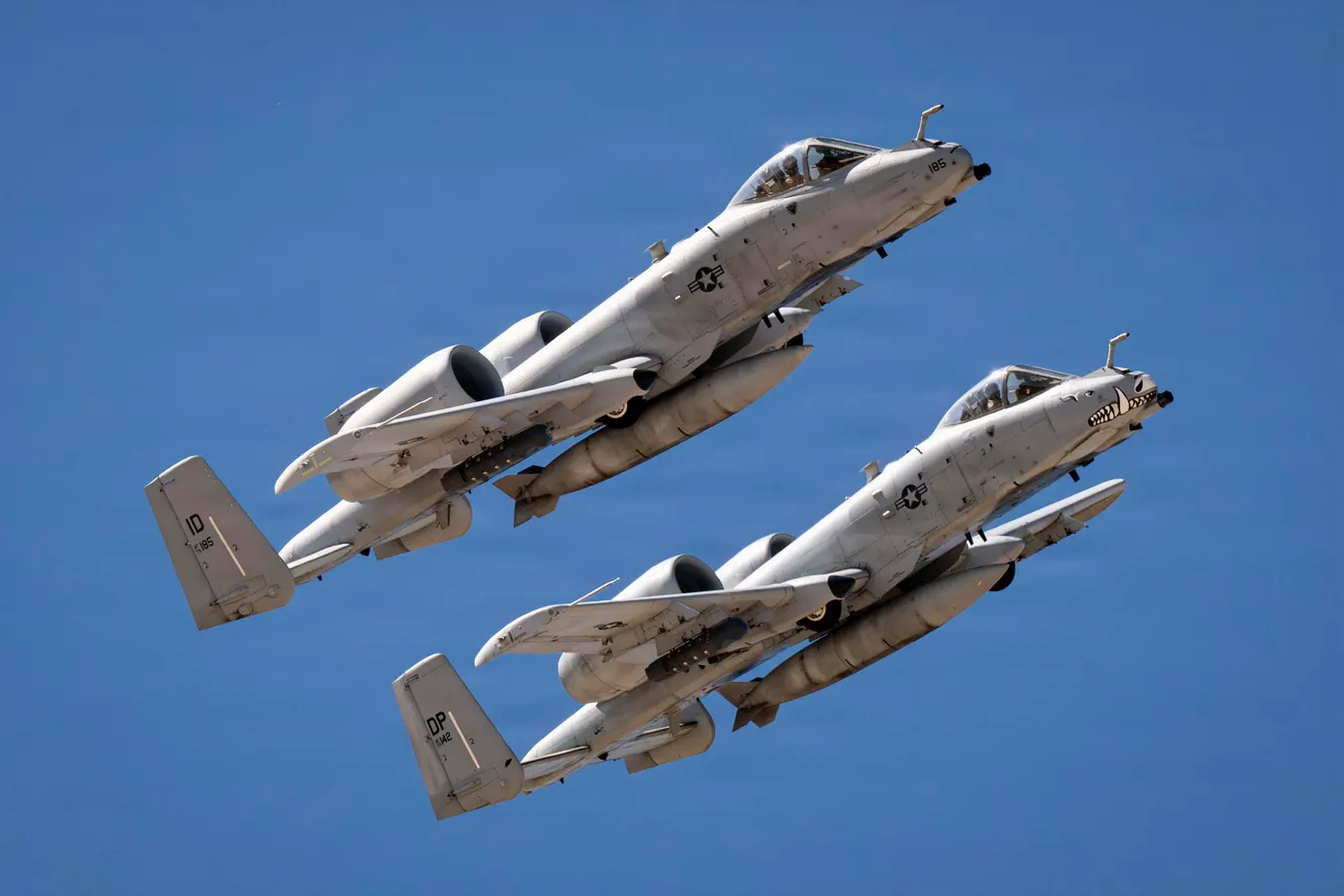

Two U.S. Air Force A-10 Thunderbolt II aircraft assigned to the Idaho Air National Guard and Air National Guard Air Force Reserve Test Center, fly in formation at Davis-Monthan Air Force Base, Arizona, Sept. 18, 2026.
(U.S. Air Force photo by Airman 1st Class Samantha Melecio)
Last week, the final squadrons flying the famed Fairchild Republic A-10 Thunderbolt II were inactivated during a ceremony at Davis-Monthan Air Force Base, Arizona. The units included the 355th Operations Group, 357th Fighter Squadron, 357th Fighter Generation Squadron and the 355th Training Squadron.
At last Friday’s ceremony, each of the A-10 unit’s guidons was rolled up and cased by their respective commander and U.S. Air Force Col. Jose Cabrera, 355th Wing commander, who presided over the historic event that closed another chapter in the famed aircraft’s history.
“For decades, every single active-duty pilot, who flew into harm’s way, was built right there on this flightline,” Col. Cabrera said in a statement. “For nearly 50 years, the A-10 Thunderbolt has occupied a sacred place in American air power. It was never just an airplane. It was a promise. Davis-Monthan was part of that promise.”
Ground “Attack” Aircraft
U.S. Airmen assigned to the 355th Operations Group, 357th Fighter Squadron, 357th Fighter Generation Squadron and 355th Training Squadron pose for a group photo with a static display of an A-10C Thunderbolt II aircraft during a unit inactivation ceremony at Davis-Monthan Air Force Base, Sept. 18, 2026.
(U.S. Air Force photo by Staff Sgt. Jasmyne Bridgers-Matos)
As each of the squadron commanders relinquished their duties, the audience responded by yelling out “attack,” a reference to the Thunderbolt II’s “A” designation, which, in the United States military naming system, stands for attack. The A-10 is not a traditional fighter plane, and instead was built to carry out precision air strikes and close air support against ground targets, enemy troops and surface vehicles.
“We say the word ‘attack’,” said U.S. Air Force Lt. Col. Rodney Dwyer, final commander of the 355 OG and 355 TRS. “We have a great amount of pride when we say that word because it’s not just the challenge or response. It’s a distinct mentality – that aggressive state of mind that means using the opportunity when conditions are chaotic.”
Five Decades Of Service At Davis-Monthan AFB
The first A-10 Thunderbolt II arrived at Davis-Monthan AFB on March 2, 1976, assigned to the 355th Tactical Fighter Wing. This past July 19, an A-10 conducted its final flight from the base, bringing an end to the storied aircraft at Davis-Monthan AFB.
“This has been an incredible job and opportunity, but it’s also been heavy,” U.S. Air Force Lt. Col. Ryan Rutter, final commander of 357 FS. “I think about my time as a wingman, my job was to learn. As an instructor pilot, it was to teach. And now my charge [as a commander] is to leave.”
The closure of the A-10 wing at Davis-Monthan AFB does not spell the end for the Warthog, the unofficial nickname for the ground attack aircraft.
Around 160 of the aircraft are still operational at nine other airbases in the United States, as Congress required that at least 100 Warthogs remain operational through 2030. In addition, a pending piece of legislation, the “BRRRRT Act” co-sponsored by Reps. Abe Hamadeh (R-AZ) and Don Davis (D-NC), could increase this number to 126 and extend the timeframe.
The A-10 – Almost a Flying Tank
The rugged attack aircraft was developed in the late 1970s, when the United States military was still relying on the Korean War-era Douglas A-1 Skyraider as its primary ground-attack aircraft.
It came as the result of extensive studies conducted between 1963 and 1969, which defined the specifications for the new aircraft. Several prototypes were considered, but in December 1972, Fairchild Republic’s A-10A Thunderbolt II was deemed the winner, with GE chosen to produce the aircraft’s 30mm tank-busting GAU-8 gun, a powerful weapon with a very high muzzle velocity 20 times that of the 75mm gun fitted to some of the North American B-25 Mitchell medium bombers in World War II.
In addition, the 30mm gun, which used rotating barrels, offered an unparalleled rate of fire for an aircraft weapon was able to fire up to 4,200 rounds per minute. No attack aircraft in history has ever mounted a gun with the tank-killing capability of the GAU-8.
Yet, speed has never been the priority for the Warthog.
Instead, the aircraft was developed to loiter near battle areas for extended periods and operate at 1,000 feet (304.8 meters) or less with 1.5 miles (2.4 kilometers) of visibility. The A-10’s short takeoff and landing capability enabled it to operate from austere airstrips near the front lines, and its heavy armor allowed it to stand up to punishing ground fire and still complete its mission.
Although it was originally developed to tear through Soviet armored columns in Western Europe, the Thunderbolt II was first deployed during Operation Urgent Fury, the 1983 American invasion of Grenada. The A-10 provided air cover for US forces, where it proved effective at operating close to the front lines. However, the CAS aircraft faced virtually no resistance and never fired its main gun in anger.
It wasn’t until the Gulf War in 1991 that the aircraft took part in combat operations. In that conflict, it performed far better than expected. In addition to numerous sorties against Iraqi Republican Guard units on the ground, Warthogs successfully shot down two Iraqi helicopters with the GAU-8.
Although it has been described as a flying tank, six A-10s were still shot down by surface-to-air missiles; around 70 other Warthogs sustained battle damage and were able to return to base. Many underwent field repairs and quickly returned to service. The A-10’s performance record during the war also saw a 95.7 percent mission-capable rate, which led the Air Force to abandon a plan to replace the A-10s with a close air support version of the F-16 Fighting Falcon.
The Warthog was later employed with success in air support missions in Afghanistan and Iraq during the War on Terror. Apart from one that was shot down by an enemy missile near Baghdad in the opening stages of Operation Iraqi Freedom in April 2003, the A-10 proved darn near impossible to take out. No further aircraft were shot down during operations in Iraq and Afghanistan.
Ship Escort
In July, an A-10 Thunderbolt II provided close air support to the USS Nebraska (SSBN-739), one of the United States Navy’s 14 operational Ohio-class nuclear-powered ballistic missile submarines.
A U.S. Air Force A-10 Thunderbolt II aircraft escorts Ohio-class ballistic missile submarine USS Nebraska (SSBN 739) in the Pacific Ocean, July 28, 2026.
(U.S. Navy photo by Mass Communication Specialist 1st Class Ryan Riley)
The Warthog can loiter near battle areas for extended periods and operate at 1,000 feet (304.8 meters) or less with 1.5 miles (2.4 kilometers) of visibility, making it relatively ideal for escorting a surfaced submarine.















Leave a comment