


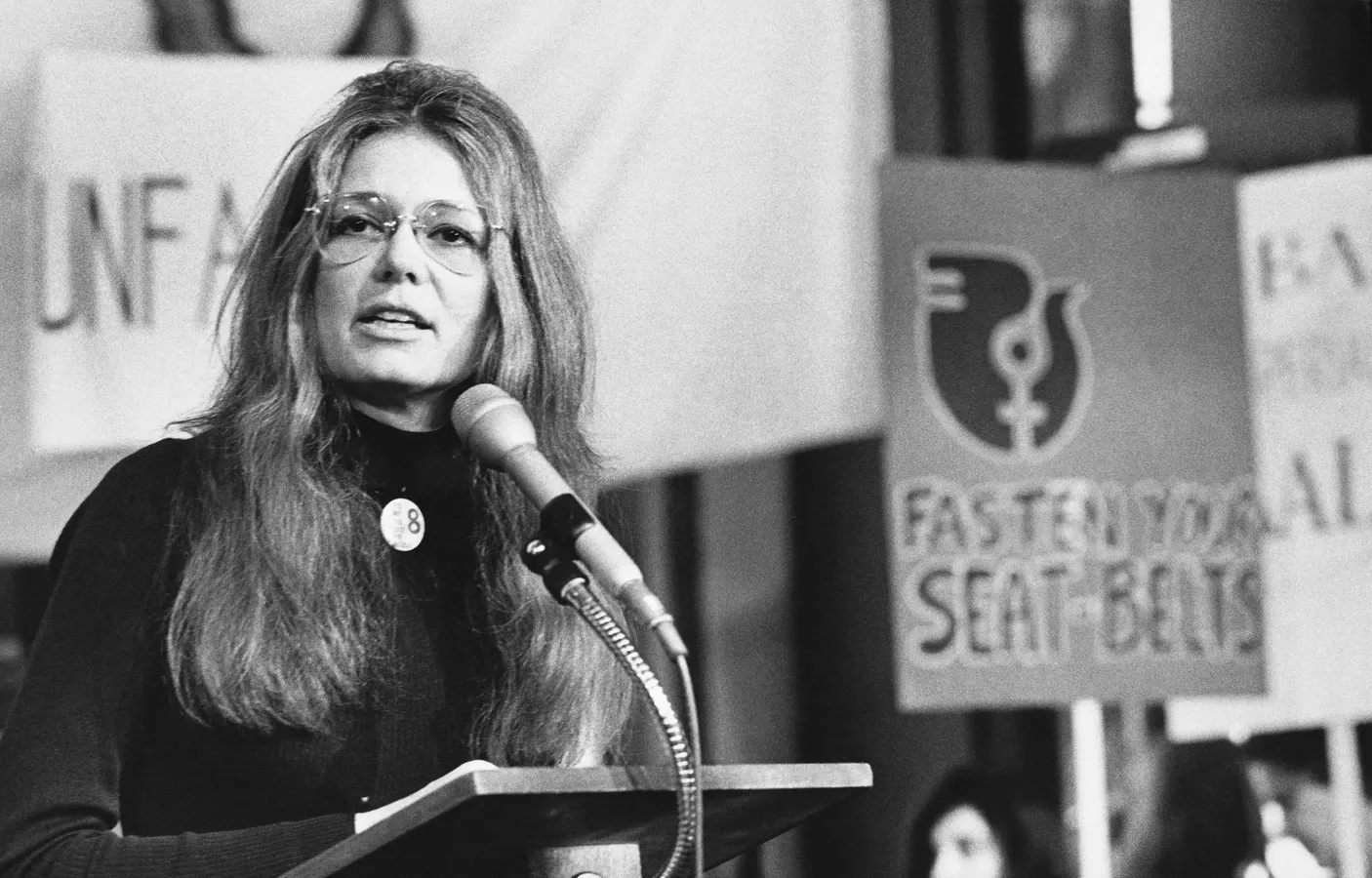

American feminist and activist Gloria Steinem speaks at a rally outside the United Nations, New York, New York, 1978. (Photo by Bettye Lane/Photo Researchers History/Getty Images)
Getty Images
It’s just one loss after another this year. Feminist icon Gloria Steinem died on September 2 at her home in New York City, surrounded by people who loved her. She was 92. Her foundation confirmed the news the following day in a statement posted to her Instagram account: “Gloria’s near-century on earth were years well-lived, and she continued working for equality until the very end.” A cause of death was not disclosed.
Her second memoir, An Unexpected Life, is scheduled for release on September 22, just nineteen days after her passing was announced.
Gloria Steinem’s Career And What It Changed For Women
Born in Ohio, Steinem moved to New York to begin a journalism career at a time when women in publishing were expected to write about beauty and housekeeping, not politics.
Her national breakthrough came in 1963, when a Show magazine assignment sent her undercover to the Playboy Club in New York.
Gloria Steinem wearing playboy bunny costume. Photo filed, 1980.
Bettmann Archive
She spent eleven days working as one of the infamous Playboy Bunnies. The resulting exposé, titled “A Bunny’s Tale”, documented the exploitative labour conditions, mandatory gynecological examinations, and systemic sexual harassment that the club’s female servers endured.
Although the piece caused a national (and eventually generational) stir, Steinem later said it also made it harder for her to be taken seriously as a journalist for years afterward. “Since hostile people still call me a former Playboy Bunny, even at 82, I probably shouldn’t have done that in my youth, even to write an exposé,” she told The Guardian in 2017.
Undeterred by the constraints of legacy media, Steinem chose to build new frameworks.
In 1968 she co-founded New York magazine, where she wrote political columns and reported on the emerging women’s liberation movement.
NEW YORK, NY CIRCA 1974: Gloria Steinem at the offices of Ms. Magazine circa 1974 in New York City. (Photo by PL Gould/IMAGES/Getty Images)
Getty Images
Six years later, she co-founded Ms. magazine — the first national American magazine owned, operated, and written by women — which became a platform for discussing reproductive rights, domestic violence, and workplace inequality in a mainstream publication for the first time. Alongside all that, Steinem helped establish the Women’s Action Alliance, the National Women’s Political Caucus, and the Ms. Foundation for Women.
Before the women’s liberation movement she supercharged, women in the United States could not apply for a credit card without a man’s co-signature, were barred from most Ivy League universities, and had no legal right to an abortion. By the time Roe v. Wade was decided in 1973, Steinem had already been one of its most visible advocates for years.
In 2013, President Barack Obama awarded her the Presidential Medal of Freedom, the nation’s highest civilian honour.
WASHINGTON, DC – NOVEMBER 20: Gloria Steinem is presented the 2013 Presidential Medal of Freedom by President Barack Obama in the East Room of the White House on November 20, 2013 in Washington, DC. (Photo by Leigh Vogel/WireImage)
WireImage
Why Gloria Steinem’s Legacy Is For Men Too
Steinem spent her career arguing that feminism was a human issue, not just a women’s one. “Once men realize that the gender roles are a prison for them too, then they become really valuable allies,” she said in an interview with Marianne Schnall.
“Because they’re not just helping someone else, they’re freeing themselves.”
(Original Caption) Gloria Steinem (center), one of the more celebrated figures in the feminist movement, is among the more than 5,000 participants in a march against pornography in New York. Marching through Times Square, feminists, college students and community activists paraded in the bright sunlight past dimly lighted sex shops, peep shows, and pornographic movie houses along 42nd Street. The march ended with a rally at Bryant Park where Mrs. Steinem, Bella Abzug (second from right) and other feminist spoke out against the pornography industry, which they said exploited women and women’s bodies and encouraged violence against women.
Bettmann Archive
Steinem extended this argument in every direction from health to longevity and intimacy.
At a lecture at UT Dallas in 2010, she argued that eliminating causes of death typically attributed to rigid masculine roles — violence, tension-related disease — would extend the average man’s life by four years, per UT Dallas News.
“We’ve had a lot of people in this country have had the courage to raise their daughters more like their sone. Which is great because it means they’re more equal, and whole women who are now standing up for themselves, is why we’re having this program,” she told PBS.
“But there are many fewer people who have had the courage to raise their sons more like their daughters.”
The conversation about what rigid gender roles cost men, whether it their relationships or their emotional lives or even their health, is one Steinem was having in the 1970s.
What Steinem leaves behind, then, is a towering legacy that has positively impacted thousands of women around the world, whether they realize it or not, whether they call themselves feminist or not.
Gloria Steinem’s 2015 words to Huffpost ring out to this day. “I would say each of us has only one thing to gain from the feminist movement: our whole humanity.”














Leave a comment