


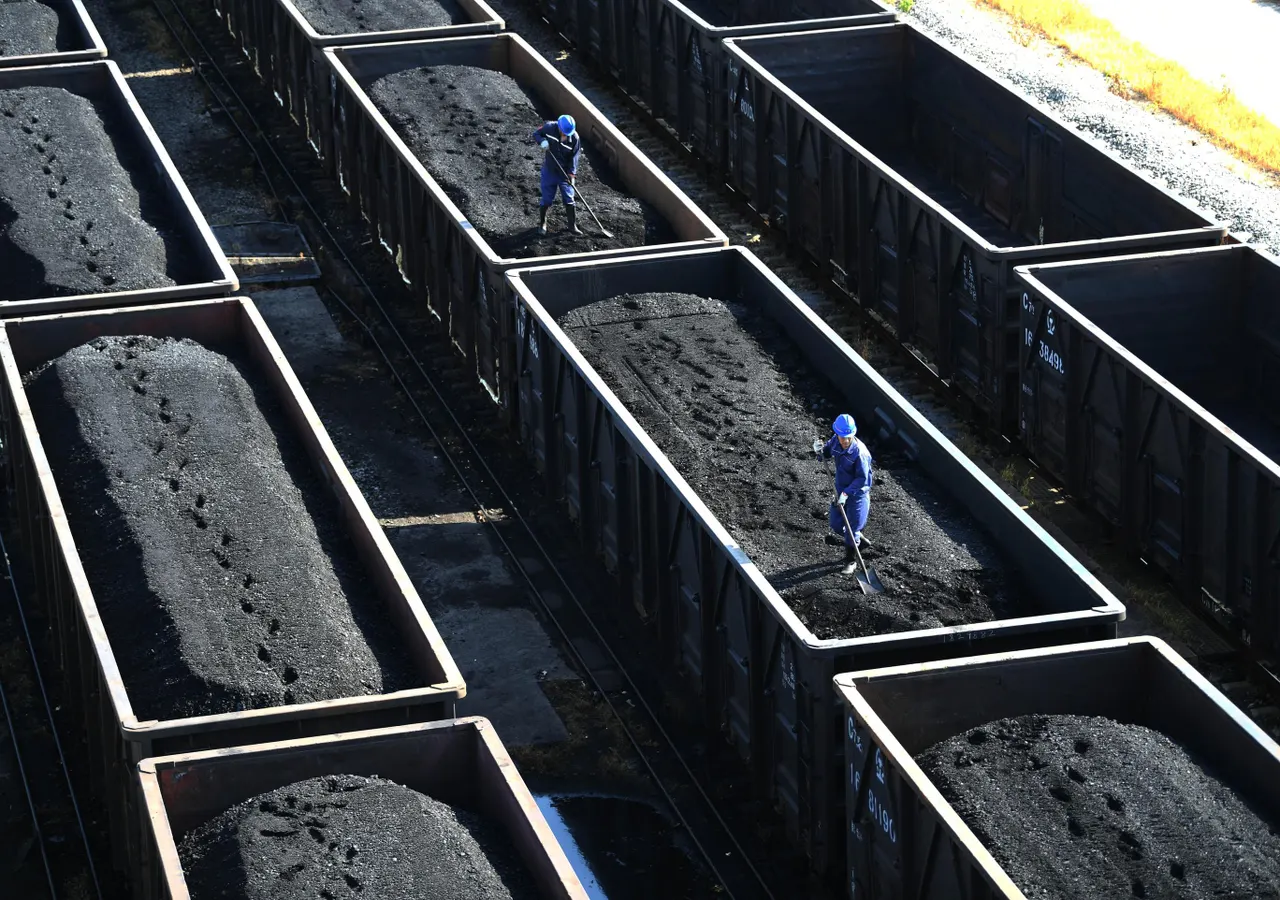

Employees work on a freight train loaded with coal at Jiangxi Coal Reserve Center, Jiujiang, Jiangxi Province of China. (File Photo: VCG/VCG via Getty Images)
VCG via Getty Images
The disruption of liquified natural gas supplies from the Middle East to the high energy demand centers in Asia in the wake of the Iran War have benefitted one alternative fuel medium in particular – coal. And it may well have amplified its near-term footprint too.
While many in the energy community are focussing on nations potentially turning to renewable energy, disrupted Middle Eastern LNG supplies – primarily from Qatar – have instead driven an unexpected resurgence in Asia’s coal demand.
That includes the continent’s two major economies – China and India – both with huge renewable energy footprints. The duo, while reducing their reliance on coal imports, reportedly ramped up domestic production, the proceeds of which they duly tapped during a crisis at the expense of gasification of power plants.
But they weren’t alone. South Korea, Taiwan, Thailand, Vietnam, and the Philippines have all posted incremental burning of coal to generate power.
Continent-Wide Coal Usage Shift
While China and India have the energy portfolio diversity to count coal as one among many sources in their energy mix, for others in Asia Pacific, the war knocking out their primary source of LNG supply made it necessary to turn to coal.
Qatar’s Ras Laffan facility, damaged in the conflict, has triggered force majeure and removed close to 10.2 mtpa of LNG supply to Asia alone, with the partial shutdown expected to extend through late summer, if not beyond, even though a peace deal has been reached between the U.S. and Iran.
Inevitably, this has tightened regional gas markets and pushed the Asia spot LNG price near three-year highs. This is discouraging some LNG demand and upping that of coal.
According to Rystad Energy, the problem runs deeper. It believes the outage in Qatar has left an estimated 35 mtpa LNG supply gap in 2026 that the region cannot easily replace.
“The shortfall is increasingly being absorbed through higher coal utilization, with roughly 90 terawatt-hours (TWh) shifting directly to coal-fired power generation,” the energy research firm observed in a recent client circular.
As a consequence, Rystad Energy now expects incremental coal consumption in Asia to rise by close to 70 million tons in 2026 under a sustained tight gas market scenario, driven not by large-scale new capacity additions but by existing coal-fired fleets running at higher utilization rates.
Other data aggregators such as S&P Global and the International Energy Agency also believe coal-fired generation across vast swathes of Asia has risen sharply. As gas output partially retreats, global seaborne coal shipments to the region have risen, even if China and India are insourcing more domestic coal.
For instance, Rystad noted that Japan’s coal-fired generation grew 11%, even as gas output fell 13%, and South Korean and Japanese coal imports are tracking more than 50% and 20% above year-ago levels for May. Across affected economies, the pivot reflects necessity over choice, with coal’s supply chain remaining untouched by the conflict.
Not A Coal Comeback, More Of A Reality Check
According to Tonmit Talukdar, analyst, coal research at Rystad Energy, what we are seeing is not a coal comeback but a reality check for the region’s energy transition.
“LNG price volatility has shifted costs without reversing the move toward cleaner energy and thermal coal prices have responded to that tightness with cautious buying, stockpiling and a geopolitical risk premium rather than any structural change,” Talukdar noted in a recent research note.
Coal is stepping in when natural gas prices spike, supply tightens or mothballed plants are briefly restarted, he added.
The response so far remains more contained than in 2022 Russia-Ukraine crisis when disruptions to Russian gas supplies triggered a sharp surge in global coal demand. At the time, renewable capacity additions were limited, and thermal coal inventories across major Asian markets were significantly lower.
“In contrast, strong coal inventories and record alternate energy availability in India, China and major Asian countries have prevented the market from becoming as structurally strained this time,” Talukdar added.
But until storage, grid flexibility, and firm low-carbon capacity scale sufficiently to cover peak demand and periods of low wind or hydro output, coal will continue to serve as the system’s fallback.
As things stand, the Iran War does appear to have amplified coal’s role in Asia’s energy mix, and perhaps even in power markets well beyond the continent.
Disclaimer: The above commentary is meant to stimulate discussion based on the author’s opinion and analysis offered in a personal capacity. It is not solicitation, recommendation or investment advice to trade oil stocks, futures, options or products. Oil markets can be highly volatile and opinions in the sector may change instantaneously and without notice.















Leave a comment