


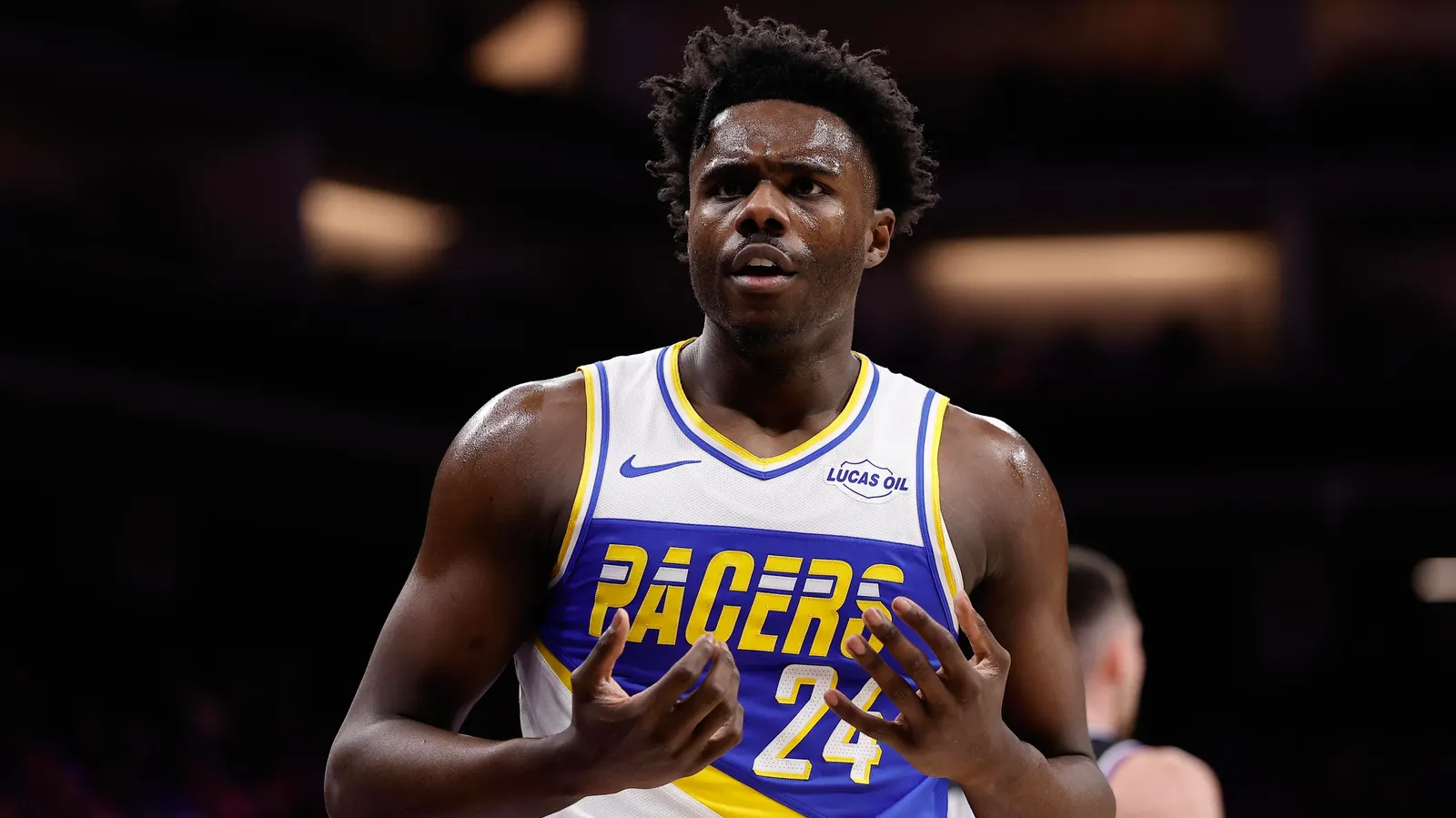

SACRAMENTO, CALIFORNIA – MARCH 10: Kobe Brown #24 of the Indiana Pacers after a foul against the Sacramento Kings during the second half at Golden 1 Center on March 10, 2026 in Sacramento, California. (Photo by Kelley L Cox/Getty Images)
Getty Images
INDIANAPOLIS – Of the 15 Indiana Pacers players that ended the season on a standard contract, only one is guaranteed to be a free agent this offseason. Kobe Brown, who was traded to the team in February as a part of the Ivica Zubac deal between the Pacers and Los Angeles Clippers, had his contract expire at the end of the 2025-26 season. He’s looking for a new one with the negotiating window now open.
Brown was viewed as a throw in at the time of the trade. He never found his footing with the Clippers, typically operating as a deep reserve with few high-quality performances. He struggled to hit three-point shots in Los Angeles and wasn’t asked to put the ball on the floor very often.
In Indiana, things were totally different. Granted, the Pacers were in the middle of a losing season, but Brown was given incomparably more playing time. In 27 games for the Pacers, he earned 668 minutes. With the Clippers, he never reached 400 total minutes in a season.
More chances should lead to more stats. And that was true for Brown, but it’s also reductive. The Missouri product drilled 43.3% of his outside shots for the blue and gold and finished shots at the rim above his career average rate. His efficiency, even with a significantly larger opportunity, skyrocketed.
His per-minute numbers, which aren’t tied to playing time, climbed. Most notable was his rebounding. Brown grabbed 7.1 rebounds per 36 minutes for the Pacers and 6.9 for the season – of all players with 500 minutes in 2025-26, only 33 of them Brown’s height or shorter grabbed that many boards, about one player per team.
“I think being more aggressive. It looks like he’s playing a lot without thinking out there on the floor,” Clippers head coach Ty Lue said of what he’s seeing from Brown after the trade. “He’s a dynamic offensive rebounder, so we gotta make sure we’re locked into him because he’s crashing every single time.”
What does that all mean for Kobe Brown and the Pacers going forward?
Now Brown, 26, is a free agent for the first time. His play with Los Angeles may not have been good enough to find another NBA home. But after a productive stint with the Pacers his stock is up.
What other teams, including the Pacers, will try to figure out is how real Brown’s recent run of play actually was. He was a much better shooter, good rebounder, and stocky defender. Even as a depth piece, that’s a valuable skill set.
INDIANAPOLIS, INDIANA – MARCH 27: Kobe Brown #24 of the Indiana Pacers shoots the ball against Kawhi Leonard #2 of the Los Angeles Clippers during the second half at Gainbridge Fieldhouse on March 27, 2026 in Indianapolis, Indiana. (Photo by Michael Hickey/Getty Images)
Getty Images
But he only did it for 27 games, a small sample. And there’s a limitation on how much the Pacers can pay Brown. As laid out here, because the Clippers declined the fourth-year team option on Brown’s rookie-scale deal, the Pacers can only pay Brown up to $4.8 million in the coming season. Every other team can pay him more.
In practice, that shouldn’t be an issue. The Pacers don’t have the financial wiggle room to offer Brown (or any reserve) that high of a salary in 2026-27 without making other financially-focused moves. But that’s just another note in a unique situation given Brown’s ascent after being traded.
“Just the style of play. The ball never stops moving… I just feel like it’s hard not to fit in here. Everything’s random, nothing’s scripted,” Brown said of the Pacers play style and how he fit in it.
Brown played well for the Pacers and popped in their system. If Indiana found that 27-game sample persuasive, bringing back the three-year pro would be a fine option. He still has room to grow, plays an important position, and wouldn’t be particularly expensive.
But finances and roster spots are big factors. The Pacers, if they make no waivers and decline no options, will only have one open roster spot in the offseason. Should they want to make some needed upgrades or add a cheaper rookie via a second-round draft pick, they’ll need to replace Brown’s previously-held spot with another player – unless they trade away other talent.
And the Pacers financial reality is a factor, too. They have resources to add depth in free agency, but the team’s current contractual situation has them rubbing right up against the projected luxury tax line for the 2026-27 season. That makes adding any player more consequential. Is keeping Brown worth going into the tax? Especially if it takes up a valuable roster spot?
Those are the questions the Pacers have to answer. Typically, free agency flows in such a way that deeper reserves are signed last after other, more important players are added. Pacers President Kevin Pritchard touched on this ordering when mapping out the offseason after the NBA Draft Lottery. “What happens is everybody goes through their draft. They redo their roster with roster depth, and then teams look at trades. Then the free agency starts to come,” he said.
Brown is a free agent, but he wouldn’t crack the Pacers rotation if re-signed. Ben Sheppard, Jarace Walker, Andrew Nembhard, Aaron Nesmith, Obi Toppin, and Pascal Siakam would certainly be above him in the off-ball guard/wing/forward rotation. When healthy, Johnny Furphy would be too. Quenton Jackson can, and often does, play shooting guard. So while keeping Brown would be a fine choice for the Pacers, it should not be a priority. Rushing to re-sign depth pieces isn’t how free agency goes in the NBA.
Should the Pacers make whatever moves they deem appropriate to improve their team, then find themselves still sitting with an open roster spot or holding financial flexibility, turning to Brown and agreeing to a deal would make good sense. The Pacers would retain his full Bird Rights if that’s how free agency played out, but those Bird Rights have no value in the current offseason thanks to the restrictions on Brown’s 2026-27 contractual value.
Given the Pacers team spending level and Brown’s lack of sustained success, a minimum deal should be enough to keep the wing if they are interested in doing so. But Indiana’s roster and spending outlook makes Brown a signing that would make more sense later in free agency, if at all.
With the NBA Finals in the rearview mirror, technically the Pacers and Brown can negotiate a new deal at any time. But nothing should be expected until farther into free agency.










Leave a comment