


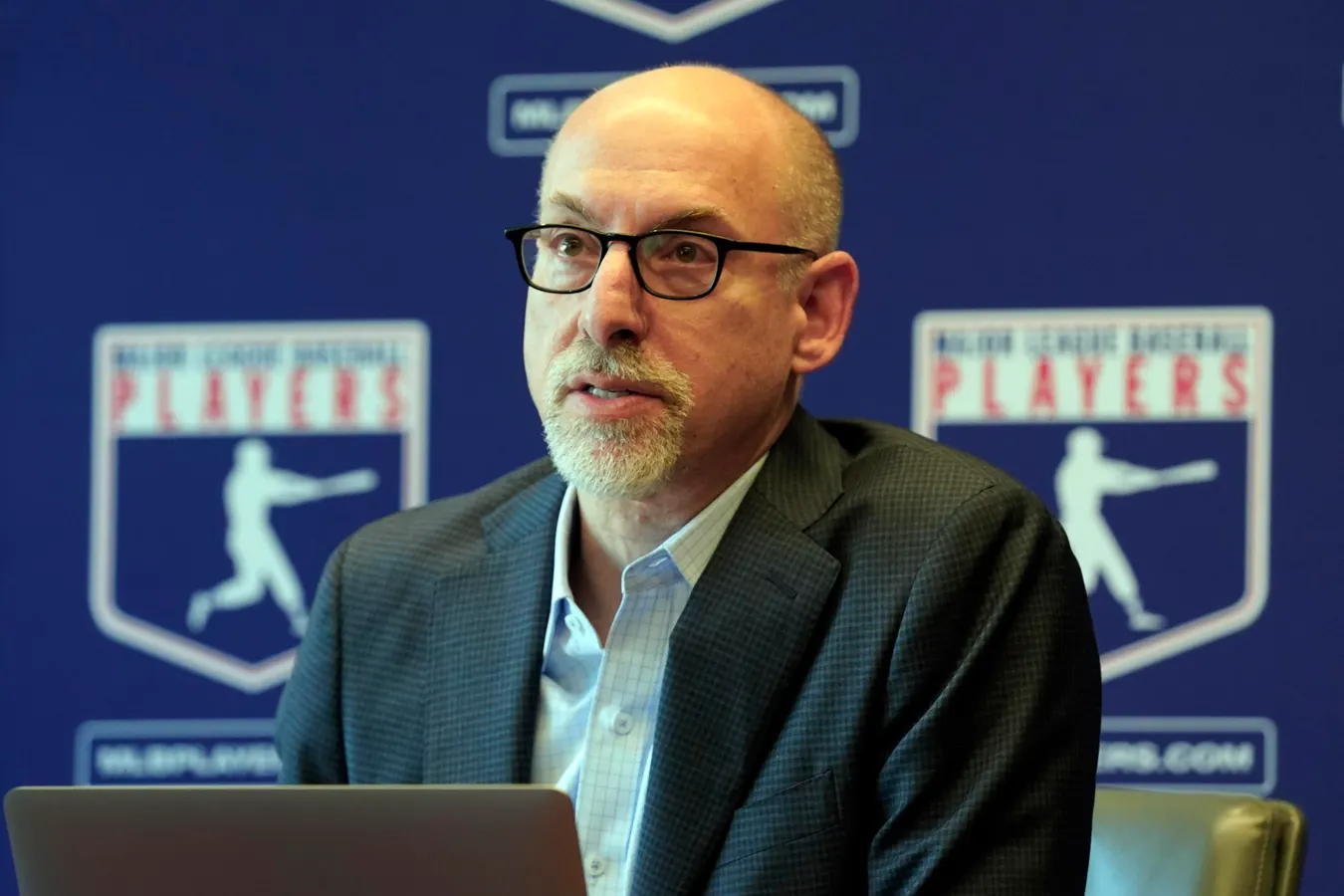

In a conference call with media, interim MLBPA executive director Bruce Meyer outlined why the players in Major League Baseball are adamantly opposed to a salary cap system. (AP Photo/Richard Drew, File)
Copyright 2021 The Associated Press. All rights reserved
In a conference call with the media today, MLB Players’ Association interim executive director Bruce Meyer outlined why the union is adamantly opposed to a salary cap system.
“Our union has never been broken, and never will be.”
That may have summed up Meyer’s and the players’ position on a recent salary cap proposal as part of labor negotiations ahead of the expiration of the current CBA on December 1st.
Meyer said that the players have fought a cap system for decades based the belief “that it’s bad for players at all levels, and not just monetarily,” but bad for the freedom of the players, bad for the fans, and “bad for players at every level – particularly bad for the middle class, who sometimes you hear that somehow that kind of system is going to benefit them.”
He went on to say, “That’s not what happens in the other sports. In fact, it’s the opposite. Why do I say bad for fans? Because fundamentally, that system is anti-competitive. It’s a form of institutionalized collusion.”
Meyer felt it was important to clarify aspects of the league’s cap proposal and the sharing of revenues 50/50.
To start, Meyer said that players’ share for this season in 2026 is projected to be well over 50%.
“Using MLB’s definitions of revenues and what counts against player share, had MLB proposal been in place in 2026 we estimate players would lose over half a billion dollars,” he said.
The league has proposed a hard cap system, with the cap being $245.3 million and a floor of $171.2 million. But Meyer pointed out what comes off the top “in billions” before it gets to actual pay to the players.
“It’s not even a real 50%,” Meyer said. “It’s taking billions of dollars off the top before they’re proposing to even share any of that in terms of what counts against player share, and their proposal is everything: salaries, as well as, all forms of benefit, other things of value, things like moving costs, and the cost of translators…. All of that gets counted against player share, and most importantly, most significantly, amateur signing bonuses, which is something you really don’t have an analog to in the other sports that have salary caps.”
When it was brought up that there were similarities between the 1994 proposal that led to the strike, specifically that the owners proposed a 50/50 split in revenues, Meyer said the recent proposal was worse given that the league was not proposing an escrow system in 1994, which by definition means salaries would no longer be guaranteed.
“If revenues are soft or they go down, then that means players at the end of the day won’t get the guaranteed money, so they won’t necessarily get the money that you see in the club-specific floor,” Meyer said. “This is not just theoretical; it’s happened in hockey, which has escrow. In the NBA, just last year, the players had to give back almost $500 million to the owners of their supposedly guaranteed contracts, because of escrow, [due to their] salary cap system.”
While Meyer said that “we have professionals on both sides” and that he hoped they would think rationally, knowing that MLB and the players will eventually reach a deal, he didn’t know when or what it was going to take.
“I wouldn’t be optimistic expecting an early deal, but on the other hand, you never know… we have people – hopefully we share an interest – in growing the game,” adding, “You don’t need a cap [to do that].”
While both the MLBPA and MLB have issued their first economic proposals, what’s next is an open question. Meyer said that there were no meetings currently scheduled, but that if the sides were not making a lot of progress on those proposals, there would be plenty of other items to work on, and pointed to negotiations ahead of the current labor agreement.
“There are a lot of other things that we bargain over, and as has happened last time, we are going to be meeting on all of those things,” he said. “There are a lot of other areas that we have to make progress on that we can talk to the league about. We’re never going to refuse to meet, we’re never going to refuse to talk. So as of right now we haven’t scheduled anything, but we will in the near future, and we’ll be meeting, I’m sure, during the whole period of time up until we get a deal, whenever that is.”











Leave a comment