


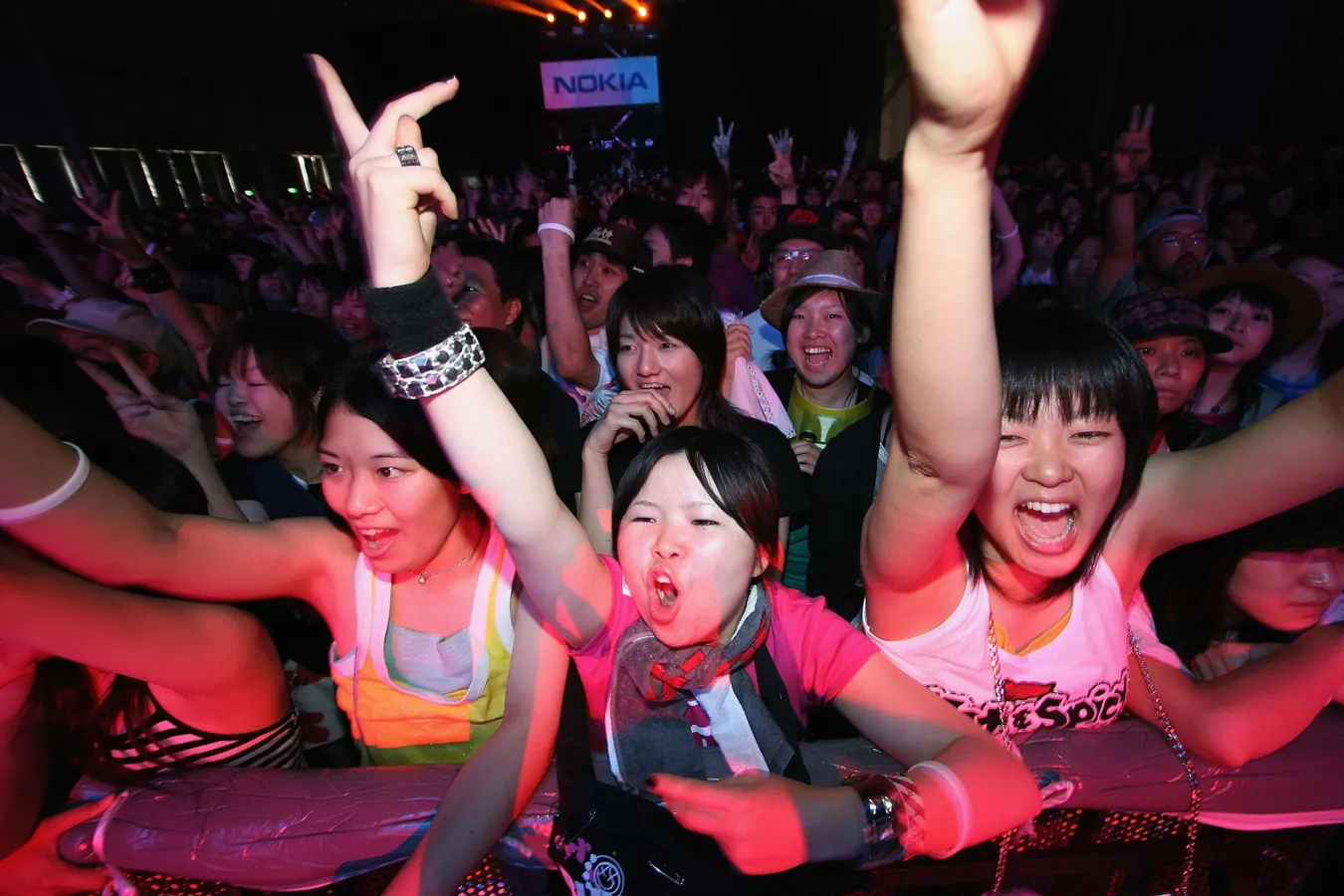

CHIBA, JAPAN – JULY 2: Japanese fans party at “Live 8 Japan” at Makuhari Messe on July 2, 2005 in Chiba, east of Tokyo, Japan. The free concert is one of ten simultaneous international gigs including Philadelphia, Berlin, Rome, Paris, Barrie, London, Cornwall, Moscow and Johannesburg. The concerts precede the G8 summit (July 6-8) to raising awareness for MAKEpovertyHISTORY. (Photo by Koichi Kamoshida/Getty Images)
Getty Images
Every superstar was once courting their first one hundred fans. Before the sold-out arenas, the platinum certifications, and the devoted standoms, there was a handful of people who showed up first. The way an artist treats those early supporters often determines whether they’ll ever reach the next stage of their career.
To find out exactly how emerging artists should be thinking about fan acquisition at the very beginning, I asked four music marketing experts the same question: What is the one most important marketing move or tool artists should rely on to build their first 100 fans? Their answers ranged from tech-enabled fan capture to something classic like showing up and shaking hands. But a common thread ran through all of them: the first 100 fans aren’t found through algorithms — they’re earned through intention and devotion.
SEATTLE, WASHINGTON – DECEMBER 08: Yoonchae, Megan, Lara Raj and Sophia of Global Pop Group KATSEYE attend Fan Meet & Greet hosted by Target at Pike Plaza Store at Target Pike Place on December 08, 2025 in Seattle, Washington. (Photo by Mat Hayward/Getty Images for Target)
Getty Images for Target
Treat Every Merch Table Like a Meet-and-Greet
Kelsey Middleton, Head of Marketing & Digital Strategy at TRACK mgmt, argues that an early artist’s most underutilized asset isn’t a platform — it’s time. “The smaller the fanbase, the deeper the connection you can make with them,” she says. “If you’re the first of three on the lineup, take the time to meet every single fan who lines up at the merch table every night.”
Middleton also emphasizes converting those in-person moments into lasting relationships using tools like Set.Live and Laylo, platforms designed to help artists capture fan contact info at live events so they can follow up later.
This is a strategy that artists who are now household names understood intuitively before they had any infrastructure behind them. Taylor Swift, long before she was a record-breaking phenomenon, was famously accessible at meet-and-greets during her early club and theater runs — taking photos, writing notes, and making each fan feel seen. That personal investment became the foundation of one of the most loyal fanbases in music history.
Let Them See the Person Behind the Music
Dan Goodwin, Senior Artist & Label Strategist at LabelWorx, is direct about the reality of today’s landscape: great music alone is no longer enough. “Allowing your potential fanbase to see behind the curtain and connect with the individual instead of just the music will help grow a genuine fanbase that will support your career instead of passive listeners,” he says. His caveat is equally important — authenticity isn’t optional. “If you aren’t happy doing videos talking to camera, this will show through 99% of the time.”
Chappell Roan is arguably the defining example of this principle in recent years. Long before “Good Luck, Babe!” dominated pop culture, Roan built a devoted early following through an unflinchingly candid social presence — drag-inspired looks, raw commentary on the music industry, and a personality so specific it couldn’t be mistaken for anyone else. She wasn’t packaging herself for mass appeal. She was being herself, and the right people found her because of it. By the time the mainstream caught up, her core fanbase had already been invested for years.
INDIANAPOLIS, IN – MARCH 01: Pusha T performs live onstage in concert as he opens for 2 Chainz during the 2 Good To Be T.R.U. Tour in The Egyptian Room at Old National Centre on March 1, 2014 in Indianapolis, Indiana. (Photo by Joey Foley/Getty Images)
Getty Images
Don’t Skip the Open Mic
Malik Wilson, President of Buvision, makes the case for one of the most overlooked rooms in an emerging artist’s career. “Open mics are one of the best ways to build your first 100 fans,” he says. “The audience is there to support upcoming artists, making them more likely to become genuine fans at this stage of your career.” Wilson also points to the community dimension: other performers at open mics are potential collaborators, connectors, and amplifiers. “Never underestimate word of mouth,” he adds. “A room of 20 genuinely impressed people reaches further than you think.”
Billie Eilish and Finneas spent years performing in intimate settings and local showcases before “Ocean Eyes” changed everything in 2015. The relationships and creative instincts developed in those low-stakes rooms were foundational — and the clip culture Wilson describes is exactly what launched the Eilish era, when a SoundCloud upload meant for a dance class went viral through person-to-person sharing. The room was small. The reach was not.
Turn Your Inner Circle Into a Street Team
Jackie Carrasco, a marketing agency founder who works with premier music artists and brands, reframes the first 100 fans question entirely. “Most artists are so focused on reaching strangers that they overlook the people already in their corner,” she says. Her strategy: make your inner circle part of the machine. “Have your bestie help you with your socials. Get your videographer friend involved. Ask your family to share your latest release.”
This isn’t a new idea — it’s just one the industry tends to undervalue. Beyoncé’s earliest supporters were family, church community members in Houston, and local industry contacts who advocated for Destiny’s Child before any label infrastructure existed. More recently, Ice Spice’s rise out of the Bronx was accelerated in its earliest stages by a tight network of friends, local creatives, and community co-signs before Drake’s co-sign and the “Munch” explosion brought her to global attention. The people closest to an artist aren’t just supporters — they’re the original street team.
The Bottom Line
Building a fanbase from zero is less about marketing tactics and more about depth of connection. Whether that means lingering at the merch table after a support slot, letting your personality bleed into your content, performing for 15 people at an open mic, or activating your group chat — the first 100 fans respond to artists who treat them like they matter. Because at that stage of the game, they do.












Leave a comment