


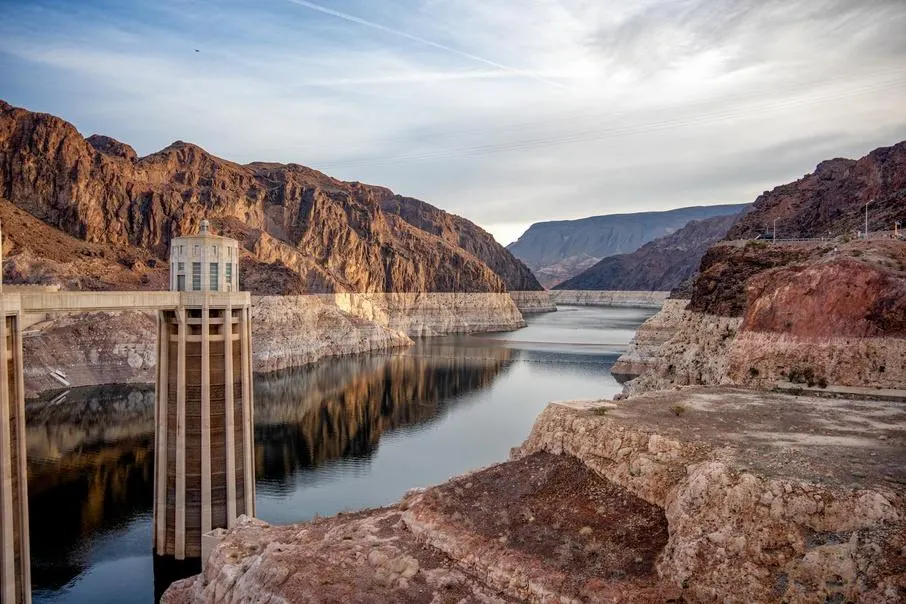

Hoover Dam at Boulder City Nevada Near Las Vegas on the Arizona Border Showing Lower Water Levels in Lake Mead Reservoir Due to Long-Term Drought Conditions in the American Southwest
getty
July 2026 broke the record for the hottest month ever recorded in the United States, first set in 1936. Back then, in the depths of the Dust Bowl, drought threatened the nation’s farms. This time it threatens the nation’s power supply.
When a heat wave hits, most people picture air conditioners running nonstop and bills climbing. As the grid strains to meet demand, the same heat also cuts supply, leading to brownouts and blackouts.
Heat and drought now hit power generation on multiple fronts at once. Water cools power plants, carries their fuel, and in the case of hydro power, generates the electricity itself. For more than a century, planners built power plants on the assumption that water would always be cheap, cool and plentiful.
Ironically, burning fossil fuels for power generation drives warming, which deepens droughts. This summer is a prime example of the new reality.
The Grid Runs On Water
Nuclear plants need water for cooling. In France, rivers grew so warm this summer that EDF, the national utility, had to throttle back reactors. On July 13 it shut two and reduced six more, pulling 6.4 gigawatts off the system in one morning.
Coal and diesel generators need waterways for fuel delivery. Much of that fuel still travels by barge. Germany’s Rhine fell to its lowest point since record-keeping began in 1880, stranding barges inland and forcing others to sail at a fifth of their capacity.
Freight ships on the river with low water level after a long period of drought (Photo by Sjoerd van der Wal/Getty Images)
Getty Images
In the U.S., the mid-South leans on barge-delivered coal. Low water has disrupted Mississippi shipping repeatedly since 2022. The river hit a record low in 2023, forcing more expensive delivery via truck. Federal regulators flagged the risk again this summer, with drought covering nearly half g nearly half the contiguous U.S.
Hydro plants need water to make power. Lake Mead, which feeds Hoover Dam, fell to a record low of 1,040.5 feet on August 7, about five feet above the point where 12 of the dam’s 17 turbines stop turning and Hoover loses roughly 70% of its generating capacity. That lost capacity could power Tucson, Arizona at the height of summer.
Why This Summer Was A Preview
The evidence points to more ahead. The U.S. just came through its hottest month on record, and the world’s oceans have warmed to their highest levels ever measured. A Pacific warming pattern called El Niño is strengthening fast, with a better than 90% chance of turning very strong by winter. El Niño releases ocean heat into the atmosphere, and though it usually peaks between December and March, the warmth lingers for months. “Looking into next summer, it can set the stage for warmer conditions, but impacts can vary by region,” says Sarah Kapnick, NOAA’s chief scientist from 2022 to 2024, who now leads climate advisory at JPMorgan Chase.
“Preparedness is key in an El Niño year,” says Kapnick, noting that readiness for stronger summer demand “will be of high interest in areas dependent on water levels and cooling-water temperatures.” Her focus is on adaptation: “building resilience and flexibility, acknowledging cooling water is warming with the rest of the planet, improving efficiency, and planning for a wider range of potential summer outcomes.”
The Fix Is Already Under Construction
Coal plants draw roughly 19,000 gallons per megawatt-hour, a gas plant about 2,800, and solar and wind almost none. That matters given that solar and wind power make up the largest source of new utility scale power generation. Running record amounts of solar on the hottest afternoons helped Europe through this summer.
Engineers now rebuild for a world with less access to water. In May, the Bureau of Reclamation released $52 million to install up to three more wide-head turbines at Hoover Dam. Designed to keep generating down to a lake elevation of 950 feet instead of quitting at 1,035, they won’t come online until at least the end of 2028.
Power generation grew up in a cooler, wetter world more than a century ago. Cooling towers, fuel barges and hydro reservoirs all lean on water, which is now drying up during hot summers. The new turbines going into Hoover Dam will keep spinning on a lake 85 feet lower than the old ones could handle. This points to a grid rebuilding for the drier world it already lives in.















Leave a comment