


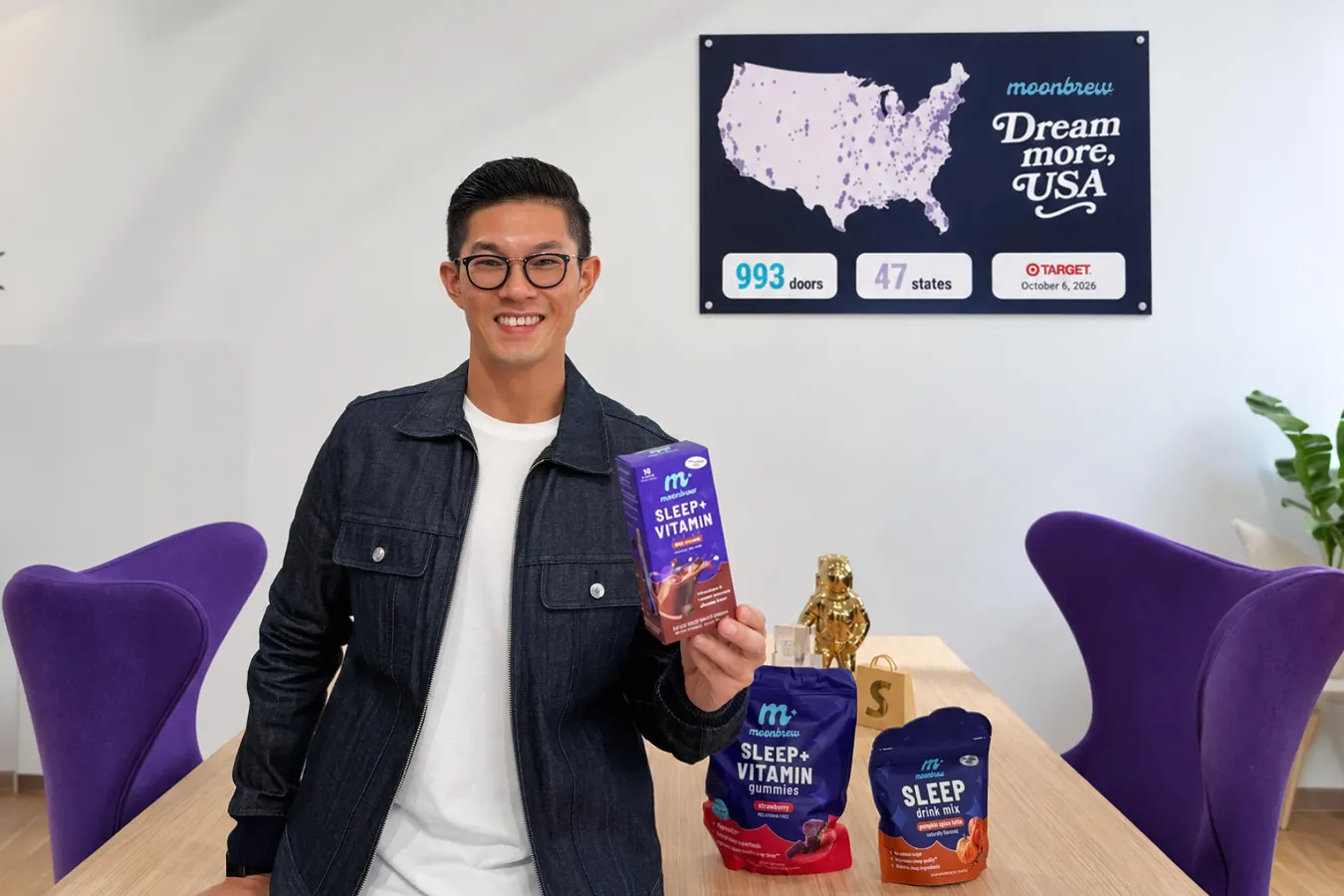

Allan Shen, founder of MoonBrew, a melatonin-free sleep brand known for its hot cocoa sleep drink is expanding MoonBrew into Target’s sleep aisle.
Moonbrew
Allan Shen grew up in his parents’ herbal apothecary in San Francisco, where, as he likes to tell his team, his toys were ginseng and reishi instead of action figures and cars. Today he’s betting that the sleep aisle, a wall of white bottles built around knocking people out, is ready for something people actually look forward to each night. His company, MoonBrew, makes melatonin-free sleep drinks and gummies led by a hot cocoa, and it’s taking that cocoa into Target while launching MoonBrew Kids, its customers’ number one request.
Dave Knox: You didn’t start as a sleep company. You started with a brand called NoonBrew, an afternoon pick-me-up. What did you experience in those early days that made you realize you might have been solving for the wrong part of your customer’s day?
Allan Shen: When we first launched this business in September 2021, we were known as NoonBrew, a coffee alternative. While scaling through 2022, we quickly learned to listen to our customers. In our first year, customers would say, “we love the energy drink, but can you make a sleep product with a similar ethos?”
As we zoomed out and looked at the data, especially the macro trends, we noticed energy was becoming more of a convenience occasion. Ready-to-drink was the optimal format for consumers on the go, and a powdered supplement had its challenges in terms of penetration and usage rates.
We dug deeper into both the energy and sleep category, taking a close look at both products. From a unit economics point of view, the sleep product was a lot stronger, in terms of online acquisition and customer repeat behavior. Zooming out further, the sleep category was ripe for disruption. When we look at the sleep category today, there has not been a whole lot of innovation. It’s still melatonin and Drug Facts panels. There was white space for us to jump in, and it was becoming evident that the category would prove to be a lot more successful than energy. So, in January 2024, we made a conscious decision to start deprecating NoonBrew. The overall transition took about six months, and by the summer, we had successfully transitioned to MoonBrew.
Knox: You also come from a fascinating background. You grew up in an herbal apothecary in San Francisco, raised by herbalist parents. I have to imagine that had a massive impact on what MoonBrew’s formulation has become.
Shen: I joke with my team all the time. I tell them, “You kids probably had actual toy figures and cars to play with growing up. My toys were ginseng and reishi.” I could tell you all about their physical anatomy.
But jokes aside, I argue it goes far beyond the formulation to the values my team and I operate by. It heavily shaped the early days of MoonBrew, as it taught me grit, tenacity, and speed to market. It also sparked a natural curiosity to learn more about products. I remember walking down the aisles of my parents’ apothecary, looking at ready-to-use OTC products and questioning how the product was made or where it originated from. Watching my parents help people with natural herbs and adaptogens showed me that there are bigger things to think about when building a business. At the end of the day, creating something is not just about the business itself, but the impact you have on other people.
My childhood experience came in handy, as it enabled us to move that much faster in the early days. At the start, we manufactured everything in-house. It was a powder-based supplement, so I did everything in my office, from packaging to shipping. I had an urge to constantly push on innovation and to move with speed to market. I wanted to bring innovation to our customers as quickly as possible, and I was hungry for more, so I took on everything to get there.
Sleep Is A Ritual, Not A Nightly Sedation Problem
Knox: You’ve argued that the sleep category has trained people to measure the wrong thing, and you think of MoonBrew as being as much about recovery as about being a sleep aid. Why has the metric been wrong, and what actual changes in the formula drove you to make that distinction?
Shen: If you look at the sleep category today, the default is to treat sleep as a nightly sedation problem. The majority of products create consumer dependency, which actually leads to poorer sleep hygiene over time.
Sleep is highly ritualistic. You have to signal to your body that it’s time to wind down. It starts with the time you fall asleep each night and extends to your routine before bed and the time you wake up in the morning. You should not solve for being sedated or knocked out, as this leads grogginess the next day. Customers purchase MoonBrew because they’re thinking about how they will feel tomorrow – not just the speed at which they fall asleep.
Taking this insight, we intentionally crafted our formula to approach sleep from a full-cycle perspective. IL-theanine, GABA and our proprietary magnesium blend, MagnesiREM, help you relax and lull you into falling asleep, while apigenin and passionflower keep you asleep and help you wake up feeling refreshed. So it goes beyond sedation. That being said, I think there’s a time and place for that. If you’re traveling or jet-lagged, this is a good way to reset your circadian rhythm. But for nightly sleep hygiene, you should be focused on building a ritual and supporting your body through the full sleep cycle, so you wake up feeling refreshed and see stronger recovery.
“Potpourri In Bath Water” Sent Them Back To The Drawing Board
Knox: You used the word routine. A nightly routine is something people need to stick with, and it’s really tough to drive that kind of behavior and habit change. You’ve made deliciousness part of your adherence strategy. What led you to that insight, and what were the first things you launched because of it?
Shen: As you mentioned, it’s really challenging to get a consumer to establish a new routine. If we randomly sampled consumers who regularly use VMS products, their usage is often centered around the morning, with the nighttime space wide open. We knew from day one that it would be an uphill battle to get customers to establish a nighttime supplement routine.
Our very first MoonBrew product was a chamomile rose-flavored powder drink. It was unsweetened and earthy. As an organization, we measure Net Promoter Score religiously to understand how consumers interact with our product, and while the coastal cities actually loved the product, Middle America felt like they were drinking potpourri in bath water.
So, we went back to the drawing board. I remember going back and forth with my team on flavor profiles people would enjoy on a nightly basis and having that “aha” moment – why not try hot cocoa? We launched hot cocoa in March 2024, and it sold out within a month. We kept bringing it back, and dove deeper into that strategy. We launched numerous limited-edition flavors centered around cultural moments like July 4th and the holidays. We noticed that customers love optionality and the taste and experience. Being delicious actually made it stickier, as customers continued to build their new routine.
Knox: There’s a real tension there. You’re selling indulgence into a health category. How do you keep the treat from undermining the trust you’ve built with the product itself?
Shen: Trust has to come first. If you can’t build trust, tasting good might help you, but it won’t get you very far. Consumers are very smart nowadays. They understand what’s working and what’s not, and there’s a lot of information readily available on social media. Trust needs to be the starting point, which is why we focus on clinical studies at the ingredient level for everything that goes into our products.
We leverage our medical advisory board, Dr. Charlene Gamaldo, and Dr. Russell Foster from Oxford University. We meet regularly to review the latest in science and our formulations and work with us to ensure this is the right approach to providing better sleep. We market from the ingredient level, using the verification work our medical advisory board has done. The treat is where the product cements its place in the routine, but it should not do the convincing.
Knox: As you build out that differentiation in the sleep category, is your competitor something that’s already on the shelf, or is it some other behavior that exists in consumers’ lives?
Shen: It’s both. We are over stimulated on a daily basis, with technology, messages and notifications. We are fighting the desire to constantly be “on,” while also working against existing solutions. This includes pure-play melatonin at dosages that far exceed what you should be taking and what your body naturally produces, and even worse, products with Drug Facts panels.
Our customers come to us because they are thinking about how they’ll feel the next day. So when we look at the experience, taste, science, and efficacy broadly, it is all about signaling. When you reach for your MoonBrew, you subconsciously tell yourself it’s time to wind down. We need to be louder than the daily stimulations and the melatonin calling your name for a quick knockout. What’s out there today is not working, and that’s the gap we are aiming to fill.
Knox: Historically, sleep products haven’t been part of a routine. As you said, they’re about knocking you out. You’ve leaned into habit as your moat. How have consumers responded? What looks different in your data because the product has become part of a routine?
Shen: We frequently engage with consumers to see how they interact with our product. Along with this, we regularly invest in new product formats and innovate, as variety and optionality are key to building a habit and routine. We know consumers are reaching for a MoonBrew product at night, and we own this occasion, but giving them optionality helps them stay around longer and build a habit that works best for them.
Just look at our company history. We started as a powder-based supplement, with a cup of hot cocoa or mint chocolate, and giving consumers the option to choose their flavor. Next, we launched gummies, which come in a delicious snack pack, with four gummies per serving. We are constantly asking, “how do we create something sticky; how do we build a moat around it, and how do we keep consumers excited about building a routine that historically hasn’t been there for them?”
Go Deeper Into The Night, Never Wider Into The Day
Knox: You had hot cocoa and other flavors, then a new form factor with the gummies, and you’ve also added ingredients like fiber and creatine. How do you think about expanding into new forms versus new benefits?
Shen: It’s easy to go far and wide and dilute yourself in the VMS category today. We have done a great job at avoiding this. We want to go deeper into the night and be your nighttime solution, rather than expanding into the day. Our overall innovation roadmap and strategy are centered around the evening, and what happens as you wind down and as your body falls asleep.
As a younger brand, we have the luxury of speed to execution, and product-market fit often tells us where to innovate next. Consumers wanted a fiber product as part of their nighttime routine, so they can actively work on their gut health while sleeping. We don’t want to launch into every occasion of the day, but we do want to meet our customers where they are. We are constantly looking at what happens while you’re sleeping, and what added benefits you may be looking for. Not just helping you fall asleep, but also recovery.
Why MoonBrew Kids Isn’t A Separate Brand
Knox: One of the brand’s most recent launches is an expansion into the kids space, and a melatonin-free option for kids was your customers’ number one request. Why launch it under the MoonBrew brand instead of taking the approach a lot of brands take and creating a separate, kid-adjacent brand?
Shen: Transparently, MoonBrew Kids has been on our product roadmap for the last two years, and it’s something we’ve been wanting to do and actively working towards. With that being said, a kids product carries a lot of risk. Parents are extremely selective about what they give their kids, and recognizing we have already built trust with our audience through the MoonBrew brand, we decided this was the strongest move.
It’s a lot easier for parents to feel comfortable giving MoonBrew to their kids if they already interact with our brand and products on a nightly basis. This is significantly easier to do than launch a new brand where your primary focus is on education and rebuilding trust with consumers. Keeping it under the MoonBrew umbrella also allows us to create a family routine around it. We get really heartwarming stories when parents reach out asking for a kids product, mentioning their kid wants to be a part of their routine. Now that we have a MoonBrew Kids product launching, the entire family can wind down together. That’s the beauty of it all, and that’s exactly why we decided to keep it under the MoonBrew umbrella.
Knox: A kids product involves a lot of choices, especially when your gummies come in a snack pack and you’ve focused on making them taste delicious. How do you figure out the line between creating a product that works really well and making sure kids don’t think of it as a snack, which could create bad behavior?
Shen: Parents are already preconditioned to put things away, like sugary snacks. Supplements are no different. For anything that should be taken once per night, parents understand they should put it out of reach. That being said, our formulations are safe. Other products include ingredients like Zinc and Iron that when taken in excess, can lead to toxicity or overdosing; we chose not to go in this direction and to keep it relatively safe, just in case.
Going back to the routine, if parents and kids are taking their MoonBrew together, there is an additional layer of supervision, as the family winds down.
The Sleep Aisle Is A Wall Of White Bottles
Knox: Switching away from the kids product, you also have the big news that MoonBrew, which has traditionally been a direct-to-consumer business, has started moving into retail, with Target as one of your first launch partners for your hot cocoa. If I walk down the aisles of Target, or really any retailer, the sleep aisle is a wall of white bottles that look like medicine. How did you think about your play there, and what led you to the sleep aisle versus somewhere else?
Shen: No pun intended, but the sleep aisle is a sleepy place. Customers come to MoonBrew because they’ve already tried what’s out there for nighttime sleep support, and it hasn’t met their needs. If we were to go into the broader VMS set at Target, it would be much harder for a consumer to find us, and it would actually lead to more confusion. So as part of our retail entry, we thought heavily about where customers are already preconditioned to shop and knew the sleep aisle should be our starting point.
As you mentioned, everything is drowned out on the sleep shelves in retail today. You either see capsules or single-dose melatonin gummies, so launching hot cocoa made a lot of sense for us.
Hot Cocoa put MoonBrew on the map, and it’s the product customers first fell in love with first. It helps us stand out amongst the capsules and gummies and gives us recognition with people who already know us from direct-to-consumer.
The Next Shelf Badge Could Be A Green Recovery Score
Knox: Something interesting has happened in the sleep category over the last few years. The only measure we used to have was whether you woke up feeling good, but you didn’t really know if you got a good night’s sleep or what that meant. Wearables have started turning sleep into a measured outcome, where you know your recovery score and maybe what drove it. How have you thought about building that into the nighttime routine and helping consumers think about their sleep?
Shen: As you said, the feeling matters first and foremost. Trackers vary a lot in how they calculate your overall recovery and sleep scores, and they should not compensate for how you feel. We have optimized for both – feeling good and waking up with a score you want to brag about. Our consumers actively measure how they wake up and how strong their recovery scores are. With MoonBrew, they wake up feeling great, followed by a good recovery score, which gives us credibility.
Big CPG players are overly diluted. No brand has remained truly focused on sleep. They treat it as a side occasion, with one or two product launches, and then expand further into daytime. For us, staying focused on sleep allows us to keep innovating and improving consumers’ nighttime routine.
Even with sleep score tracking, a standard is yet to be set. As trackers and data become more readily available, the standard will be established over time. I hypothesize you will start seeing badges on the shelf, pointing to a positive green recovery score, as tracking becomes more ubiquitous and accessible.
Knox: Looking out over the next few years, where do you see MoonBrew going, and sleep overall?
Shen: We want to meet consumers where they’re at. Today we’re a melatonin-free product, but melatonin does have its place. As I said earlier, when you’re traveling, or you’ve just had a really bad streak of sleep, using a little bit of melatonin is not a bad idea to reset your circadian rhythm.
When going deeper into the sleep category, we want to understand where current formulas and ingredients are falling short. Today, basic dosages for melatonin gummies start at 3 to 5 milligrams. Your body alone produces less than 1 milligram, and this is what leads to next-day grogginess. We are looking to address some of these common pain points as we expand.
Not everyone needs a sleep aid. I’m actually really jealous of the people who sleep well and can fall asleep anywhere. But everyone does not to optimize for stronger recovery while they’re asleep. We want to make a product for every sleeper, giving them a stronger overnight reset. So we’re looking deeper into what happens to your body while you’re sleeping, form the science to the problem, and product-market fit. We’re building deeper into the nighttime routine we’ve already established, and we’ll continue to convert more people to the idea that VMS is not only a morning or early afternoon occasion. There’s also a nighttime VMS occasion that can give your body the nutrients it needs for you to feel your best tomorrow and for your body to recover its best.














Leave a comment