


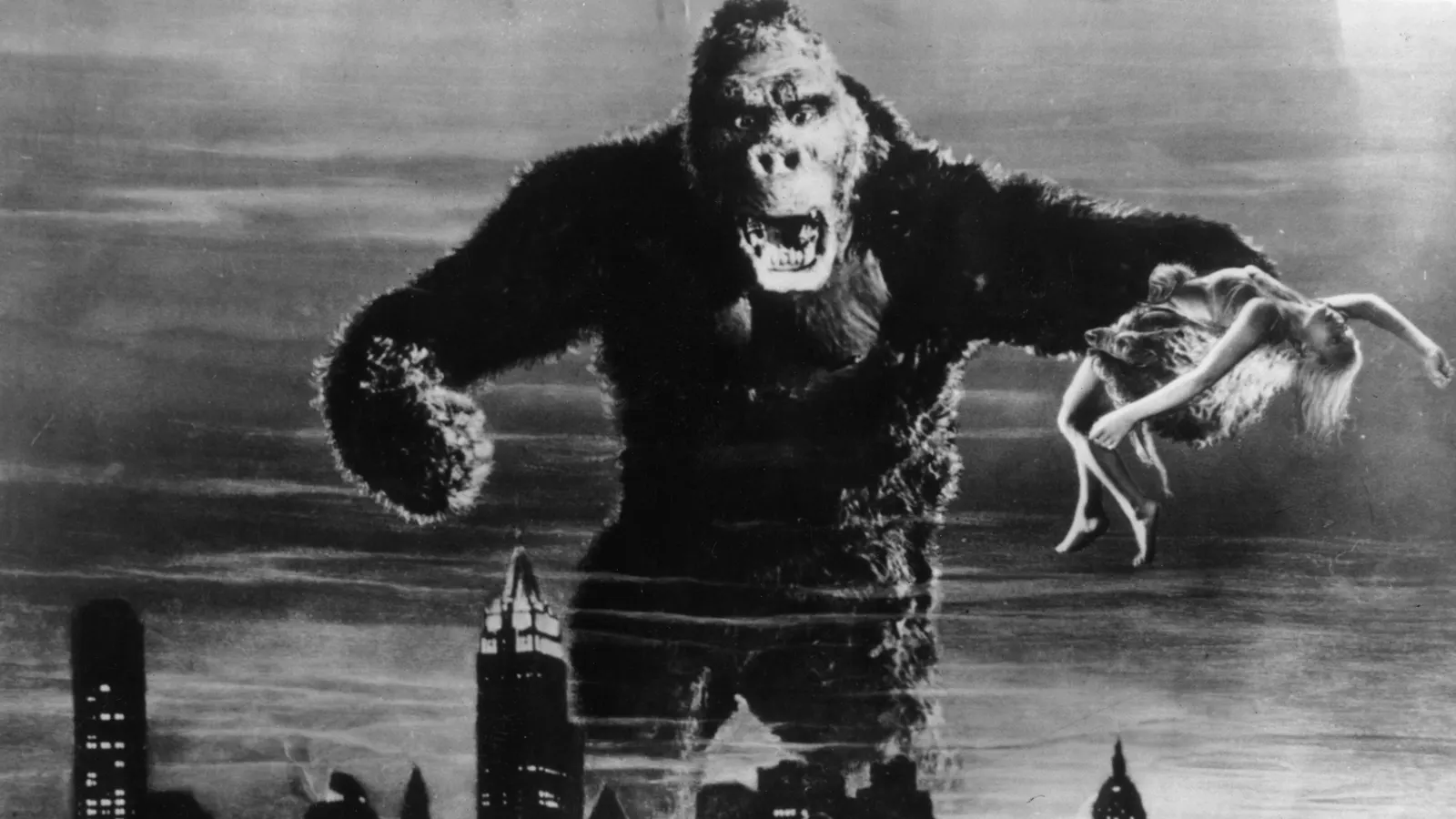

1933: One of John Cerisoli’s models of the giant ape, poised above the New York skyline in a scene from the classic monster movie ‘King Kong’. In one of his enormous hands is leading lady Fay Wray, the film’s heroine. (Photo by Hulton Archive/Getty Images)
Getty Images
Ninety-three years have passed since audiences were first introduced to the legendary King Kong. Often called the “Eighth Wonder of the World,” this colossal gorilla has been a global pop culture icon since his 1933 debut, and today we celebrate his enduring impact on cinema.
When King Kong premiered in New York City on March 2, 1933, at Radio City Music Hall and the RKO Roxy Theatre, audiences were immediately captivated. The reviews were positive, with critics praising its groundbreaking stop-motion animation and musical score. During its initial theatrical run, the movie earned a profit of $650,000, a figure that would grow to $2,847,000 by the time of its re-release in 1952. That $2,847,000 in 1952 is roughly equivalent to $33.5 million today.
A poster for Merian C. Cooper’s 1933 adventure film ‘King Kong’. (Photo by Movie Poster Image Art/Getty Images)
Getty Images
A Groundbreaking Technical Achievement
At the heart of King Kong’s success was the work of Willis O’Brien, whose stop-motion animation brought the colossal ape to life. O’Brien had previously worked for Thomas Edison, honing the skills that would make Kong a cinematic marvel. The film’s technical accomplishments were unmatched for its time, and its effects remain influential, inspiring generations of filmmakers. While King Kong initially faced censorship, with certain scenes removed during its early releases, they were restored in 1970.
Cultural and Historical Significance
In 1991, King Kong was deemed “culturally, historically, and aesthetically significant” by the Library of Congress and selected for preservation in the National Film Registry. The movie has continued to earn acclaim: in 2010, Rotten Tomatoes ranked it the greatest horror film of all time and the fifty-sixth greatest film ever made.
A scene from the film ‘King Kong’ with the giant gorilla astride a Manhattan skyscraper grabbing a passing aeroplane. The film was directed by Merian C Cooper and Ernest B Schoedsack for RKO. (Photo by Hulton Archive/Getty Images)
Getty Images
A Legacy That Keeps Growing
King Kong’s influence extends far beyond his original 1933 release. A sequel, Son of Kong, was released the same year, and the story has inspired multiple remakes and follow-ups. These include King Kong Escapes (1967); the 1976 remake starring Jeff Bridges, Charles Grodin, and Jessica Lange; and the direct sequel King Kong Lives (1986), in which Kong faced tragedy atop the World Trade Center.
A poster for Ishirô Honda’s 1967 adventure film ‘King Kong Escapes’ (original title: ‘Kingu Kongu No Gyakushû’) starring Rhodes Reason and Linda Miller. (Photo by Movie Poster Image Art/Getty Images)
Getty Images
In 2005, the film was remade again under the direction of Peter Jackson, known for The Lord of the Rings trilogy. It was the ninth entry in the franchise.
Animated Adventures
The “eighth wonder of the world” has also been a staple in animated media. His first televised cartoon came in 1966 with The King Kong Show, which was produced in Japan followed the famous gorilla on various adventures with a human family as they battled giant monsters, robots, aliens, and mad scientists.
His second animated series outing arrived in 2000 with Kong: The Animated Series, which featured a cloned Kong with DNA spliced with a human. The series aired on Fox Kids and spawned two straight-to-DVD movies: Kong: King of Atlantis and Kong: Return to the Jungle. Next was Kong: King of the Apes, which dropped on Netflix in 2016.
Fun Factoids
- Merian C. Cooper’s Vision: The film’s co-creator originally envisioned a giant ape atop the world’s tallest building, battling airplanes. He worked backward from this climactic image to develop the rest of the story.
A poster for Merian C. Cooper’s 1933 adventure film’King Kong’ starring Fay Wray and Bruce Cabot. (Photo by Movie Poster Image Art/Getty Images)
Getty Images
- Fay Wray Casting Surprise: After deciding that a blonde would provide the perfect contrast to King Kong’s, Cooper cast Fay Wray in the lead role. To sweeten the deal, he told Wray she would star opposite the “tallest, darkest leading man in Hollywood.” Wray assumed this meant Clark Gable, until Cooper later showed her a picture of her actual co-star: a colossal ape.
American actress Fay Wray in the clutches of King Kong, in a scene from the Hollywood horror movie,’ King Kong’, directed by Merian C Cooper and Ernest B Schoedsack for RKO. (Photo by Hulton Archive/Getty Images)
Getty Images
- Willis O’Brien’s Roots: King Kong’s chief special effects artist, Willis O’Brien, had previously worked for Thomas Edison, giving him early experience in pioneering cinematic techniques.
- First Re-Release: King Kong was the first movie ever to be re-released, a practice that would become common in Hollywood.
Nearly a century later, King Kong remains a towering figure in cinema. Its combination of spectacle, emotion, and innovation set a standard for visual storytelling that continues to shape films today. From technical marvel to cultural icon, Kong’s legacy spans live-action, animation, and global popular culture, cementing his place as one of cinema’s most enduring giants.
A poster for Merian C. Cooper’s 1933 adventure film ‘King Kong’. (Photo by Movie Poster Image Art/Getty Images)
Getty Images














Leave a comment