


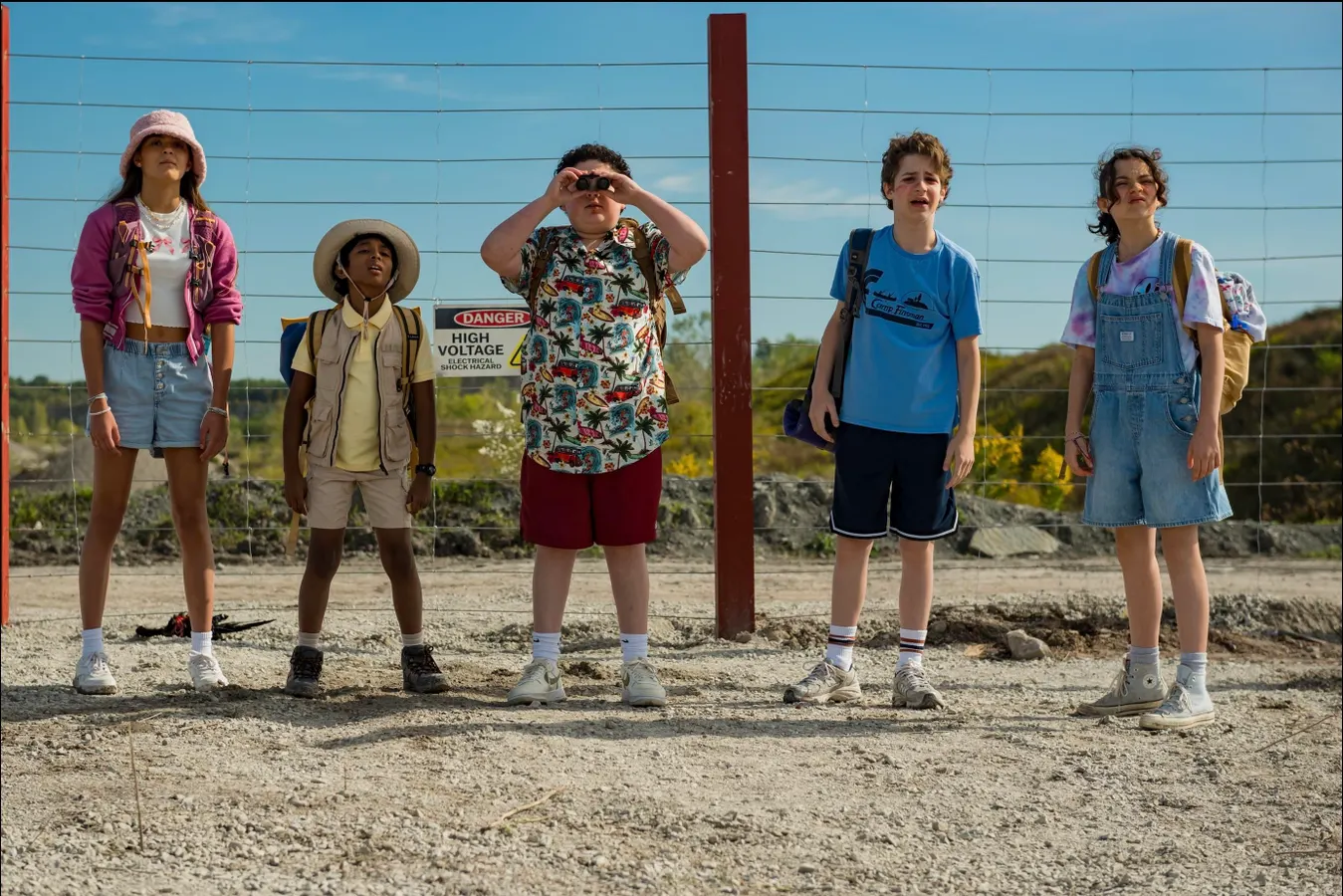

L-R: Sophie (Alyssa Gervasi), Leon (Jai Soundar), Charness (Aaron Harris), Jacob (Benjamin Pajak), and Tali (Isa Bernal Steiner) in ‘Tiny Fugitives’
Courtesy of Inaugural Entertainment
Just as the headline says, it all began with an extraterrestrial attending a Hebraic summer camp.
Writer/comedian Jacob Kaplan never expected his animated pilot idea to go anywhere; it was merely a spec writing sample his manager could disseminate around town. The script ultimately landed on the desk of Michael Lewen, a longtime director/producer for Apatow Productions on Trainwreck and The King of Staten Island, who had aspirations of writing and directing his own feature.
“A small alien gets sent to Earth to report back on what humanity is like, but gets dropped at Jewish summer camp,” Lewen told me over Zoom, summarizing Kaplan’s pitch. “It doesn’t realize it’s reporting on the truths of the world as told through this hyper-specific sensibility. I just thought it was really funny and a good pairing for some of my instincts.”
He and Kaplan used it as the jumping-off point for a comedy film based on their own sleepaway camp experiences. “We started with this firm idea of, ‘What if it was kids who never want to go home?’” Kaplan explained on a separate call. “That whole idea of living ‘10-for-two.’ Living 10 months of your life for the two months of camp. [Then] this idea of going ‘12-for-12’ and doing year-round camp.”
The result was the biggest comedy surprise of 2026—Tiny Fugitives.
The movie follows two brazen middle-schoolers, Jacob Udell (a heartbreakingly earnest Benjamin Pajak), and Max, a.k.a. Charness (Aaron Harris channeling The Goonies’ Chunk and a young Jonah Hill), who conspire to stay at their beloved Camp Fineman forever in order to evade the harsh realities of divorce and bullying back home.
While not everyone gets to attend Jewish summer camp, the terror and ambivalence of suddenly facing the harsh realities of burgeoning adulthood and wanting to seek out some kind of refuge is a universal concept.
“There are places where you just feel like you make sense,” Lewen said, referencing the monologue Jacob gives at the start of the movie. “For some kids, it’s baseball. For some kids, it’s chess club. For some kids, it’s your cousin’s house. For me it was summer camp … [but] you don’t have to have gone to summer camp to like the movie. You just have to have been 12-years-old. It’s just toeing that line, the way Ladybird is about Sacramento, but you don’t have to get Sacramento to know what that feels like.”
Still, the hope is Tiny Fugitives can serve as a window into the idiosyncratic experience that is Jewish sleepaway camp. “What I wanted to capture, which was a challenge—but I think it’s such such a core thing to camp—is this idea that camp is its own isolated universe from the rest of the world,” Kaplan said. “A place where you have your own language, all these inside jokes, all of this shorthand. It was very important for me to have this feeling that camp is this world in and of itself, while also not making it seem like a total foreign language to anyone watching.”
Going along with Jacob and Charness’s brilliant scheme to take up residence at Fineman’s original site are Sophie (Alyssa Gervasi), Leon (Jai Soundar), and Tali (Isa Bernal Steiner). The only thing standing in their way is longtime counselor Bob (Johnny Knoxville), whom the kids know more as a walking amalgam of half-true campfire legends than as an actual person.
He gives chase, desperately trying to get the kids back before their parents arrive to pick them up. Along the way, he and Jacob form an adversarial dynamic inspired by the one enjoyed by Vincent Hanna and Neil McCauley in Michael Mann’s Heat.
“Instead of Pacino and De Niro, it’s Johnny Johnny Knoxville and a 12-year-old both have the same kind essential emotional truth,” mused Lewen, “which is that the only place they ever made sense was at summer camp.”
LOS ANGELES, CALIFORNIA – SEPTEMBER 15: (L-R) Jacob Kaplan, Johnny Knoxville, and Michael Lewen arrive at the Los Angeles Special Screening of “Tiny Fugitives” at AMC The Grove 14 on September 15, 2026 in Los Angeles, California. (Photo by Maya Dehlin/Getty Images)
Getty Images
The decision to cast Knoxville specifically was born out of the fact that “he represents something in culture that I think is thematically simpatico with our movie,” continued Lewen. “Tiny Fugitives and Jackass fall under this same dirty and wholesome idea of the joy of boys in a way. This kind of forever young, inner child thing. At the same time, Johnny is someone that everyone knows a certain way, and I was interested to explore another side of him … I was interested in trying to use his ethos as a way to do something unexpected and a little more emotionally three-dimensional than your classic ‘I’m gonna get ya!’ villain.”
“Regardless of the comedy and the story, everything should have a very human core,” concurred Kaplan. “A strong, believable and real emotional center to it.”
He and Lewen also drew on coming-of-age touchstones like Rob Reiner’s Stand By Me, Bo Burnham’s Eighth Grade, Richard Linklater’s Boyhood, and Hulu series Pen15—all of which treat their adolescent characters with respect.
“I don’t think any of those projects condescend,” Kaplan elaborated. “I very much wanted to ensure it didn’t feel like adults writing 12-year-olds. What I find so funny about the humor of that age, is the stakes are so low but feel so high. You don’t make fun of the kids for thinking that something that’s not the end of the world is the end of the world. It’s funny, but it’s also true.”
Agreed Lewen: “It’s always trying to find a balance of doing something big and delivers comedically in a theatrical setting, but also swims in emotionally deeper waters than you might expect. Just balancing the tone of doing things that are big and funny and for everyone, while still making the kids feel real. The movie has these bigger action/adventure heist-y, fugitive-y things, [while] remembering that they’re actual people. Both Johnny Knoxville and the kids are human beings with inner lives that mean something.”
As uproariously funny and clever as it is heartfelt, the movie captures the raunchy, foul-mouthed spark of envelope pushing comedies Superbad and Good Boys.
Not too surprising, given that Seth Rogen and Evan Goldberg’s Point Grey Pictures banner produced the film. “If you’re gonna make an old R-rated comedy about 12-year-olds,” said Kaplan, “they’re the best people for that.”
L-R: Aaron Harris as Charness and Benjamin Pajak as Jacob in ‘Tiny Fugitives.’
Courtesy of Inaugural Entertainment
Lewen described the experience of further developing the script with Point Grey’s Josh Fagen and James Weaver as “super collaborative,” with a great deal of emphasis placed on jokes, improvisation, and tailoring dialogue to the actors.
“Any time your producers are also writers and directors themselves,” said the director, “they come at it from such an artistically thoughtful and funny place. It’s just really helpful as a filmmaker.”
Echoed Kaplan: “They’re great at taking already very funny material and giving it a bigger scope; having it be something that is worthy of being seen in a theater. And I do think this movie is best seen with a bunch of people in a theater. I really am hoping theatrical comedies can make a comeback.”
In casting the project, Lewen partnered with Jessica Kelly (Euphoria) and called on his tenure with Judd Apatow, “who has a great track record of finding new voices and helping write to them,” noted the director. “I learned a lot about casting and the rehearsal process; trying to find this middle ground between your voice as a filmmaker and their comedic attitude as performers.”
The goal was to find novice talent who would bring authenticity to the material. Said Kaplan, “I think the best actors at that age are not necessarily super-polished because they’re real kids. No one’s going to be a fully formed person at 12. It was truly a global search. We saw everyone. People who had no credits, people who had tons of credits. I’m super happy with the crew we found.”
Once the ensemble fell into place and filming began, Lewen fostered a camp-like atmosphere on and off the set. “The style of the movie is built to make them feel free enough to try stuff,” he explained. “I always had an attitude with the kids that the movie would work if they thrived, so I tried to build the production around what was going to make them most set up for success.”
This resulted in the young stars publishing their own newspaper called The Tiny Times. “They would write op-eds, funny comedy pieces, and features where they would interview the other cast and department heads,” Lewen recalled. “I just tried to give them the camp experience. They hung out all day long during the making of it. Then they’d go home and want to hang out with each other more.”
Tiny Fugitives is in theaters Sep. 18. Click here for tickets.















Leave a comment