


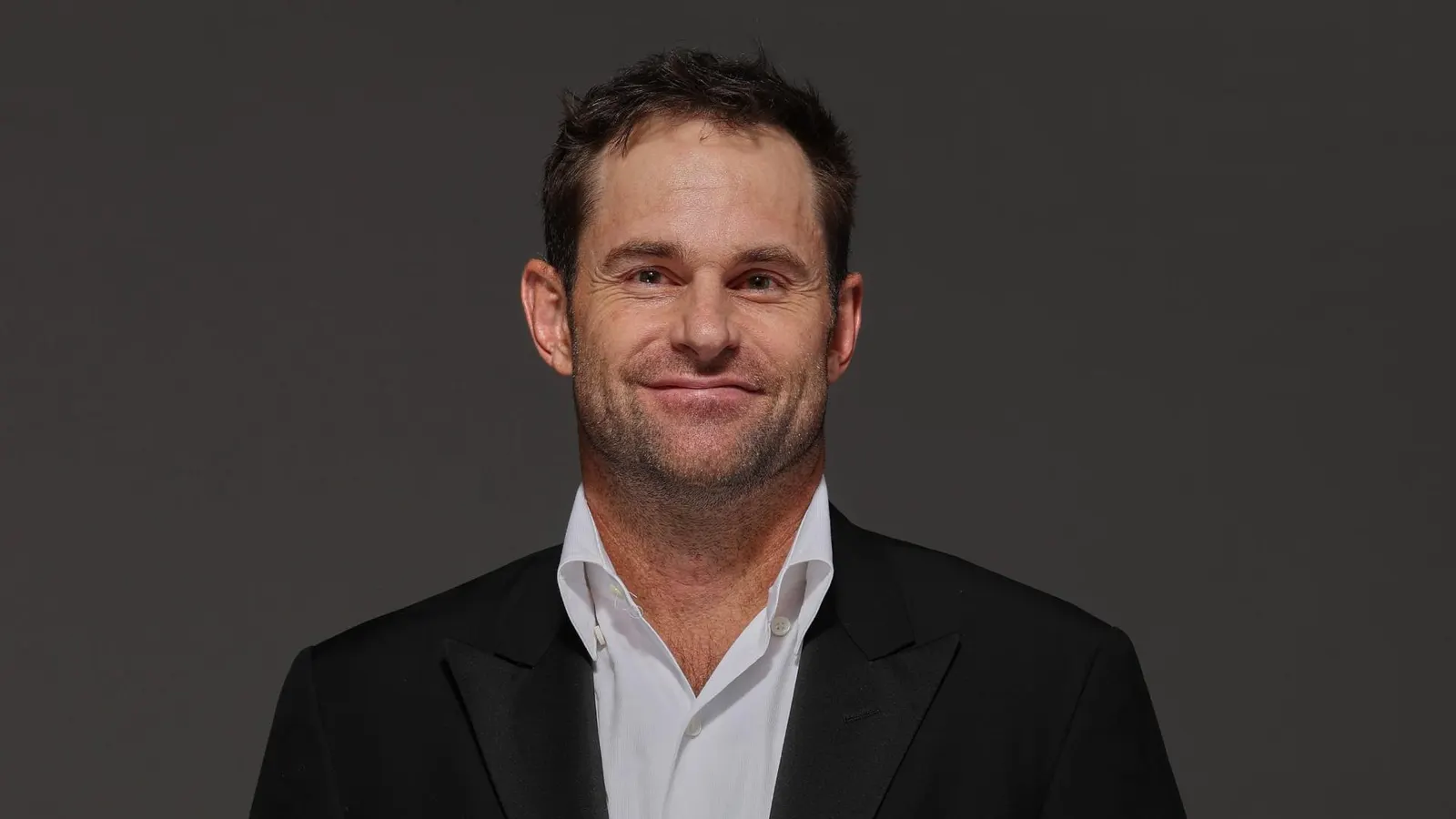
When Andy Roddick was approached by Ben Stiller to appear in a movie he was producing, about a tennis pro who takes up pickleball, the former world No. 1 turned down the award-winning actor and producer. Repeatedly. “Athlete cameos in movies are normally horrendous,” Roddick says. “I said no to him probably four or five times.”
But this role was no cameo, Stiller explained, and the movie really couldn’t be made without Roddick embodying the protagonist’s childhood tennis rival, who eventually faces off against him in the climactic pickleball match. The guilt trip worked, and Roddick finally agreed to star alongside Jake Johnson in The Dink, which premiered on Apple TV this summer.
The movie is only one piece of the 43-year-old Tennis Hall of Famer’s reemergence into the public eye, after more than a decade when he was seldom seen or heard from. Roddick also appeared in the commentary box and at the analyst desk for ESPN for the first time at Wimbledon in July, and he will return for the U.S. Open this month, all while hosting his twice-weekly show Served, which he has grown into arguably the most popular tennis podcast in the world. Forbes estimates the show generated roughly $4 million in advertising revenue over the past year—much of which goes directly into Roddick’s pocket, along with nearly $1 million in estimated earnings from his combined TV and film work.
“I was always busy in the ten years I was away from the game, so I don’t know that it was a conscious thing,” Roddick tells Forbes of his return to the spotlight. “I think it was more just a snowball effect, and I’ve just enjoyed the stuff I’ve done along the way.”
Considering his crossover into mainstream fame in the 2000s—complete with celebrity relationships, SNL hosting gigs and “Got Milk?” commercials—a second career in tennis media would have seemed like a natural fit after Roddick abruptly announced his retirement in 2013, on his 30th birthday. But at that time, podcasting was not yet a viable media category, and Roddick was adamant that he wasn’t going to follow the ATP Tour around as a TV personality, having burnt out on the global travel schedule. He was also struggling under the burden of carrying monikers like “One Slam Wonder” and “last American male to win a Grand Slam” that had stuck to him since his triumph at the 2003 U.S. Open and his four subsequent losses in Grand Slam finals to Roger Federer.
“TV is not something I thought I would ever do,” says Roddick, who won 32 tour-level singles titles and finished in the top ten of the ATP rankings for nine straight years, raking in more than $20 million in career prize money. “Back then, it was hard for me to negotiate the mental gymnastics of convincing myself to go sit in a commentary box when I knew I could probably still be out there playing.”
Instead, Roddick retreated from public view. He invested in commercial real estate, ran a foundation and focused on his young children, moving the family to Charlotte, North Carolina, to be closer to his wife’s family. When he was approached for a profile in GQ around the 20th anniversary of his Grand Slam win, it was his wife—the model and actress Brooklyn Decker—who had to talk him into it. “What’s your deal?” he remembers her saying. “It’s OK to remind people you’re alive.”
Roddick’s vanishing act was so convincing that when he befriended Mike Hayden in the pickup line at their children’s preschool, Hayden’s wife had no idea who he was. “She’s like, Andy who?” Hayden recalls. But Hayden saw Roddick’s potential and offered to combine his years of experience working in sports television with Roddick’s tennis knowledge to create a video podcast. After a few glasses of wine one night, they ordered $5,000 worth of equipment off Amazon and decided to give it a try.
Launched in January 2024, Roddick’s show filled a hole in the tennis media ecosystem, where most analysis is traditionally reserved for 30-second spots on live TV and most players are available for only a few minutes during press conferences. Roddick’s stature as a former world No. 1, combined with co-host Jon Wertheim’s journalistic bona fides from Sports Illustrated and 60 Minutes, allowed the show to buck convention on both fronts. The business got an early bump when the Tennis Channel licensed the show on cable, and soon it grew too large for Roddick and Hayden to manage alone.
Living Legends: On his podcast, “Served,” Roddick has long-form conversations with tennis stars—among them Andre Agassi, whom he played six times on tour.
Eakin Howard/Laver Cup/Getty Images
“I don’t know anything about sales,” Hayden says. “I had to Google ‘DAI’ [dynamic ad insertion] when people were saying it in meetings.”
In late 2024, the show signed with the Vox Media Podcast Network for ad sales and distribution, and when tennis legend Rafael Nadal joined for a March 2025 episode in his first long-form conversation after retiring, the show “went kablooey,” Roddick says. Served grew from less than $1 million in ad sales in its first year to more than $2 million in Year 2, according to Forbes estimates.
As with most top podcasters, Roddick maintained ownership of his show—Hayden and Wertheim each have a stake as well—and licensed it to Vox in exchange for an upfront minimum guarantee and a split of the ad revenue. But joining a larger network, especially one that didn’t specialize in tennis, led to new headaches. Because ad sales had to run through the Vox team, Roddick couldn’t package together his personal endorsements and appearances with media ad buys, which would create the kind of scale that attracts larger brands. The partnership also limited his ability to launch new shows on the same podcast feed, which Roddick wanted to do.
After some negotiation, the two sides decided to terminate their two-year agreement less than a year in. By then, however, the Served team had some revenue it could reinvest, and in time it hired two sales roles and launched a spin-off show hosted by former Grand Slam champion Kim Clijsters.
Revenue doubled again in Year 3, and the network now averages 2.2 million downloads and views per month, with half of that audience coming from outside the United States, according to Hayden. Roddick has begun to map out a future in which Served Media houses multiple shows, newsletters and other content offerings.
“The numbers we’re talking about now is bananas for just a fun little garage show that’s kind of turned into a tennis thing,” Roddick says. “In 2026, it’s still growing. I don’t know that I thought that was possible.”
The World’s Highest-Paid Tennis Players 2026
View Full List
The success of the podcast is what allowed Roddick to finally entertain the idea of TV commentating, because he could dictate his own terms. He wanted his kids to be old enough to travel as a family, he wanted to be confident in his knowledge of all the players, and most importantly, he wanted to make sure that the TV appearances wouldn’t interrupt the cadence of his podcast releases.
“We had to make Served big enough so whoever was pursuing me for broadcasting didn’t think they would have a say in it,” Roddick says. ESPN agreed, and signed him to a multiyear contract.
“Andy is absolutely brilliant on his podcast,” tennis legend Andy Murray wrote on X.com when the deal was announced. “Great knowledge of the game, well researched, speaks well, loves tennis, good fun, enjoys a debate and my god tennis needs way more of that on its broadcasts.”
Suddenly, Roddick is a star in the tennis world once again, with an opportunity to carve out a legacy in the sport for a new generation that may not have watched or even been alive for his Grand Slam losses to Federer. Almost anything seems possible—other than him starring in more movies. His ego, he says, is still too fragile around his wife.
“I won’t let Brook watch it,” Roddick says of The Dink. “I would recognize in her face very quickly if I said something in the movie and she thought it was terrible, and that would ruin me.”










Leave a comment