


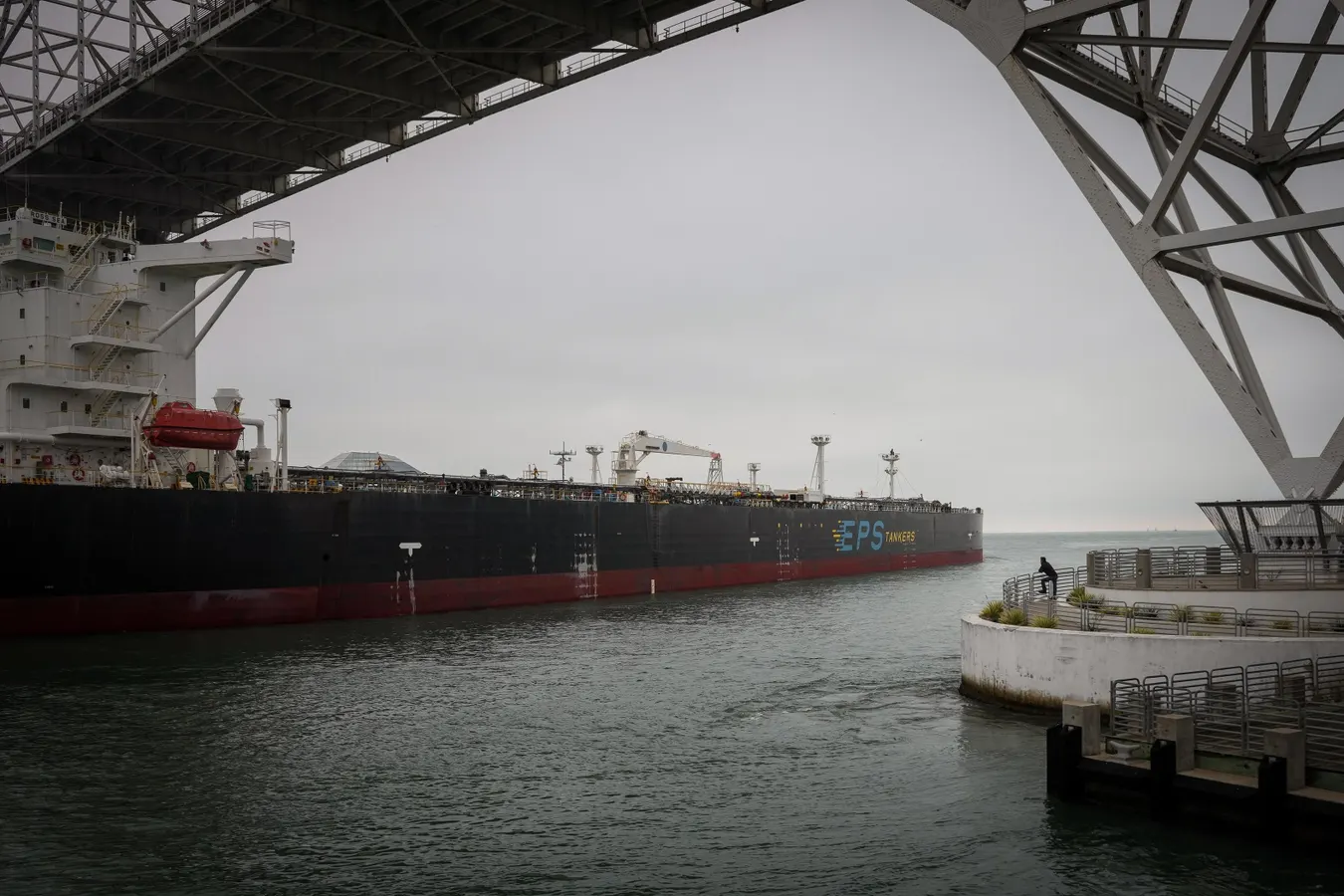

CORPUS CHRISTI, TEXAS – NOVEMBER 16: A man watches a ship pass under the Harbor Bridge as it leaves the Port of Corpus Christi on Thursday, Nov. 16, 2023, in Corpus Christi. (Jon Shapley/Houston Chronicle via Getty Images)
Houston Chronicle via Getty Images
Three decades ago, I had just graduated from Texas A&M University and taken my first job as a chemical engineer in Corpus Christi, Texas. At the time, few people would have expected that this Gulf Coast city would one day sit at the center of the global energy system. Corpus was an important regional hub—refineries, chemical plants, steady industrial activity—but it wasn’t viewed as a strategic asset on the world stage.
Today, it is exactly that.
The Port of Corpus Christi has become the largest crude oil export hub in the United States, moving massive volumes of oil to customers around the world. Tankers leaving its docks now help supply Europe, Asia, and beyond. What happened here isn’t just a local success story. It’s a case study in how quickly energy systems can change when the right pieces fall into place
From Import Dependence to Export Dominance
The turning point was the shale revolution. Advances in horizontal drilling and hydraulic fracturing unlocked enormous oil and gas resources in formations like the Permian Basin and the Eagle Ford. U.S. production surged, reversing decades of decline and forcing a complete rethink of the country’s energy outlook.
But production alone wasn’t enough. For years, U.S. policy effectively prohibited crude exports, so the entire system, from pipelines to refineries, was built around domestic consumption. When Congress lifted the export ban in 2015, it set off a rapid transformation. Suddenly, the United States needed to move millions of barrels per day to global markets.
Corpus Christi was in the right place at the right time to make that happen.
Geography Meets Infrastructure
Corpus Christi’s location gave it a natural advantage. It sits closer to the Permian Basin than Houston and has direct access to the Eagle Ford. As production surged and pipeline capacity expanded, crude began flowing toward the Gulf Coast in volumes that few had anticipated.
“There was far more oil coming out of the ground than anyone expected,” Port CEO Kent Britton recently told me. “Once exports were allowed, the system had to adapt quickly.”
Adapting meant building at scale. Over the past decade, the port has deepened and widened its ship channel, improved vessel traffic flow, and enhanced maneuverability throughout the system. Those changes are central to competitiveness. Every hour saved in transit or loading reduces costs and improves margins for exporters.
The result is a system designed for throughput. What started as a regional port has evolved into a high-efficiency export platform moving more than 2 million barrels per day.
A Fully Integrated Export System
What makes Corpus Christi particularly effective is how tightly integrated the system has become. Pipelines bring crude from inland basins. Storage facilities manage flows. Marine terminals handle loading. Offshore operations transfer cargo onto the largest vessels in the global fleet.
Each piece depends on the others. If one part slows down, the impact ripples across the entire chain. When it works well, the system moves enormous volumes with surprising efficiency.
That integration didn’t happen by accident. It required coordinated investment across midstream operators, terminal companies, and port authorities—all responding to the same signal: global demand for U.S. energy.
The Permian Still Drives the Story
Despite all the infrastructure along the coast, the real engine behind Corpus Christi’s rise remains the Permian Basin. Production continues to grow, but the nature of that growth has changed. The early shale years were defined by aggressive expansion. Today, capital discipline and consolidation dominate, with larger operators focusing on efficiency and long-term returns.
That shift has increased the importance of reliable export capacity. These companies are planning further out, and they need confidence that their barrels can reach global markets without disruption.
At the same time, constraints are beginning to re-emerge. Pipeline capacity is once again becoming a limiting factor. As Britton noted, significantly expanding exports from current levels will require additional takeaway infrastructure.
That point was echoed in a recent conversation I had with LNG pioneer Charif Souki, who put it more bluntly: “Production isn’t the issue. Bandwidth is.”
LNG: The Next Phase of Growth
While crude exports put Corpus Christi on the map, natural gas may define its next chapter. Global demand for liquefied natural gas has surged, particularly in Europe, where energy security concerns have reshaped supply chains.
The United States is now the world’s largest LNG exporter, and the Gulf Coast is at the center of that expansion. Corpus Christi already hosts a major LNG facility, with additional projects under development.
“The next major wave of growth is LNG,” Britton said.
That growth has the potential to further cement the region’s role in global energy markets, but it will also depend on the same factors that enabled the crude export boom: infrastructure, permitting, and execution.
The Constraints That Come Next
Success brings its own challenges. In South Texas, one of the most pressing issues is water. Industrial operations—refining, petrochemicals, LNG, and emerging hydrogen projects—all require substantial water resources. As development accelerates, pressure on local water systems is increasing.
Efforts are underway to address the issue through groundwater development, reuse systems, and desalination, but the broader point is clear. Energy systems don’t operate in isolation. They depend on a full ecosystem of supporting infrastructure.
As projects scale, those supporting systems become just as important as the resource itself.
A Transformation Few Saw Coming
When I first arrived in Corpus Christi, I never imagined it would become one of the most important energy gateways in the world. Yet that is exactly what has happened.
The shale revolution unlocked the resource base. Policy changes opened global markets. Private capital built the infrastructure. And good leadership and growing global demand pulled it all together.
Corpus Christi is the result of that alignment.
The United States still has the resource base to remain a dominant energy exporter for decades. But as Souki pointed out, the challenge isn’t production—it’s building the systems needed to move that energy efficiently.
Corpus Christi shows what’s possible when those systems come together. It also serves as a reminder that they don’t build themselves.














Leave a comment