


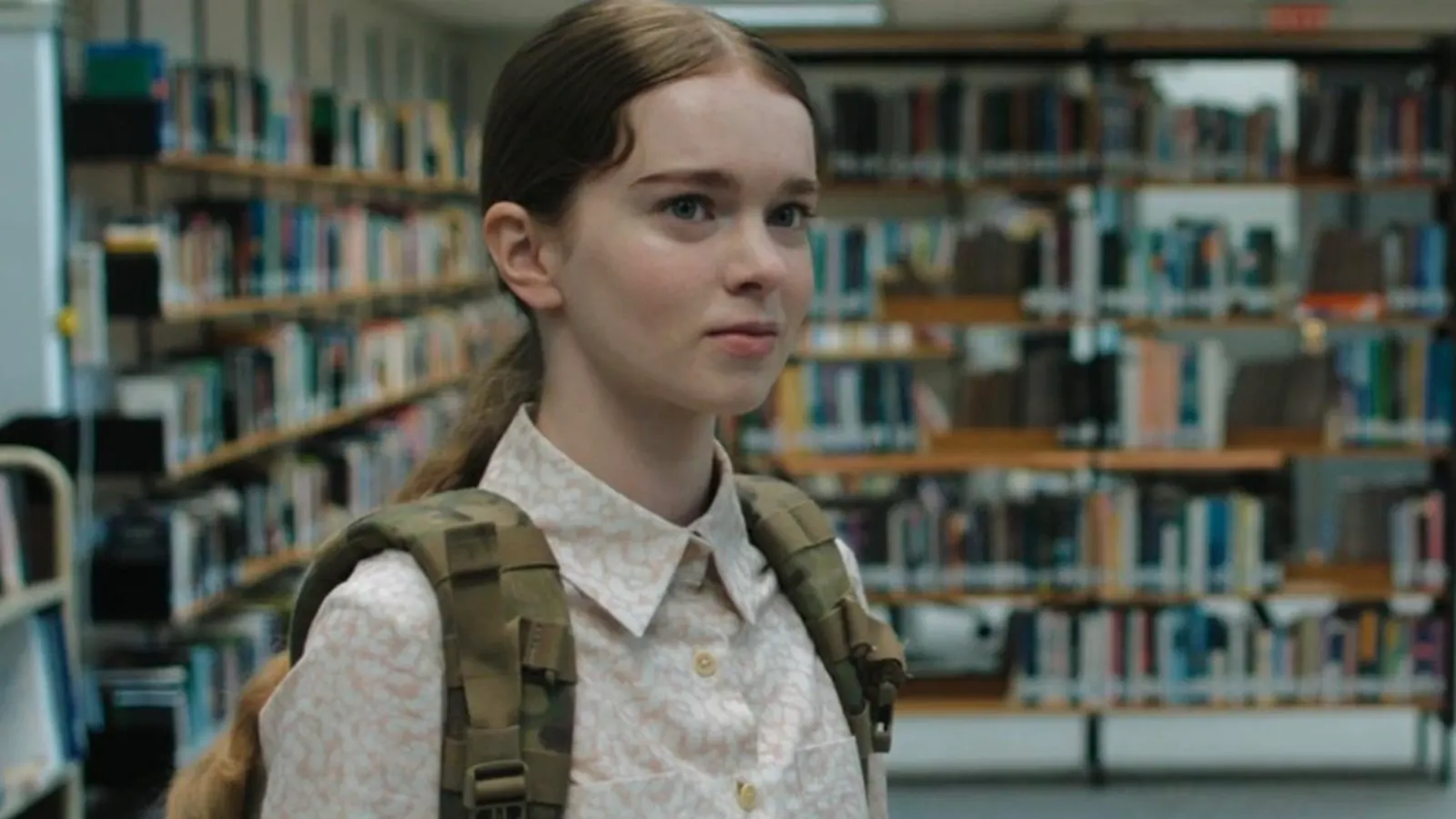

Summer H. Howell as Carrie White on “Carrie.”
Prime Video
One small scene in Mike Flanagan’s Carrie adaptation feels especially timely in the book ban era. In Prime Video’s new series, Flanagan reimagines Stephen King’s tragic story of the telekinetic teenager for a modern audience. The eight-episode series stars Summer H. Howell as Carrie, a sheltered and innocent girl who is relentlessly bullied and mocked by her peers after getting her period for the first time.
In episode two, as Carrie struggles to fit in at Ewen High School, she bonds with the school’s guidance counselor, Mr. Morton (Tim Bagley), over their shared love of reading and their ability to recite favorite literary quotes.
Carrie confides in him that she misses her father, who died a few months earlier, and that she has been seeing visions of him ever since. She also admits that she knows she isn’t normal in many ways. Mr. Morton responds with kindness, reassuring Carrie that she is normal, unaware that her telekinetic abilities make her far from ordinary. Hoping to cheer her up, he takes her to the school library for the first time.
Despite its small size, a result of dwindling funding, the library excites Carrie. She is delighted by the number of books available and, perhaps more importantly, the freedom to read whatever she wants, scary stuff or otherwise. She pulls several well-known, seminal works from the shelves before settling down with a stack. All the books are titles that her conservative and religious extremist mother, Margaret White (Samantha Sloyan), definitely wouldn’t approve of — and she’s not the only one.
The Books Carrie Picks Have A Pattern Of Being Challenged, Banned Or Restricted In U.S. Schools
Carrie’s stack of books.
Prime Video
The library scene builds on a flashback in the series premiere, which shows a young Carrie befriending Stella (Naika Toussaint), her older next-door neighbor. Stella introduces Carrie to books that broaden her understanding of the world beyond the Bible, the only book her mother let her read while she was growing up.
Carrie’s book selection in episode two includes Maya Angelou’s I Know Why The Caged Bird Sings, Malinda Lo’s Last Night at The Telegraph Club, Margaret Atwood’s The Handmaid’s Tale, John Green’s Looking For Alaska and Ken Kesey’s One Flew Over The Cuckoo’s Nest. In real life, these books are all notable for being banned or challenged in U.S. schools as part of an ongoing, increasing movement. According to PEN America, frequently targeted books include young adult titles that explore race and racism, people of color, LGBTQ+ identities, and sexuality.
Angelou’s celebrated memoir I Know Why The Caged Bird Sings has been banned or challenged for its depictions of sexual abuse, sexuality, racism and explicit language. Kesey’s One Flew Over The Cuckoo’s Nest, meanwhile, has been criticized for its depictions of violence and accusations that it’s pornographic and glorifies criminal behavior.
Lo said Last Night at the Telegraph Club is her most successful novel and the one she’s been most targeted for. Set in 1950s San Francisco during the Red Scare, the coming-of-age story follows a 17-year-old Chinese American girl as she discovers her sexuality. The title refers to a lesbian bar the protagonist visits, and the book has faced bans and challenges over its sexual content and LGBTQ+ representation.
Looking For Alaska, Green’s debut young adult novel, focuses on love, loss, grief and forgiveness. It has been banned for sexually explicit scenes, offensive language and depictions of underage smoking and drinking. In a 2025 interview with PEN America, Green said the novel has been “banned pretty consistently over the last 20 years.”
Atwood’s The Handmaid’s Tale, a 1985 dystopian novel about women’s rights and religious extremism, has been banned for its depiction of violence, sexually explicit content and profanity. Censorship is so widespread that Atwood and Penguin Random House released a fireproof edition of The Handmaid’s Tale in 2022.
Summer H. Howell as Carrie White on “Carrie.”
Prime Video
PEN America has been tracking school book bans since 2021, documenting the rise and normalization of literary censorship. According to its Index of School Book Bans, 11,982 books were banned in public schools during the 2025-2026 school year, with a record number of unique titles. This marked the largest number of recorded bans in a single year since the organization began tracking the data, with Texas and Florida accounting for most cases. The Handmaid’s Tale and Looking For Alaska were also among PEN America’s list of most banned books in the 2025-2026 school year.
According to 2025 data reported to the American Library Association’s Office for Intellectual Freedom (OIF), most attempts at book censorship came from “pressure groups, government officials, and decision makers,” with a small percentage originating from individual parents. PEN America has similarly pointed to state legislation and the sway of organized groups as contributing to the rise of banned books.
In an age of continued book banning, it’s fitting that Flanagan’s Carrie includes a subtle reference to the ongoing fight over what young people should be allowed to read. King’s own novel has often faced bans and challenges, and Carrie discovering books censored for their differing perspectives shows how literature can broaden her thinking and challenge the stringent beliefs her mom imposed on her.






Leave a comment