


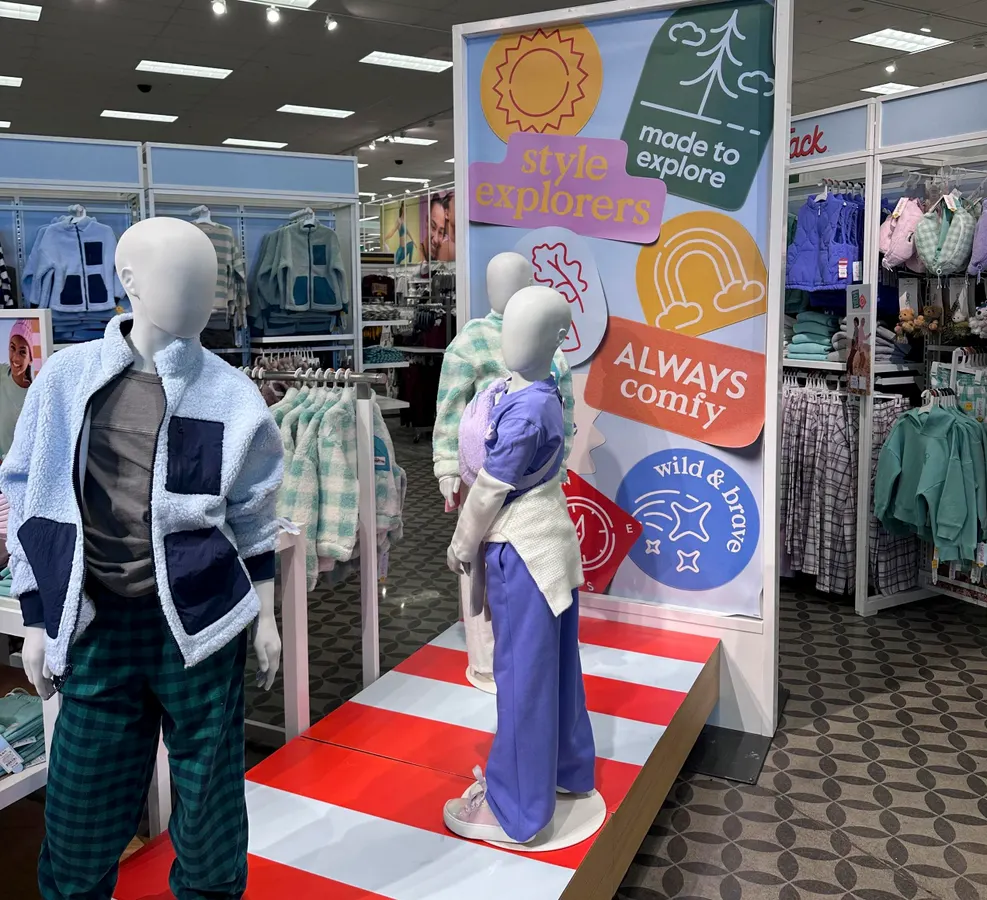

Cat & Jack display inside Target store
Courtesy of Target
Target’s private label Cat & Jack kid’s clothing brand is celebrating a milestone 10th anniversary. In just a decade, it’s grown to $3 billion in annual sales with nearly 300 million items sold each year, making it the nation’s number one private-label kids brand, according to Circana POS data—quite an accomplishment given Walmart’s Wonder World has far wider distribution across roughly 4,600 stores compared with Target’s 2,000.
Cat & Jack’s scale is even more impressive when set against the nation’s leading dedicated children’s clothing company: Carter’s and its OshKosh B’gosh brand. Together, these brands generated $2.9 billion last year. In other words, a single private-label brand that did not exist before 2016 is now on par to the combined sales of a legacy pure-play specialist with more than a century behind it.
Overall, Cat & Jack holds some 6% market share in the $47 billion U.S. kids’ apparel market, which Market Research Future projects will grow 3.6% annually to $70 billion in 2035.
Under the surface, Cat & Jack’s rise points to the strength of Target’s private-label strategy and its profit-building implications. Target approaches private label more like a CPG company—backed by research and market analysis to identify white space—as then-senior vice president and chief merchandising officer Jill Sando explained in the 2024 year-end earnings call.
More importantly, the brand’s success reinforces CEO Michael Fiddelke’s strategic pivot to “Busy Families” as a defensible moat that can power the company forward not just over the next year, but the next decade.
Cat & Jack’s Path To Success
“From the very start, Cat & Jack has been centered on kids and the style they want combined with the quality, durability and value that is really important to parents,” said Gena Fox, recently promoted executive vice president of design, who’s spent her entire 26-year career at Target. “Those things come together to create a best-in-class brand because of our consumer insights, design expertise and sourcing capabilities—so that Cat & Jack and all our other brands feel connected, intentional, and distinctly Target.”
Across Target’s roughly 50 private label brands, Cat & Jack holds a special place in Fox’s heart—she was part of the original design team that launched the brand. “When I look back at the brand’s 10-year journey, we’ve always been focused on our insights and guest research and translated that to create incredible designs that meet the needs of kids and their parents,” she added.
One of the insights that has powered the brand is identifying the age when children begin to develop their personal style preferences and exert more influence in family purchasing decisions. Over the years, Target has seen that age shift younger. Today the critical tipping point is around six years old.
“Parents still have full control, but kids’ influence is starting earlier than ever before and they have a much stronger point of view these days,” she explains.
Cat & Jack started by offering everyday essentials, but today it is leaning into more style-forward options for layering and occasion dressing—sharpening its focus on kids between ages three to eight, when they are discovering their personal style.
Private Label Core To Target’s Growth Strategy
A lot of responsibility is riding on Fox’s shoulders because she is responsible for what the company calls its owned brands and collaborations. And that is the “Tar-zhay” magic.
Number one in the next chapter of growth strategic plan outlined by CEO Fiddelke in March was to “lead with merchandising authority by setting trends with differentiated, culturally relevant assortments that win in style, design and value.”
According to the company, about one-third of total sales are generated by its owned brands—about on par with Walmart and Costco but theirs are primarily grocery focused while Target’s span a much broader range of design-centric categories.
And it is widely reported that 10 of Target’s private-label brands generate over $1 billion annually, led by Good & Gather in grocery at $4 billion, Up & Up across baby, beauty, home and healthcare nearing $3 billion and Cat & Jack.
Previous chief growth officer Christina Hennington said, “Our own brand capabilities will only become more prominent in the decade ahead,” adding that owned brands represent a competitive advantage few retailers can match and that they are a “springboard into the future.”
There is no evidence that perspective on private label has changed under Fiddelke; rather, it’s only accelerated.
Leaning Into Busy Families
Private labels, like Cat & Jack, are a powerful beacon drawing customers to Target. “For Target, differentiation is how we win, and Target is built to be different. We’re doubling down on our design ethos across our products and experience,” said Fiddelke in the 2025 year end earnings call when he laid out the company’s strategic pivot to busy families.
“We’re getting crisper on the guests who power our growth. These guests are united by mindset,” he explained. “We refer to this group as busy families, and it’s one where we see outsized strength in sales and loyalty. We’re leaning in here, knowing that when we serve busy families well, we create durable, long-term value that has a positive ripple effect for all Target guests.”
Busy families is not just a consumer mindset—“They move fast, they’re digitally fluent, and they gravitate toward brands that mix practicality with fun and personal expression,” Fiddelke explained. It’s a life-stage marketing strategy that aligns Target’s merchandising strategy with the predictable transitions that shape household spending over time.
At the top end of the busy-family segment is Gen X (47-62 years old next year), many with older teenagers and college-age kids preparing for self-supporting adulthood. Behind them come Millennials (31 to 46 next year), the core busy families cohort—parents in the thick of raising school-aged children, juggling work, activities and housekeeping. Then comes Gen Z (18 to 30 next year), with the leading edge entering full adulthood, settling down and beginning to start families.
Boomers (63-81 next year) may sit outside the busy-family segment—though I feel quite busy fitting my twin grandsons’ ball games into my schedule—but they remain an important source of spending as grandparents.
And increasingly influential inside those households is Gen Alpha—children up to age 17, who are still largely dependent on their Gen X, Millennial, even Gen Z parents. According to PwC’s Generation Alpha survey, kids are increasingly functioning as the family’s “chief influence officer.” Some 55% of kids say they hold a lot of sway in clothing purchases and exert strong influence in skincare and beauty products as well.
PwC notes that “Parents may be underestimating how much their children’s preferences shape household spending, particularly in categories where purchases happen quickly and digitally.”
Target, however, is not underestimating Gen Alpha’s influence at all. The company understands if it can attract kids, their parents and grandparents will follow. And family shopping habits formed early tend to carry forward as those families move through predictable life stage transitions: marriage, birth of a child, starting school, graduations, buying a house or moving.
Building A Moat With Private-Labels For Busy Families
This is Target’s moat: a private-label powerhouse built for successive life stages that drive the most durable, high-repeat spending for American households. Target’s owned brands are geared to the patterns of family life— across apparel, home, beauty, baby, home, toys and essentials where design, trust and value matter most. Cat & Jack is a proof point. When Target wins busy families, it wins the next decade because it wins every life stage that comes after.
“The kid and family segment is core to who we are,” Fox concluded. “Joy is part of Target’s DNA and nothing brings more joy than kids. Cat & Jack shows how defensible this strategy is: it wins with families today and people keep coming back. It’s looking down the generations and evolving with them—their changing needs, their growing kids, their different routines—and that’s why this focus is our right to win.”
See Also:















Leave a comment