


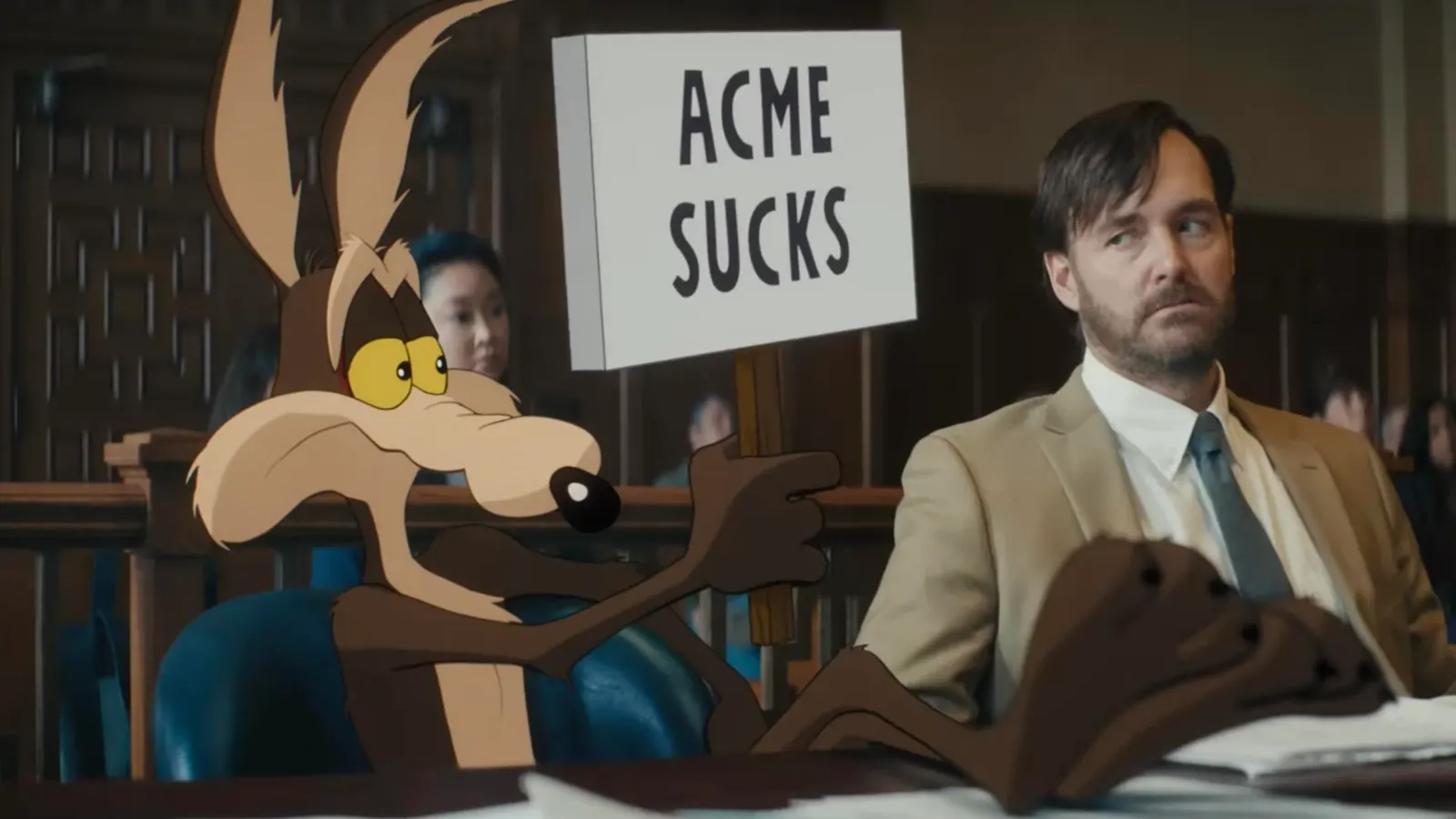

L-R: Wile E. Coyote and Kevin Avery (Will Forte) in ‘Coyote vs. Acme’
Courtesy of Ketchup Entertainment
After decades of suffering horrific accidents caused by Acme products, Wile E. Coyote becomes a class action lawsuit of one in Coyote vs. Acme (now playing).
Based on Ian Frazier’s 1990 satirical article published in The New Yorker, the animated/live-action hybrid film (à la Roger Rabbit, Space Jam, and Looney Tunes: Back in Action) finds the titular character taking the Acme Corporation to court for selling faulty, malfunctioning merchandise that has not once allowed him to capture and eat the quick-footed Road Runner in their endless game of cat and mouse across the American Southwest. What’s more, the company’s devices add literal injury to insult by blowing up in the Coyote’s face.
His futile determination may sound like the definition of glutton-for-punishment insanity with a dash of Sisyphean torture, but for Coyote vs. Acme composer Steven Price, saw it as the mark of an “eternal optimist.”
“It seems he’s never beaten down by stuff. Musically, that gave me an opportunity to work in very short blasts,” he recently told me over Zoom. “He goes at something really hard, then hits the brick wall, or falls off the cliff, or whatever it might be.”
“I think [director] Dave Green has described it brilliantly, that this is what Iron Man is to the Avengers,” Price continued. “It’s a film that really focuses in on a character. That was great for me, because I got to focus in on this amazing, resilient, character, and give him a voice.”
The Coyote’s fanatical obsession with having poultry for dinner inspired Price to define the Road Runner via choir. “The idea was that the Road Runner is on his thoughts all the time,” he said. “So much so, that all he hears in his head is the sound of the animal that keeps escaping him. Almost like a horror film technique, where the voices in his head are this operatic kind of ‘Meep’-ing.”
You’ll notice Mr. Price said “Meep” and not “Beep,” adding his opinion to the heated debate over the Road Runner’s iconic pseudo-catchphrase. “When you see it written down, it’s always ‘Beep,’” noted the composer. “But I always heard it as ‘Meep.’ We actually did a thing with the choir by asking them at the start of the session, ‘What do you think it is?’ Then we recorded it in a couple of different ways, and ‘Meep’ was definitely the one. So I will stand by it being ‘Meep’ eternally.”
Wile E.’s case is taken on by small-time billboard lawyer Kevin Avery (Will Forte), who has been settling Acme complaints out of court for years, convincing his clients to accept pitiful sums rather than go up against the multi-billion dollar behemoth represented by his old law school classmate, Buddy Crane (John Cena). In essence, Avery (named for trailblazing cartoonist Tex Avery) is the anti-rainmaker.
The theme for Avery and his low-effort Albuquerque practice “plods along and goes round in a little circle because every day for them is the same,” Price explained. “They do little cases, get paid off, and it’s all fine and not very exciting.”
That music strengthens over the course of the movie as Avery, spurred on by his idealistic niece Paige (Lana Condor), finds the courage to go up against the corporate Goliath, whose theme “haunts the whole thing,” Price added. “There’s lots of iterations of that throughout the film because obviously, they’re the big bad of the whole thing.”
Wanting the music to reflect the New Mexico backdrop’s “hometown feel,” while supplementing the score’s orchestral work, Price utilized banjos, acoustic guitars, and other folksy instruments: “I kind of found myself playing with slide guitars, making little misty textures and stuff like that, to fit the dustiness of the whole thing. It’s kind of a scrappiness I was quite pleased to find a home for.”
Like millions of people around the world, the composer grew up on the beloved (not to mention looney) antics of Wile E. Coyote, Road Runner, Bugs Bunny, Daffy Duck, Porky Pig, Elmer Fudd, Foghorn Leghorn, Yosemite Sam, Taz, Sylvester, Tweety, and the rest.
“It was probably one of the first times I realized how music and picture go together, because those things are scored incredibly,” said the Oscar-winner known for his work on Gravity and Baby Driver. “They’re so tied to the action. They’re funny, they’re imaginative, they’re incredibly creative with how they use music … All the different colors they’d achieve from the orchestra was super inspiring.”
In an effort to recapture the delight he felt as a child, Price embarked on “a massive YouTube trawl,” watching as many Looney Tunes shorts as possible—”You can watch these things for days”—and tapping into Warner Bros.’ digital library of original Merry Melody sounds.
“There are little hints of that in the score,” he teased. “They all come from early sound design things from those cartoons back in the day.”
The orchestra members he recorded with at London’s Abbey Road Studios brought their own love of the IP to the table as well. “People would see Coyote was falling from a great height and immediately knew what to do,” said Price. “They would suddenly dig into their own box of tricks and give you a little bit extra.”
Dave Green (sitting on couch) and Steven Price (foreground) during the scoring process on ‘Coyote vs. Acme.’
Courtesy of Ketchup Entertainment
While Coyote vs. Acme needed to channel the zany, unpredictable sound of the original cartoons, it also called for deeper emotion as the eponymous legal proceedings gradually reveal unexpected layers to the nonverbal desert predator and his speedy prey. “I would say it’s an emotional story about loony characters, and hopefully the score encompasses all of that in various ways,” mused Price.
He continued: “I’m super proud of the fact people are coming out of our film saying it surprised them by how emotional it was. Which kind of tells you a lot about the characters and the fact that they are kind of codependent and do need each other. The stuff that looked so comedic in the original cartoons, there was a bit of depth in there; they were capable of having these backstories and having this extra life to them. I think we’ve all got warm feelings of laughing through the ages at them, but I love the fact that we can take them somewhere else as well.”
But that didn’t happen overnight. Getting the music to work successfully alongside picture took a great deal of finessing. “You could break a scene so easily if you were just a couple of frames wrong,” Prince admitted. “The timing of these characters has to be absolutely perfect, or it just doesn’t work. So you would find yourself asking, ‘Is it funnier one frame to the right? Is it funnier one frame to the left?’ You could start second guessing yourself, but it was a really great team. Working with Dave and his editor, Carsten Kurpanek, was delightful.”
As many of us know, the road to getting Coyote vs. Acme into theaters has not been smooth. The film was nearly locked away forever by Warner Bros. as a money-saving measure following the studio’s merger with Discovery.
Remember the composer, “It was such a shock when we were told it wasn’t going to come out. Because when we finished the film, we were all really happy. It felt like everyone had given their best. It felt like it had all come together beautifully, and we were super proud of it. And then, to think that was all for nothing, was a really weird feeling you’d never really come across.”
Overwhelming public support for the movie (whose core themes of shady business practices and corporate malfeasance only felt more relevant in the wake of WB’s angling for an easy tax write-off) led Ketchup Entertainment to swoop in and acquire the distribution rights.
“When people started to get behind it and support it was amazing because you realized you were working with these characters that everyone has grown up with,” finished Price. “Everyone on the filmmaking side of it is just really grateful to all the people who made a noise and made it possible for this to happen. Because for a long time, we were worried it wouldn’t.”
Coyote vs. Acme is now in theaters. Click here for tickets.














Leave a comment