


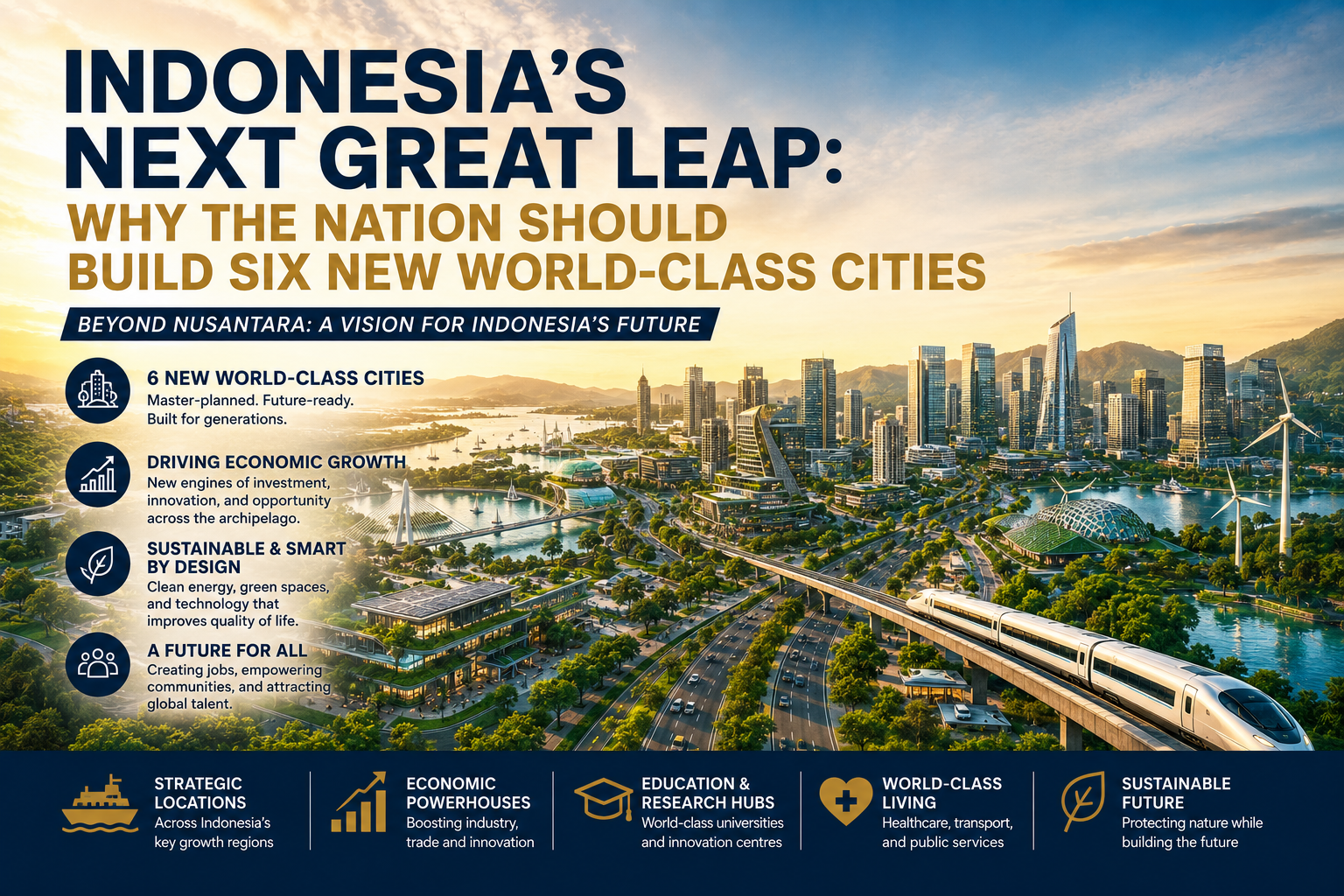
Indonesia’s Next Great Leap: Why the Nation Should Build Six New World-Class Cities
Beyond Nusantara: A Vision for Indonesia’s Future
By Jamie McIntyre
Chief Editor, Australian National Review
For decades, the world’s attention has focused on China’s extraordinary transformation.
Hundreds of millions of people were lifted into the middle class as China built entirely new cities, modern highways, high-speed rail networks, ports and industrial centres at a pace rarely seen in history.
Indonesia now has the opportunity to write its own version of that success story.
With a population approaching 280 million people, one of the youngest workforces in Asia, extraordinary reserves of natural resources, and an economy forecast by many analysts to become one of the world’s largest by the middle of this century, Indonesia possesses every ingredient needed to become an economic superpower.
The question is no longer whether Indonesia will grow.
The question is whether it will grow intelligently.
Jakarta Has Reached Its Limits
The greater Jakarta metropolitan region has become one of the largest urban areas on Earth, with around 42 million residents.
Its remarkable growth has powered Indonesia’s economy for decades.
Yet success has also created enormous pressure.
- Traffic congestion costs billions annually.
- Housing affordability continues to tighten.
- Flooding remains a persistent challenge.
- Air quality is frequently under pressure.
- Population density strains infrastructure and public services.
These are not signs of failure.
They are signs that Jakarta has succeeded beyond what it was ever originally designed to accommodate.
Indonesia’s decision to establish Nusantara as its future capital recognises precisely this challenge.
Rather than endlessly expanding Jakarta, Indonesia is beginning a new chapter.
That chapter should not end with just one new city.
Think Bigger
If Nusantara can eventually support around 1.9 million residents, why shouldn’t Indonesia ultimately develop five or six additional master-planned cities over the next 30 years?
Each could be designed from the ground up with:
- Wide roads
- Efficient public transport
- Reliable utilities
- World-class hospitals
- International universities
- Smart technology
- Green spaces
- Excellent waste management
- Clean rivers
- Renewable energy
- Affordable housing
Cities that improve quality of life instead of merely accommodating population growth.
Where Could They Be?
This is not a government blueprint, but several regions stand out as worthy of long-term consideration.
1. The Malacca Gateway
Indonesia’s coastline along the Strait of Malacca represents one of the world’s greatest untapped strategic opportunities.
Few shipping lanes on Earth carry as much international trade.
A modern financial, logistics and technology city on Indonesia’s side of the Strait could become a major gateway for global commerce while complementing, rather than competing directly with, neighbouring regional hubs.
2. North Sumatra Growth Corridor
A master-planned city in North Sumatra could strengthen manufacturing, logistics, agriculture, exports and tourism while creating a powerful economic engine outside Java.
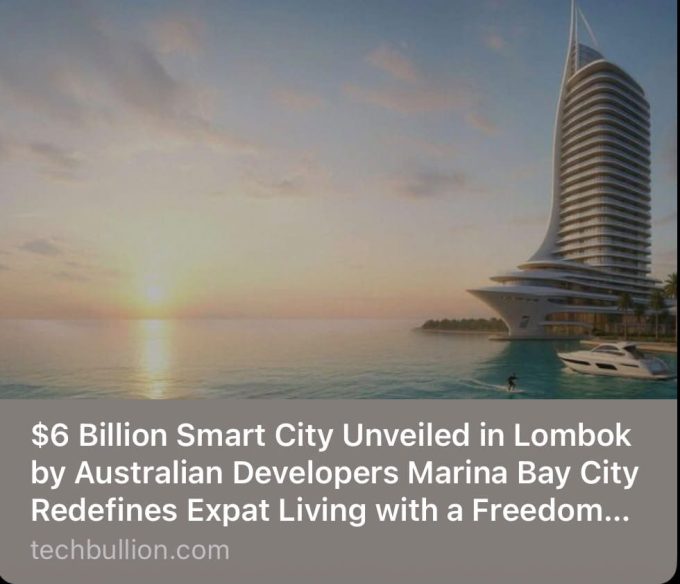
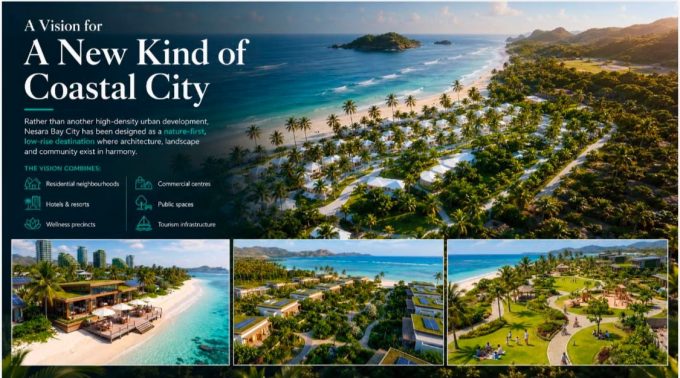
3. Southern Lombok
Southern Lombok possesses exceptional tourism potential, beautiful coastlines and substantial room for carefully planned growth.
With world-class infrastructure and sustainable development, it could evolve into one of Asia’s premier tourism and lifestyle destinations while protecting its natural environment.
4. Eastern Indonesia Innovation Hub
Eastern Indonesia deserves greater investment.
A major city serving eastern provinces could encourage industry, education, healthcare and research while reducing regional inequality.
5. Kalimantan Expansion
Nusantara should not stand alone.
Supporting regional cities throughout Kalimantan could create a network of complementary urban centres that strengthen the island’s long-term economic future.
6. Sulawesi Economic Gateway
Sulawesi continues to grow rapidly through mining, agriculture, fisheries and manufacturing.
A new master-planned city could accelerate investment while providing a modern urban centre for millions of future residents.
Learning From Singapore
Few countries illustrate the power of strategic planning better than Singapore.
Within a generation, Singapore transformed itself from a developing economy into one of the world’s wealthiest nations through long-term planning, efficient government, excellent infrastructure and openness to international investment.
Indonesia begins with advantages Singapore never possessed.
- A vast domestic market
- Extraordinary natural resources
- An expanding workforce
- A rapidly growing consumer economy
- An archipelago stretching across one of the world’s most strategically important regions
Imagine combining those advantages with world-class urban planning.
Special Economic Cities
Several of these cities could operate as expanded Special Economic Zones.
Rather than focusing solely on manufacturing, they could become complete economic ecosystems featuring:
- Financial services
- Artificial intelligence and technology
- Universities and research centres
- International healthcare
- Tourism and hospitality
- Green manufacturing
- Maritime industries
- Renewable energy
- Creative industries
- Global conference and exhibition centres
Competitive taxation, streamlined regulation and legal certainty could encourage both domestic entrepreneurs and international investors to establish long-term operations.
Housing People, Not Just Buildings
Perhaps the greatest lesson from many rapidly growing cities around the world is that infrastructure should come before population.
- Roads first
- Water first
- Power first
- Schools first
- Parks first
- Public transport first
- Then homes
By planning communities before they become overcrowded, Indonesia can avoid many of the challenges experienced elsewhere.
A Magnet for Global Talent
Well-designed cities would not only attract Indonesians.
They could attract entrepreneurs, engineers, researchers, retirees, investors and digital professionals from around the world.
Combined with sensible immigration policies, competitive business regulations and investment-friendly frameworks, Indonesia could become one of Asia’s most attractive destinations for international capital.
A Nation Ready for the Future
President Prabowo Subianto has repeatedly spoken about accelerating Indonesia’s development and strengthening long-term economic growth.
Nusantara is already evidence that Indonesia is prepared to pursue bold, nation-building projects.
Perhaps the next step is even more ambitious.
Not one new city.
Six.
Six cities designed not for today’s Indonesia, but for the Indonesia of 2050.
- Clean
- Affordable
- Environmentally responsible
- Technologically advanced
- Economically vibrant
- Built for families
- Built for business
- Built for future generations
The greatest infrastructure projects are rarely built because they are easy.
They are built because future generations deserve them.
Indonesia has the talent.
It has the resources.
It has the vision.
Now it has an opportunity to build not simply more cities, but a new model for urban development that the world may one day look to with admiration.












Leave a comment