


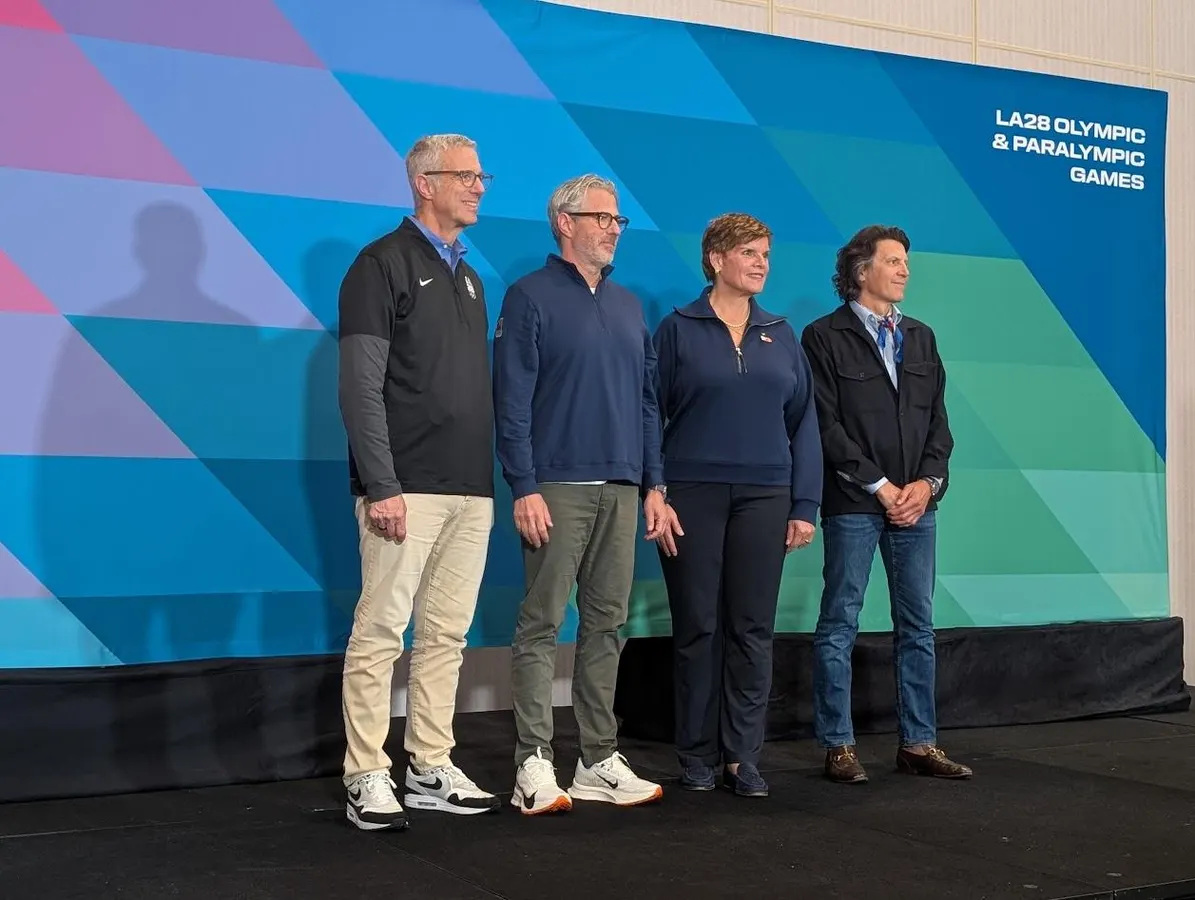
(I attended this press conference in Los Angeles June 4, 2026. All quotes are taken directly from a transcript of the event.)

From left to right: LA28 Chief Executive Officer Reynold Hoover, LA28 Chairman Casey Wasserman, IOC Chair of the Coordination Commission Nicole Hoevertsz, and IOC Executive Director Christoph Dubi June 4, 2026. Los Angeles, California
(Photo courtesy of Tim Genske)
Two years before the Opening Ceremony of the 2028 Olympic Games, senior leaders of the International Olympic Committee (IOC) delivered perhaps the strongest public endorsement yet of Los Angeles’ preparations, declaring that LA28 is further ahead than any previous Olympic organizing committee at the same point in the planning cycle. The remarks came during a press conference following a week-long series of coordination meetings between the IOC and LA28 leadership at the JW Marriott in downtown Los Angeles.
Déjà Vu All Over Again
For a city that successfully hosted the Olympics in 1932 and again in 1984, the stakes are high. The 2028 Games will be the largest sporting event ever staged in the United States and will arrive during a period of unprecedented growth for Olympic and Paralympic sport with 15,000 athletes expected. When asked to assess LA28’s progress compared to previous host cities, IOC Vice President and LA28 Coordination Commission Chair Nicole Hoevertsz did not hesitate:
Former swimmer Nicole Hoevertsz, Chair of the IOC Coordination Commission for LA28, speaks during a LA28 and International Olympic Committee news conference on preparations for the 2028 Games at the JW Marriott L.A. Live in Los Angeles on June 4, 2026. (Photo by Patrick T. Fallon / AFP via Getty Images)
AFP via Getty Images
“I can with every confidence say that this was the best Coordination Commission Meeting ever,” Hoevertsz said.
Her comments followed my question comparing the current stage of preparation to a student’s midterm examination, with the final test coming when the Olympic flame is lit in July 2028. The answer was emphatic.
Confidence Growing Inside The IOC
For Hoevertsz, who has now participated in seven official coordination meetings in Los Angeles, the difference has been noticeable. Each visit, she said, has revealed measurable progress and increasing organizational maturity.
“The team is ready. The Games are on track, and the Games are in the safe hands of a very qualified and very capable team,” she told reporters.
Los Angeles, CA – June 4: From left, Reynold Hoover, LA28 chief executive officer; Casey Wasserman, LA28 chairperson and president; Nicole Hoevertsz, chair of the IOC Coordination Commission for LA28; Christophe Dubi, IOC Olympic Games executive director, speaking; and Bernardo Domingues, head of communications for the International Olympic Committee, listen during a press conference at the JW Marriott Los Angeles L.A. LIVE on Thursday, June 4, 2026, following the International Olympic Committee Coordination Commission’s annual three-day meeting with the LA28 Organizing Committee to review planning for the 2028 Olympic and Paralympic Games. (Allen J. Schaben / Los Angeles Times via Getty Images)
Los Angeles Times via Getty Images
Much of that confidence stems from the leadership team assembled by LA28 Chairman Casey Wasserman and Chief Executive Officer Reynold Hoover. Hoevertsz described the workforce as “young, dynamic, passionate, knowledgeable, and trained people who know what they’re doing.”
Los Angeles, CA – June 4: Reynold Hoover, left, LA28 chief executive officer; and Casey Wasserman, center, LA28 chairperson and president, listen as Nicole Hoevertsz, chair of the IOC Coordination Commission for LA28, speaks during a press conference at the JW Marriott Los Angeles L.A. LIVE on Thursday, June 4, 2026, following the International Olympic Committee Coordination Commission’s annual three-day meeting with the LA28 Organizing Committee to review planning for the 2028 Olympic and Paralympic Games. (Allen J. Schaben / Los Angeles Times via Getty Images)
Los Angeles Times via Getty Images
The praise is particularly significant because the IOC Coordination Commission serves as the organization’s primary oversight body for Olympic planning. Its role is to identify risks, monitor progress, and ensure every aspect of Games delivery remains on schedule. When the commission expresses confidence publicly, it carries considerable weight within the Olympic movement.
A Different Kind Of Olympic Preparation
One factor separating Los Angeles from previous host cities is time. Unlike many recent Olympic hosts that faced compressed planning timelines, LA28 has benefited from a longer preparation runway. That extended timeline has allowed organizers to move beyond conceptual planning and into operational detail earlier than usual. IOC Olympic Games Executive Director Christophe Dubi emphasized that point.
Executive Director of the Olympic Games Christophe Dubi speaks during a LA28 and International Olympic Committee news conference on preparations for the 2028 Games at the JW Marriott L.A. Live in Los Angeles on June 4, 2026. (Photo by Patrick T. Fallon / AFP via Getty Images)
AFP via Getty Images
“Nothing like it before at this level two years out where we are today,” Dubi said.
The veteran Olympic executive has worked on numerous Games cycles and has observed preparations in cities around the world. Yet he suggested that LA28 has reached a level of readiness rarely seen this far in advance. Among the indicators cited were fundraising success, volunteer recruitment, and planning precision.
According to Dubi, organizers have already raised more revenue than previous organizing committees had achieved at comparable stages and have engaged what could become the largest volunteer pool in Olympic history. For an event expected to rely on tens of thousands of volunteers, that early momentum matters.
The LA28 Olympic cauldron is lit during a ceremonial lighting at the Memorial Coliseum in Los Angeles on January 13, 2026, ahead of the launch of ticket registration for the 2028 Summer Olympic Games. (Photo by Frederic J. Brown / AFP via Getty Images)
AFP via Getty Images
The Advantage Of Los Angeles
The IOC’s confidence extends beyond the organizing committee itself. Los Angeles offers unique advantages that few Olympic cities can match.
Unlike hosts that must build extensive new infrastructure, LA28 will utilize an existing network of world-class venues spread across Southern California. Many facilities already host professional sports franchises, major entertainment events, and international competitions. Dubi highlighted the strength of the local market as a critical asset.
LOS ANGELES, CALIFORNIA – JANUARY 28: A general view of the Hollywood sign on January 28, 2026 in Los Angeles, California. (Photo by Luke Hales/Getty Images)
Getty Images
“When you organize an event like this one, you have the best operators, you have the best venues, and you have the most creative industry around,” he said.
That creative industry may ultimately become one of LA28’s defining characteristics. Los Angeles sits at the center of the global entertainment business, giving organizers access to storytelling, production, and fan-engagement capabilities unlike those available in most Olympic host cities.
Paris dazzled audiences in 2024 with iconic backdrops and historic landmarks. Los Angeles appears poised to offer something different: a fusion of sport, entertainment, technology, and fan experience on a scale never previously attempted.
LOS ANGELES, CA – MAY 08: The Los Angeles Memorial Coliseum and SoFi Stadium will share the opening ceremony for the 2028 Olympic games. The Coliseum will be the site of the closing ceremony. Photographed in Los Angeles, CA on Thursday, May 8, 2025. (Myung J. Chun / Los Angeles Times via Getty Images)
Los Angeles Times via Getty Images
From Plenary Sessions To Working Groups
Another sign of organizational evolution can be found in how the coordination meetings themselves are conducted. Hoevertsz noted that the IOC and LA28 recently transitioned from traditional plenary-style meetings toward specialized working groups.
During the latest coordination commission gathering, seven separate groups focused on specific operational areas requiring attention. The change reflects the increasing complexity of Olympic planning as preparations move closer to execution. Instead of broad presentations, experts now spend more time solving detailed challenges involving transportation, security, venue operations, technology, sustainability, athlete services, and fan experience. For Olympic organizers, this is the stage where vision begins transforming into reality.
PASADENA, CALIFORNIA – JANUARY 01: A general view outside the stadium before the CFP Semifinal Rose Bowl Game between the Alabama Crimson Tide and the Michigan Wolverines at Rose Bowl Stadium on January 01, 2024 in Pasadena, California. (Photo by Harry How/Getty Images)
Getty Images
The long days of meetings described by Hoevertsz suggest that planning is advancing from strategic concepts into detailed operational execution.
The Road To 2028
While much work remains, the message delivered by IOC leadership was unmistakable. Two years before the Games, officials see a project that is not merely on schedule but potentially setting new benchmarks for Olympic preparation.
INGLEWOOD, CALIFORNIA – SEPTEMBER 08: The interior of SoFi Stadium is seen following a ribbon-cutting event on September 08, 2020 in Inglewood, California. (Photo by Rich Fury/Getty Images for Hollywood Park Management Company)
Getty Images for Hollywood Park Management Company
That assessment matters because recent Olympic hosts have often faced significant challenges in the final years before opening ceremonies. Budget pressures, construction delays, political concerns, and logistical hurdles have become common features of modern Olympic planning.
Remember Milano-Cortina just months ago and the Ice Hockey Arena? It faced severe last-second construction delays that nearly jeopardized the NHL’s participation. The arena went down to the wire, with missing seats, unfinished amenities (like running water in bathrooms), and a small ice delay before ultimately hosting the games.
MILAN, ITALY – FEBRUARY 19: A general view outside of the arena as fans arrive prior to the Women’s Gold Medal match between the United States and Canada on day thirteen of the Milano Cortina 2026 Winter Olympic games at Milano Santagiulia Ice Hockey Arena on February 19, 2026 in Milan, Italy. (Photo by Maja Hitij/Getty Images)
Getty Images
Los Angeles appears to be following a different trajectory.
The combination of existing infrastructure, strong commercial support, experienced leadership, and a favorable planning timeline has created conditions that IOC officials believe are exceptional. Two years from now, Los Angeles will face its final examination when athletes from around the world march into the Opening Ceremony and the eyes of billions turn toward Southern California.
If the IOC’s assessment is accurate, LA28 has already earned high marks on its “midterm exams”, and that bodes well for the “final.”














Leave a comment