


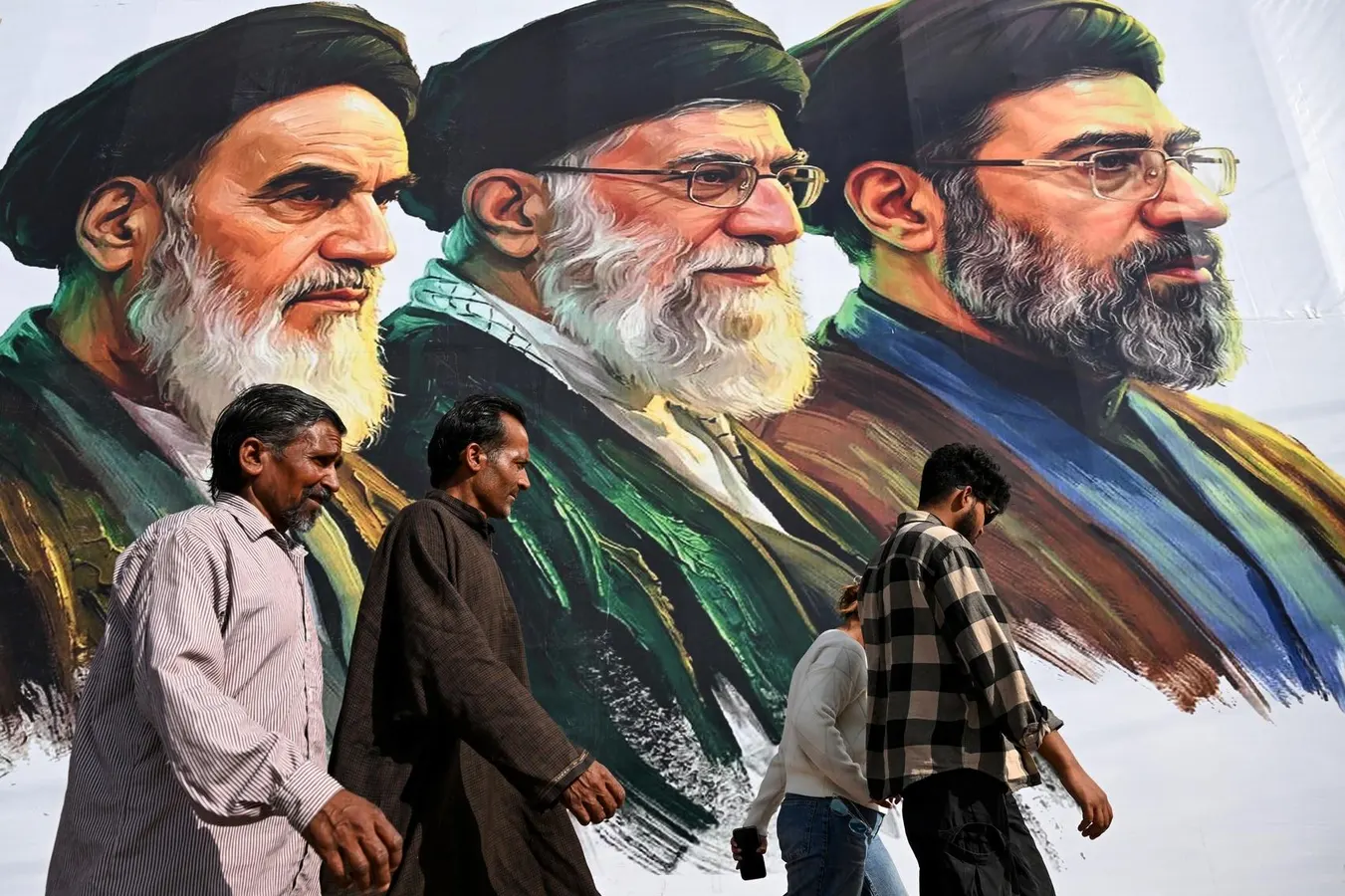

People walk past a billboard featuring Iran’s late supreme leaders Ayatollah Ruhollah Khomeini (L) and Ayatollah Ali Khamenei (C) next to newly elected supreme leader Mojtaba Khamenei in Srinagar on April 27, 2026. (Photo by Tauseef MUSTAFA / AFP via Getty Images)
AFP via Getty Images
An Iranian worker earns about 160 million rials a month, or about $116 dollars. With rising inflation, shortages and blackouts this makes it incredibly challenging for the average Iranian to make ends meet. The Statistical Centre of Iran reported an overall rate of inflation of 88.6% in June of 2026. As many as 32-40 million Iranians out of a population of 92 million live below the absolute poverty line and Iran has one of the highest food inflation rates in the world. The effects of war, sanctions and the worst drought in forty years have taken a toll on Iran’s poor.
Yet these challenges have barely affected the regime’s hardliners in charge, which may be even more emboldened to ensure that they maintain all the immense wealth they have accumulated. This runs contrary to the way the Iranian leadership portrays itself. Deceased former Iranian leader Ayatollah Ali Khamenei presented himself as a man of austerity and humility. Officially his wealth declaration listed assets worth only $50,000, and he supposedly only keeps company with the “poor” with claims that his living standards are “below average.”
Yet behind this façade of a man of the people, lies a powerful financial empire, reminiscent of totalitarian regimes of the past where wealth is tied to the complete control of the state. This is different than the private enrichment model of typical authoritarian regimes where wealth accumulates through corruption and consists of private assets, offshore accounts, companies and family fortunes. True, the Iranian regime has engaged in private enrichment as well. But much of the Khamenei’s wealth is driven by the extraordinary level of control he had over the state and its economic resources. Like past leaders such as Josef Stalin, his power and wealth were impossible to separate. It stems less from personally owning vast private wealth and more from his control over state-linked institutions that dominate large parts of the economy.
Regarding his private wealth accumulation, the former Khamenei headed a financial network with luxury properties in several countries such as Spain and the United Kingdom. This includes several luxury resorts and golf courses in Mallorca and Marbella, locations that the Ayatollah’s family have increasingly looked to, to diversify their investments since protests rocked the country in 2022. Beyond the UK and Spain, some of the Ayatollah’s funds are deposited in Venezuela, Syria and the United Arab Emirates. Venezuela in particular has helped to launder the Ayatollah’s money, helping to safeguard the family’s assets if the regime collapsed.
Despite his standard and unadorned attire that might suggest a modest income, the former Ayatollah’s wealth is somewhere between $100 and $200 billion, even more than what Iran earns annually through oil exports (Recent estimates show that Iran earned a sum of over $11 billion during the current months long war, and a further $6.5 billion during the ceasefire).
And the wealth seems to be all in the family. Khameini’s son Mojtaba, the new Supreme Leader, controls an empire worth at least $3 billion in the UK, the UAE and other European countries, though his name does not appear on any official ownership documents. These assets and properties are then used to facilitate money laundering and to finance institutions that are under his control.
The Rise of Setad, the Powerful Economic Juggernaut
After the 1979 revolution that ended the rule of the Shah, an organization called Setad Ejraiye Farmane Hazrate Emam or Setad was set up to manage properties that had been abandoned after the revolution, as hundreds of thousands of Iranians fled (one in 15 Iranians live abroad). The objective was to use the Setad for charitable purposes and only for a two-year transition period.
Some of these properties had not been actually abandoned, however. The owners of these properties – who were deemed enemies of the regime–were threatened and ordered to pay the Setad rent on properties they had owned for years. Anyone who refused was evicted. After these properties were seized, they were then incorporated into the real estate portfolio of the regime or sold off adding much more wealth and income for the regime.
Under Khamenei, what was supposed to be a charitable endeavor, was transformed into a wealth generating machine. The capital gained was used to reinvest in strategic companies and industries– from telecommunications to making contraceptives to ostrich farming. Other businesses in economic sectors such as health, infrastructure and automobiles were forced to pay bribes and fees to companies linked to Khamenei and his family to continue to operate. State-owned land was incorporated into the family’s assets. The network of wealth reaches nearly every sector of Iran’s economy and touches every aspect of Iranians’ lives. It is unclear how much money from the Setad actually goes to the poor, as there is no transparency.
In 2013, Reuters conducted an investigation that shed light on how Setad functions. Setad answers only to the Supreme Leader with no oversight by the Iranian Parliament—as the Parliament voted to prohibit itself from monitoring Setad in 2008. It pays no taxes and is never subject to external audits. Control is exercised through shell companies and tax haves in Switzerland led by front men who are dual nationals of Iran residing abroad.
While the Shah was ostentatious about his wealth and life of luxury, even holding a party to commemorate the 2,500th anniversary of the Persian Empire that today would have cost about $100 million, the Ayatollah’s wealth and assets far exceeds the fortune of the Shah (worth about $3 billion accounting for inflation). The Setad’s real estate holdings alone are worth over $50 billion with another $43 billion in corporate holdings, going by data from as early as 2008.
The system is similar to the Russian oligarchic structure where powerful business dominate key industries, but Iran’s network is much broader encompassing thousands of individuals who are deeply loyal to the regime.
Military Inc.
Not to be outdone is the wealth of Iran’s Revolutionary Guard Corps– the IRGC– which has developed a business empire that includes oil, transportation, banking, telecommunications, agriculture, medicine and real estate. Khatam al-Anbiya, an IRGC-affiliated engineering firm runs various projects in agriculture, industry, hydrocarbon, health, real estate, mining, pharmaceuticals, roadbuilding, education, and transportation sectors. The annual value of contracts awarded by the regime to Khatam al-Anbiya is worth in the tens of billions.
The IRGC also has a network of foundations or bonyads, that are semi-private monopolies that generate more wealth for its organization, accounting for more than half of Iran’s GDP in 2013.
While Iranian businesses have been cut off from legal finance and trade, the IRGC has had greater black-market opportunities- smuggling goods such as alcohol, narcotics, weapons and tobacco. The IRGC also controls the majority of Iran’s oil exports, bypassing sanctions using shadow tankers and falsified documents. This type of smuggling yields a 200–300% profit margin for the IRGC, accounting for approximately $12.4 billion to $25 billion annually from illicit oil sales and smuggling.
The result is a system where ordinary Iranians face economic hardship, while state-controlled wealth remains concentrated in the hands of the Supreme Leader, the IRGC and other actors and institutions that sustain their rule. So even as Iran has faced staggering damage to its military infrastructure and economy as a result of its war with the US and blockade, those in charge have been largely insulated from the consequences, leaving them with little incentive to agree to a deal.














Leave a comment