


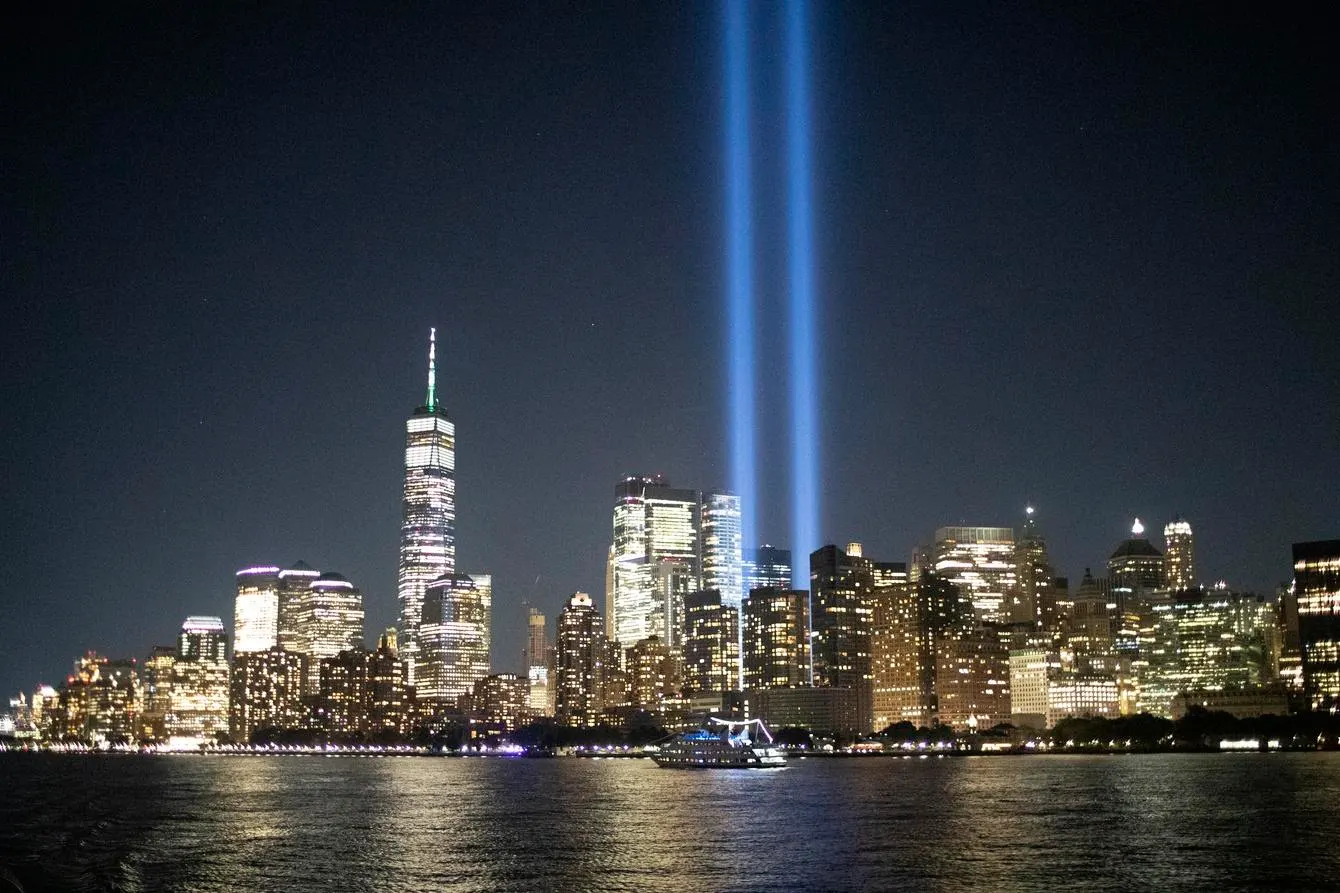

NEW YORK, NEW YORK – SEPTEMBER 10: Testing 9/11 Tribute in Lights are seen from a ship on the Hudson River ahead of the 20th anniversary of the September 11th terrorist attacks on September 10, 2021 in New York City. (Photo by Liao Pan/China News Service via Getty Images)
China News Service via Getty Images
Canada’s public broadcaster, the CBC, has defended its guidance to journalists not to use the word “terror” when writing about the upcoming 25th anniversary of the September 11th attacks that killed nearly 3,000 people–including 26 Canadians. “It is the practice of the CBC to exercise extreme caution before using the words ‘terrorist’ and ‘terrorism,’” CBC Public Affairs Director Kerry Kelly said Thursday, explaining that the network’s preference is for those terms to be used with attribution, or only when a source or interview subject says them.
The network was widely criticized after a Toronto Sun columnist reported that CBC journalists had received a memo advising them “do not refer to the Sept. 11 attacks as terrorist attacks.”
New York City Councilwoman Vickie Paladino accused the network of ignoring the victims of 9/11 and their families, and using language to minimize what happened on that day nearly 25 years ago.
“The CBC guidance is frankly outrageous and insulting, but it stands as a stark warning for what happens when you allow institutions of public trust to be taken over by leftists and foreign interests,” Paladino said.
“This is not merely a callous disregard for the memory of those who perished on 9/11, it is a deliberate effort to undermine the fundamental truth of what happened that day in direct service to Islamism, as Europe, Canada, and the United States become increasingly overwhelmed by Islamist politics.”
394261 05: Smoke pours from the World Trade Center after being hit by two planes September 11, 2001 in New York City. (Photo by Fabina Sbina/ Hugh Zareasky/Getty Images)
Getty Images
If 9/11 wasn’t “terror,” then what was it, according to the CBC? “The hijackings led to passenger jet crashes,” the memo explains, describing the destruction of the World Trade Center in terms few people would use to describe the hijacking of passenger jets and deliberately guiding them into office towers full of people.
But it’s not just the CBC. The Associated Press, which provides editorial guidance not just to its own journalists, but to reporters and editors across the country through its Associated Press Stylebook, says that while terrorism is “the calculated use of violence, especially against civilians, to create terror,” the terms terrorism and terrorist should be avoided.
“(They) have become politicized, and often are applied inconsistently. Because they can be used to label such a wide range of actions and events, and because the debate around them is so intense, detailing what happened is more precise and better serves audiences.”
US newspapers headline 12 September, 2001 the terror attacks on New York and Washington 11 September 2001. A total of four passenger jets were hijacked, with two flying into the World Trade Tower in New York and collapsing them, one flying into the Pentagon and the fourth crashed in a rural area of Pennsylvania. AFP PHOTO (Photo by AFP) (Photo by -/AFP via Getty Images)
AFP via Getty Images
In a political climate where people shot and killed by ICE agents have been called “domestic terrorists” by members of the Trump Administration, and the president has called anti-police demonstrations in Los Angeles and Portland “terrorism,” it’s understandable that using those terms in certain cases might be best avoided.
But when talking about September 11, what shall we call the people who carried out the attacks? “Hijackers” seems to miss the point, and calling the attacks on the Twin Towers and Pentagon “plane crashes” veers closer to journalistic malpractice–unless we’re going to change what a “plane crash” suggests to the average American.
The CBC has been through this before, as its policy on the use of “terror” and “terrorist” isn’t new. After the Hamas attacks on Israel in 2023, the network tried to explain its thinking:
“Attribution of the word ‘terrorist’ has been our policy for decades — mirrored by other news organizations such as the BBC, AP, AFP and Reuters, among many others. Our focus is to report the facts of such atrocities with accuracy, clarity and detail; to convey the scale and scope of violent acts wherever they occur; to quote the people affected, and to convey the views of officials and experts on these events. We bear witness. But CBC News does not itself designate specific groups as terrorists, or specific acts as terrorism, regardless of the region or the events, because these words are so loaded with meaning, politics and emotion that they can end up being impediments to our journalism.”
That’s all fair. But thinking of my days as a television reporter, I can’t imagine standing in front of a camera at the 9/11 Memorial, with the 9/11 families present, and speaking of what happened on that awful day as a pair of plane crashes.













Leave a comment