


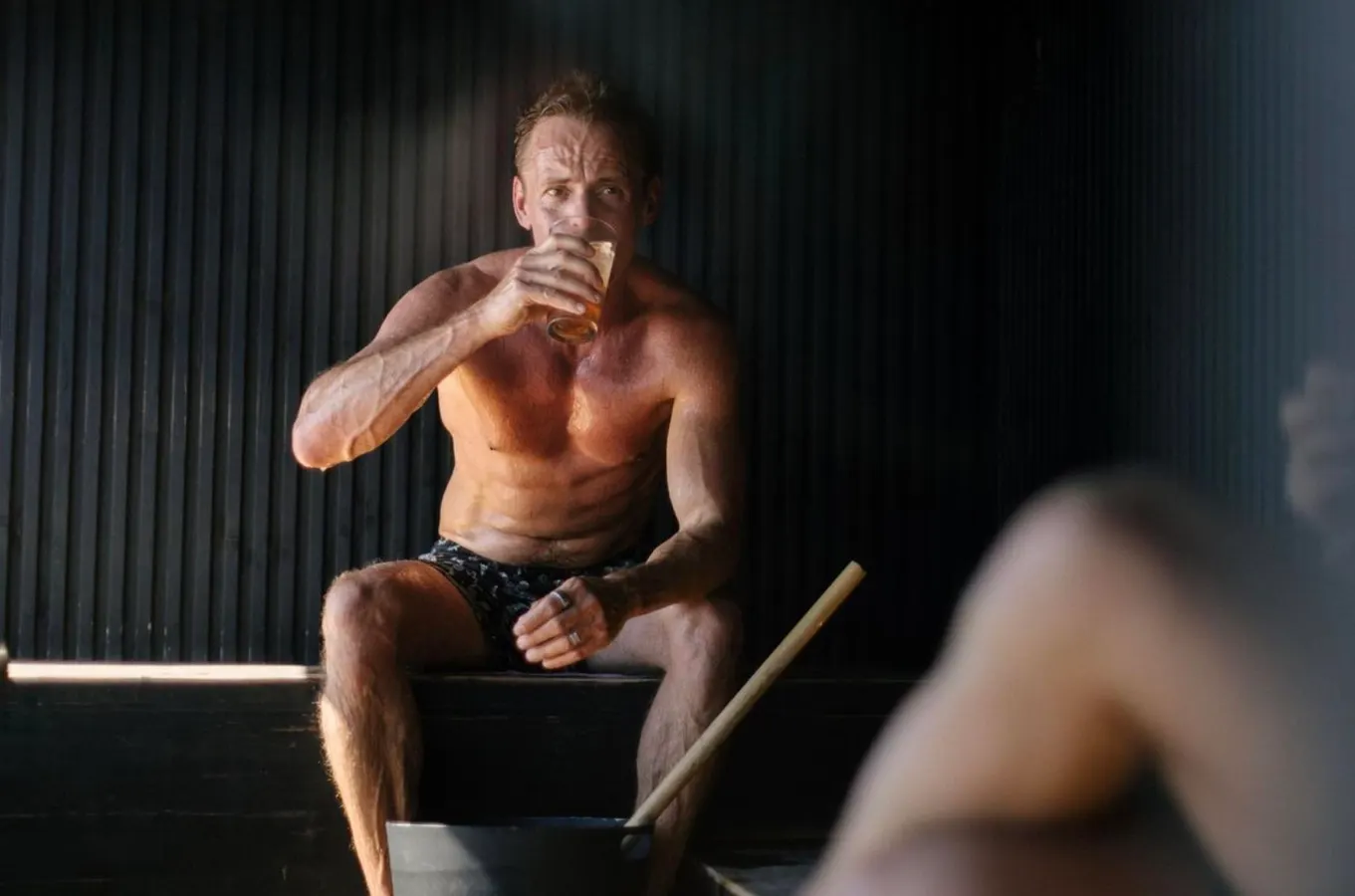

Jasper Pääkkönen enjoys a cold drink in the sauna.
Antti Rastivo
American cinephiles might recognize Jasper Pääkkönen as Halfdan the Black from the hit TV series Vikings. Back in his native Finland, however, the actor is a veritable superstar known not only for his appearances on screen, but for being one of the most influential figures in Nordic hospitality and wellness culture.
A decade ago he co-founded Löyly, a stunningly modern sauna and restaurant-complex set beside the Baltic Sea in the heart of Helsinki. Today it enjoys status as a top tourist destination within the Finnish capital city.
The Finns, for their part, have integrated sauna traditions into daily life for millennia. There you’ll find 3.3 million hotboxes in a nation filled with just 5.5 million total residents. And research shows regular users enjoy myriad health benefits, including 24% lower risk of mortality. It’s a big reason why the country consistently ranks as the happiest on earth.
Though it’s not just about the hot air itself. As Pääkkönen is quick to point out, the sociable nature of the endeavor has a lot to do with the ritual. As does the value of the beverage you hold in your hand while engaging in it.
“Hot skin, cold bottle, steam rising around you, a view of the lake nearby–that sensory contrast gives a Finn incredible peace of mind,” he tells Forbes. “It almost feels like it connects us to something deeper, like an over-generational tradition.”
And now Pääkkönen wants to export that tradition around the globe, beginning here in North America. Earlier this year, he launched AITO–a collection of prefabricated outdoor saunas designed to bring the Finnish experience to the “backyards, lakesides and rooftop spaces” of the US and Canada.
They don’t come cheap. The most modest of the ultra-premium, made-to-order units start at around $34,900. But, it turns out, the drinks ritual that goes along with the experience doesn’t have to cost you more than the price of a six-pack. To learn more about the practice from one of its most notable sources, we sat down with the venerated actor and entrepreneur.
The following interview has been edited for length and clarity.
Enjoying a Finnish Long Drink before entering the sauna
Antti Rastivo
In Finnish tradition, is there a ‘right’ way to prepare your body before entering the sauna and does that extend to what you drink beforehand? Are there drinks that open you up for the experience versus ones that work against it?
Jasper Pääkkönen: “In Finland, sauna is less about strict rules and more about listening to your body. Traditionally, you don’t arrive rushed, overly full, or (too) intoxicated. You ease into it. Hydration matters of course, but the mindset is just as important. Sauna works best when you slow down mentally before stepping inside. Finns often say sauna is a place to quiet both the body and the mind. What’s interesting today is the contrast between Finnish sauna culture and the newer sauna culture emerging in places like the United States. In Finland, people find almost any reason to sauna: to relax after work, spend meaningful time with family, celebrate with friends, recover mentally, or simply unwind at the end of the day. It’s woven into our everyday life. Keep in mind that every Finnish family on average has more than one sauna, so it’s not a question of wealth but an essential part of our lives. In the U.S., sauna culture still feels more connected to either luxury or to wellness trends, biohacking, and health optimization: very structured, very protocol-driven. In Finland, the relationship is usually much more intuitive and social. And what surprises many people outside Finland is that mild alcohol is actually a very common and almost emblematic part of the sauna experience. An ice-cold lager is probably the classic sauna drink, especially in summer. And then there’s another Finnish staple, Long Drink, which has become a real favorite of summer sauna evenings as well. And some people, especially women, opt for a crisp, extra dry apple cider over ice.”
The image of cracking open a cold beer on the sauna bench is iconic, but is there a right beer for the sauna? Light lager, craft ale, something else entirely? And is the cold bottle itself part of the ritual as much as the drink?
JP: “The classic Finnish sauna beer is definitely a cold lager. Crisp, clean, uncomplicated. You don’t really want a heavy imperial stout after a 185 degree sauna. But honestly, the ritual is bigger than the beer itself–it’s the contrast that matters. But to answer the second part, yes, the cold bottle is absolutely part of the experience. You feel the heat, the cool air afterwards, the water, the wood, the drink in your hand. All of it becomes part of the ritual. And then there’s the sauna sausage, another mind blower for people outside of Finland: we tightly wrap sausages in a tin foil package and place it on the sauna’s hot rocks to cook while we sweat it out. A sauna by the lake, a hot sauna sausage and an ice-cold beer. That is as Finnish as anything will ever get.”
For those skipping alcohol, what are the most authentically Finnish non-alcoholic options, beyond just water? Are birch water, herbal teas, or fermented drinks like kvass or sahti part of the tradition?
JP: “Water is the obvious one, you want to stay hydrated in the heat. But beyond water and alcohol, Finland absolutely has non-alcoholic sauna drinks too, a lot of saunaing is obviously done without a drop of alcohol. My personal favorite and something I’ve had as a sauna staple for the past few years is kombucha. It is not traditionally Finnish, but it has found its place here, and I see more and more people getting into it. Homemade berry juices are very Finnish: blackcurrant, lingonberry, blueberry. They are probably closer to everyday life than to a strict sauna tradition, but they fit the environment perfectly. Birch water and herbal teas also exist in the broader Nordic world, but they are not as central in sauna culture as people sometimes assume. Old traditions like sahti are really fading in that context. I can’t remember the last time I heard anyone talk about it in a sauna setting.”
Some sauna purists say you shouldn’t drink anything alcoholic until after you’ve sweated it out. Others sip throughout. Is there a cultural etiquette around this in Finland, or is it entirely personal?
JP: “I’m sometimes a bit amused by the idea of ‘sauna police’ telling people what they should or shouldn’t do. In reality, Finns don’t really operate that way. It’s obvious that getting hammered in the sauna is a terrible idea – yet many Finns do that too. But there is no formal etiquette book. When it comes to an ice cold beer, it just tastes better and complements the sauna experience after the sauna. Before the sauna it’s just a beer. After it’s something much more significant, a part of the ritual. Traditionally, sauna was a place of cleansing and even spiritual significance, so historically it wasn’t really about drinking. But modern Finnish sauna culture is broad. The only etiquette is really about moderation and respect for the sauna, for the people around you, and for your own limits. Good sauna culture is calm and considerate. If drinking starts to overpower the sauna experience itself, most Finns would feel you’re missing the point. Having said that, when the Finnish national ice hockey team wins the world championship, the first thing they do is take the trophy to a sauna and drink tons of champagne out of it, and the whole nation celebrates with drinks in home and public saunas. As a curiosity, there are even popular Finnish radio hits about this phenomenon where a championship trophy is taken straight into the sauna after a big win and celebrated there with champagne as part of a very Finnish way of marking victory.”
Drink and sauna ritual intertwine in the longstanding Finnish tradition that stretches back centuries.
Antti Rastivo
The afterglow of a good sauna is one of life’s great feelings. What’s the ultimate post-sauna drink in your opinion, the one that perfectly seals the experience? And does it change depending on the season?
JP: “After a proper sauna, your body is craving liquid, so almost any drink tastes better. My absolute personal favorite is cold kombucha in a big glass pint with lots of ice. In summer, it’s hard to beat an ice-cold lager by the lake at sunset. Your senses become incredibly sharp after alternating heat and cold. The perfect Finnish postcard moment is sitting outside a lakeside sauna in silence with a cold drink in your hand, steam still rising from your skin, breathing fresh air.”
Sauna in Finland seems to be a whole event, not just a quick sweat. How does drinking weave into the broader sauna evening, the food, the conversation, the cooling off? Is there a loose ‘menu’ that Finns naturally gravitate toward?
JP: “Absolutely. In Finland, sauna is often an entire evening rhythm. You heat up, cool down, sit outside, maybe swim, maybe talk, maybe sit quietly. Then back into the sauna again. Drinks and food – no other food than the sauna sausage, as real dinner is always had post-sauna – naturally weave through those cycles. Conversation changes too. Sauna has a way of slowing people down and bringing out the truth. In Finland, some of the most sincere and open conversations happen inside and between sauna sessions, when everyone is relaxed and stripped of egos, titles and status. That’s one reason sauna remains so important for Finns culturally, and why I think it’s gaining incredible popularity in big cities around the US. It creates a rare environment where people are genuinely present and can’t really hide behind a mask.”
In all your travels and sauna experiences building Aito Sauna, what’s the most unexpected or unconventional drink someone has introduced you to in the sauna context and did it actually work?
JP: “I’ve seen everything from electrolyte drinks to vodka shots, mushroom elixirs to champagne, but I was recently served young pine cones marinated in honey, then mixed with hot water as a sort of tea. That was a first for me. The best sauna experiences usually aren’t about luxury or novelty. They’re about good heat, good company, clean water, and being fully present in the moment.”
A pre-fabricated Aito Sauna box sits underneath the Williamsburg Bridge in Brooklyn, New York.
Antti Rastivo
















Leave a comment