


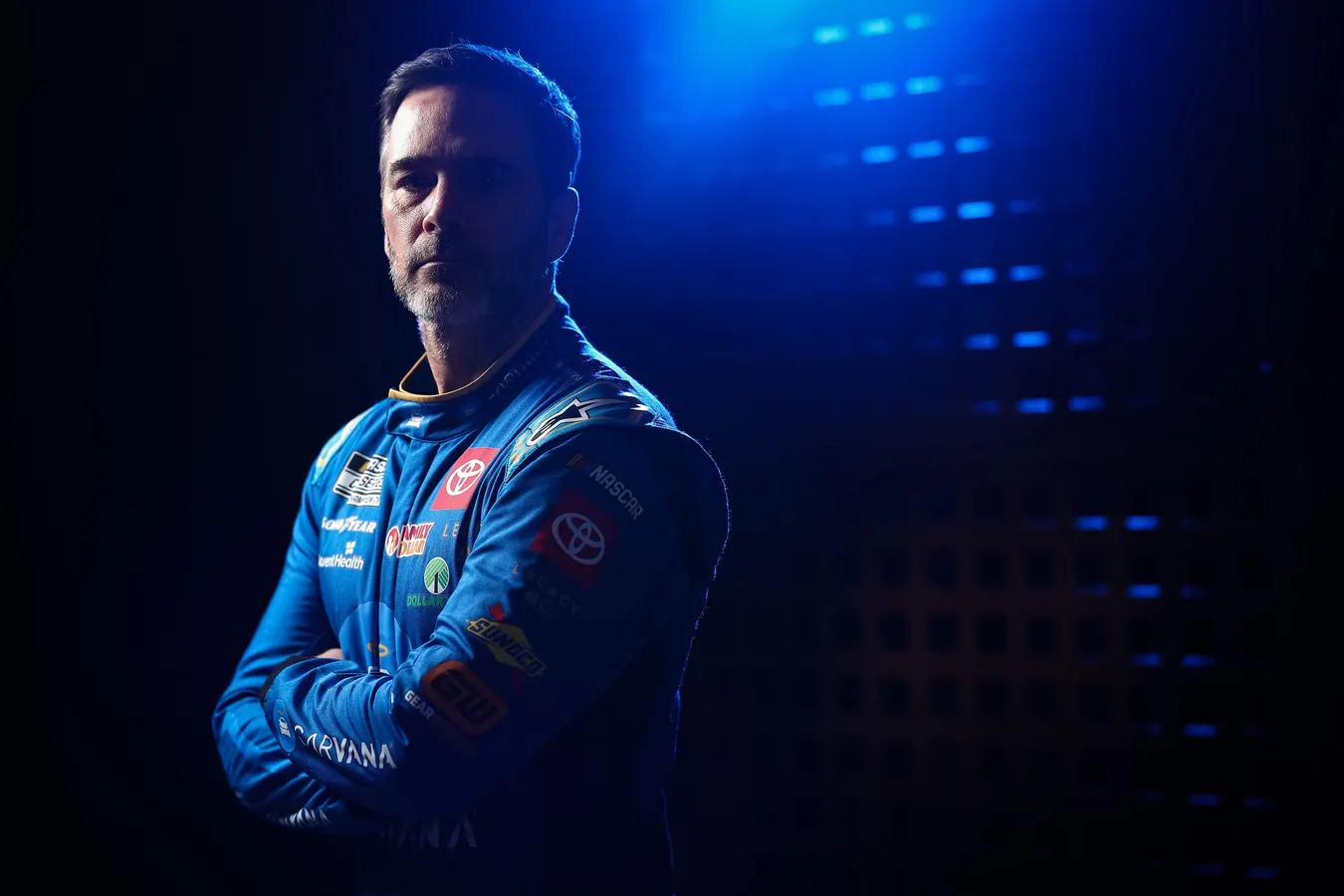

CHARLOTTE, NORTH CAROLINA – JANUARY 18: NASCAR driver Jimmie Johnson poses for a photo during the 2024 NASCAR Production Days at Charlotte Convention Center on January 18, 2024 in Charlotte, North Carolina. (Photo by Jared C. Tilton/Getty Images)
Getty Images
There can be little argument that Jimmie Johnson made an impression on NASCAR. Arriving in the sport as a young 20-something from California in the late 1990s, by the early 2000s he was the driver everyone else was chasing. And they would be chasing him for a very long time.
Johnson became one of just three drivers to win seven NASCAR Cup Series championships, joining Richard Petty and Dale Earnhardt in a club that has yet to admit another member. Along the way, he collected 83 career victories. He defined an entire era of NASCAR, a GOAT by any definition.
When he stepped away from full-time Cup racing at the end of 2020, he stood sixth on the all-time wins list. In 2024, he added another distinction to an already crowded trophy cabinet when he was inducted into the NASCAR Hall of Fame.
Johnson could have walked away at the end of 2020 having accomplished just about everything a driver could reasonably hope to accomplish. He could simply have rode off into a California sunset, enjoyed his accomplishments and spent the rest of his days explaining to people at dinner parties what it feels like to win seven championships.
But he didn’t. Instead, he is still making an impression on the sport and defining a new era. This time as a team owner and entrepreneur.
He’s also found another way to compete.
Today, Johnson is trying to change how a NASCAR organization operates. He wants to build a motorsports lifestyle brand, one that stretches beyond the familiar NASCAR audience and into the wider worlds of sports, entertainment and business.
And he’s assembled an ownership group that looks less like a traditional racing organization and more like the guest list for an unusually competitive Hollywood party.
A Different Kind of Team Ownership
Johnson acquired an ownership stake in an existing organization in 2022, joining a team that included fellow seven-time Cup champion Richard Petty. In 2023, the organization became Legacy Motor Club, a name that now seems particularly appropriate given Johnson’s latest business strategy.
The team plans to expand to three full-time Cup Series entries in 2027. But the operation is building something beyond its on-track program, bringing together a strategic ownership group that includes IndyCar champions Scott Dixon and Dario Franchitti, baseball star Bryce Harper, former tennis world No. 1 Andy Roddick, surfing champion Kelly Slater, celebrity chef Guy Fieri and musician Darius Rucker, among others.
And while it’s a list that reads like a red carpet on a night at the ESPYs, along with someone to feed everyone when it’s over all while being serenaded, it’s a collection of names with very different careers, audiences and areas of expertise. The common thread, Johnson says, is a willingness to build something and a competitive streak that doesn’t necessarily disappear when the playing career ends.
LAS VEGAS, NV – DECEMBER 01: Host Guy Fieri hands NASCAR Sprint Cup Champion Jimmie Johnson a bottle of Patron Silver Tequila during the NASCAR Sprint Cup Trophy during NASCAR After The Lap at The Pearl concert theater at Palms Casino Resort on December 1, 2016 in Las Vegas, Nevada. (Photo by Jonathan Ferrey/NASCAR via Getty Images)
NASCAR via Getty Images
“I really want to build a motorsports lifestyle brand,” Johnson says. “And I know that’s a vague term and maybe an overused term with a lifestyle brand, but we’re very focused on building a legacy brand as well as building that brand within motorsports as well as outside of.”
That distinction matters. Johnson isn’t simply assembling a group of famous people to add some sparkle to the team hospitality suite (an upgraded version of that is something he pioneered by the way). He wants to create a business with a wider cultural footprint, using the relationships and commercial reach of the ownership group to strengthen the racing operation.
“Everyone in the investment group are builders, are champions, are extreme competitors, and on top of that, friends,” he says.
The group also represents people at different stages of their careers. Some remain firmly in the competitive arena, while others are contemplating what comes next. For Johnson, that creates an opportunity to bring together people who understand competition but have different perspectives on business, entertainment and the next phase of their professional lives.
“Where they all are on their journey in life, some are retired, some thinking about the chapter two thing, some still in the game,” Johnson says. “There’s just a lot of great synergy around building the legacy brand all to service our NASCAR program, all to follow our commitment to becoming an elite team within NASCAR.”
Turning Celebrity Into Commercial Value
The idea of sports teams building a brand beyond the playing field isn’t new. Professional leagues have spent years developing hospitality programs, premium experiences and entertainment offerings that give fans more reasons to engage with their favorite teams. Johnson believes NASCAR has room to do more, particularly at the team level.
“For our sport to become a lifestyle brand, hospitality and experiential,” Johnson says. “If you look at stick and ball sports, they all have that element. In the world of motorsports, specifically in North America, there isn’t a team out there doing it. I think McLaren does an incredible job internationally and that’s starting to show up more in their IndyCar program.”
NASHVILLE, TN – MAY 31: Darius Rucker walks in the garage area prior to the running of the NASCAR Cup Series Cracker Barrel 400 on May 31, 2026 at Nashville Superspeedway in Lebanon, TN. (Photo by Jeff Robinson/Icon Sportswire via Getty Images)
Icon Sportswire via Getty Images
Fieri, for example, brings considerable experience in food, hospitality and entertainment. Harper brings the perspective of an active professional athlete who has spent years competing at the highest level while thinking about what life might look like after baseball.
“He’s an individual that doesn’t know when that last at bat’s gonna come,” Johnson says. “There’s less runaway than there’s been in the past, right? So what is his chapter two? He’s one of those chapter two guys. Like, what do I do next? I want to stay competitive. He loves motorsports. He’s come to multiple races with me. We have a great friendship. So there was that intriguing interest that we might not have a specific need now, but down the road, I really feel like he’s going to show up for us.”
The trick is turning all those individual brands into something that works collectively. A baseball star, a musician and a celebrity chef each have their own businesses, commitments and audiences. Getting them all to pull in the same direction requires more than putting their names on a piece of paper.
Johnson acknowledges that the process will take time, and he isn’t expecting everyone to drop their day jobs and report to the race shop on Monday morning.
“Over time, there will definitely be asks,” he says. “The phase in where we sit is Legacy Motor Club, our growth pattern and literally what we can digest and manage, we just need to be measured.”
The immediate priority is building the organization itself. Legacy has raised capital with participation from its ownership group, and Johnson says a second phase of fundraising is underway. The money is intended to help provide the infrastructure and resources necessary to compete with established organizations such as Hendrick Motorsports, Team Penske and Joe Gibbs Racing.
In other words, the celebrity connections might get people talking about Legacy, but Johnson wants the resulting business to pay for something considerably more useful than a few extra headlines.
The North Star Is Still Winning
Johnson says the ownership group has already delivered a tangible commercial benefit. The announcement generated earned media beyond the NASCAR audience at a time when Legacy was negotiating renewals with several partners. That broader exposure helped the team make its case at the negotiating table.
“Our announcement with the strategic ownership group and the earned media it brought us was in a renewal cycle with a few of our partners,” Johnson says. “And us being able to show the earned media that came with these names and how we transcended the NASCAR bubble and ended up in all these other media outlets, helped at the negotiation table already.”
It’s a useful early example of the strategy at work. Sponsors want exposure, and an organization that can reach audiences beyond the racetrack has another selling point when it comes time to negotiate a deal.
But Johnson insists that the immediate publicity isn’t the reason he has brought these people into the business. He has given up a portion of his ownership to make room for investors and partners he believes can help build the organization over the long term.
“We knew that would come,” he says. “It’s really about the long-term journey and the long-term value they can bring for the brand that then gives us the firepower for faster race cars, that dry powder, the gunpowder to go racing.”
AVONDALE, ARIZONA – NOVEMBER 04: Former NASCAR driver, Jimmie Johnson (C) speaks to the media announcing he has invested in an ownership stake in the Petty GMS Motorsports as team owners Richard Petty (L) and Maury Gallagher (R) look on during a press conference at Phoenix Raceway on November 04, 2022 in Avondale, Arizona. (Photo by Chris Graythen/Getty Images)
Getty Images
That last part is important. For all the talk of lifestyle brands and cultural relevance, Legacy remains a NASCAR team. It needs to qualify, compete, win races and eventually contend for championships. A famous name on the ownership roster won’t help much if the cars spend Sunday afternoon running at the back of the field.
Johnson’s own experience as a driver has given him a close look at the business challenges facing team owners. He has seen how expensive it is to maintain a competitive operation, with large workforces and assets that traditionally depreciate over time. The charter system, he says, has changed that equation by giving teams a more permanent place in the sport and creating valuable franchises.
“Timing is always everything,” Johnson says. “And it appears so far, my timing and interest in being a car owner, I came in at the right time. And I think charter values are so high right now, there’s no chance I could have gotten in in 26. I mean, 23 was my window. And the opportunity with Maury Gallagher was the moment. So, timing plays a big role in it all as well.”
He also sees a changing relationship between sports and entertainment, one that creates opportunities for teams willing to think beyond the traditional racing business model. Johnson points to the additional business interests associated with established organizations such as Hendrick Motorsports and Team Penske, which can draw on resources beyond their racing operations.
Legacy is trying to develop its own approach, with a strategic ownership group that can help expand the business and create additional opportunities to fund competition. The plan is still taking shape, and Johnson says more names will be announced as the organization moves through the offseason and into 2027.
NORTH WILKESBORO, NORTH CAROLINA – JULY 18: NASCAR Hall of Famer Jimmie Johnson, co-owner of Legacy Motor Clublooks on during practice for the NASCAR Cup Series Window World 450 at North Wilkesboro Speedway on July 18, 2026 in North Wilkesboro, North Carolina. (Photo by David Jensen/Getty Images)
Getty Images
“We’re going to do things the right way, not right now,” he says. “And their involvement, their participation, all these elements will really start to come together for the Homestead race, the finale. And then through the offseason into next season, more of the plan will become public and easier for people to process.”
Johnson adds that there are still other investors to be announced, including people with significant business experience who can help the organization grow.
For now, he is determined to keep the various pieces focused on the same objective. The ownership group, the brand-building efforts and the commercial strategy all have a purpose, but none takes precedence over competition.
“First and foremost, every sponsor, every employee, every investor has committed to our path And that is chasing the North Star. That is the top priority. Winning races, winning championships. The other elements are part of the ecosystem.”
Johnson believes NASCAR is entering a period in which the traditional boundaries between sports and entertainment are becoming less distinct. His aim is to take advantage of that shift without losing sight of what happens when the green flag drops.
“We’re in 2026, the world’s changing, sports and entertainment have now combined where sports and entertainment are in the same sentence,” he says. “I feel that I’m bringing a more modern sports approach to generate revenue, to serve our core product, to win championships, to be that elite team. That really is objective #1. And this is all in service of that.”
Johnson spent much of his driving career proving he could beat just about anyone who lined up beside him. Now he’s trying to build an organization capable of doing the same, with a rather unusual collection of people helping him along the way.
The celebrity names may attract attention, the business relationships may open doors, and the commercial strategy may provide additional resources. But in NASCAR, all that matters in the end is what the car does on Sunday.
Jimmie Johnson knows that better than most. And he has no intention of settling for anything less than winning.









Leave a comment