


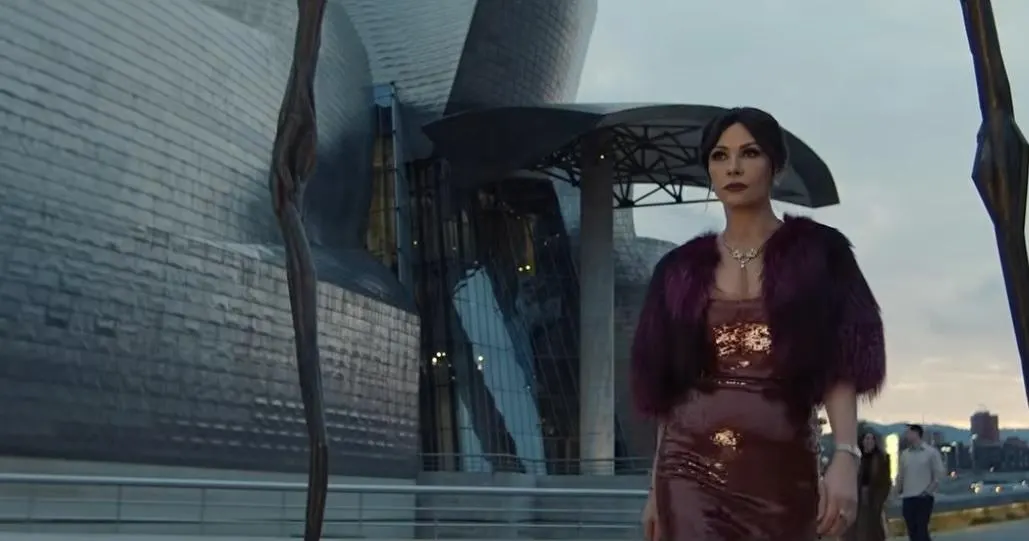

An image from the AMC+ series “Kill Jackie”
Sky, 2026
There is a moment in Kill Jackie when Catherine Zeta-Jones, playing a fabulously wealthy art dealer and former cocaine kingpin who is apparently so bored with life that she has begun treating international assassination as a kind of recreational enrichment course, explains that the problem with magic tricks is that eventually they stop being magic.
This is a pretty good description of the show.
Only Kill Jackie has an additional problem: it never manages to make anything magical in the first place.
The premise is magnificent in the way a junkyard is magnificent after three bottles of bad tequila. Jackie Price has spent twenty years turning the global art market into her personal money fountain, exploiting freeports and tax loopholes while acquiring paintings for people whose bank accounts have more commas than their consciences. Before that, she was some kind of criminal superdealer, moving cocaine with the serene efficiency of a woman arranging flowers.
Now she’s bored.
Then someone hires the Seven Demons, a legendary squad of professional killers, to murder her.
And Jackie, rather than doing what any normal human being might do in such a situation — panic, flee, call somebody, reconsider her life choices — decides to kill the assassins first.
Beautiful! Stupid! Potentially glorious!
This could have been a ferocious little cocktail of Killing Eve, John Wick, European crime caper and old-fashioned pulp delirium. Instead, it is eight hours of expensive-looking people standing around waiting for the plot to remember why they are there.
The show has guns. It has knives. It has cars. It has parkour. It has ear-biting. It has a vegetable peeler deployed as an instrument of death, which is exactly the sort of detail that makes you think, briefly, that perhaps somebody involved has the right idea. There are assassins in outrageous clothes, mysterious organizations, sadistic threats, sexual propositions involving medically induced multiple orgasms, talk of cannibalism, liquid nitrogen and testicle-eating.
And yet somehow the whole thing feels less dangerous than an airport lounge.
This is the great achievement of Kill Jackie: it has constructed a world in which virtually anything can happen and has made everything feel like paperwork.
Jackie travels across northern Spain — Bilbao, the Pyrenees, those gorgeous European landscapes that television producers normally point at and say, “Great, don’t ruin that” — while various killers try to murder her in increasingly elaborate ways. But the geography never becomes adventure. The scenery sits there looking expensive and vaguely embarrassed to be involved.
The Seven Demons ought to be terrifying. Instead they resemble a collection of Halloween costumes purchased by people who became bored halfway through October. Here’s The Cuban, all snakeskin boots and menace. Here’s Li Dong, a hipster parkour assassin who seems to have wandered in from a different, considerably more entertaining show. Here’s The Doc, dressed like a dominatrix who has recently been hired to redesign the Thom Browne catalog.
These people have names, costumes and signature methods. What they don’t have is souls.
And then there’s Jackie herself, which brings us to Catherine Zeta-Jones.
Zeta-Jones is an actress who has spent enough time on screen that she ought to be able to sell almost anything. Give her a glass of champagne, a machine gun, a stolen Picasso or a man tied to a radiator and you’d expect at least a little electricity.
Here, however, she spends much of the series looking as though someone has just explained to her that the restaurant is out of her preferred dessert.
Jackie is supposed to be cool. Instead, she is anesthetized.
The character’s emotional range appears to consist of mild surprise, mild disappointment and mild amusement, all delivered from behind an invisible sheet of glass. Her Welsh accent is lovely — genuinely lovely — and there is something perversely satisfying about hearing Zeta-Jones finally sound like herself. But the dialogue keeps throwing bricks at her.
“Do you know what’s really sexy,” Jackie asks at one point, “I’m talking weak at the knees, take-me-against-the-bread-bin sexy? Export taxes.”
This is not dialogue. This is a cry for help.
The show keeps insisting that Jackie is an extraordinary woman. It tells us she is brilliant. It tells us she is dangerous. It tells us she has contacts everywhere, knows how to obtain anything, has survived impossible situations and can outthink the most lethal people on the planet.
Then it introduces Poltergeist.
Poltergeist is an Icelandic shadow organization that apparently handles everything Jackie needs. Money? Poltergeist. Weapons? Poltergeist. Impossible intelligence? Poltergeist. Exotic gadget? Poltergeist. Target that cannot possibly be found? Don’t worry, some Icelandic cyber-wizard has already put it in a briefcase.
After a while you begin to wonder whether Jackie is actually an international criminal mastermind or simply the world’s most glamorous customer-service representative.
“Hi, yes, I’m being hunted by seven legendary assassins.”
“Certainly, Ms. Price. Would you like the black briefcase or the silver one?”
This is the fatal problem with the supposed badassery of Kill Jackie: the show repeatedly tells us about competence instead of dramatizing it. Jackie doesn’t so much solve problems as receive solutions.
And whenever the machinery threatens to grind to a halt, someone shoots somebody.
Bang.
Car chase.
Bang.
Fistfight.
Someone bites an ear.
Bang.
Jackie looks mildly surprised.
Another voice-over.
This becomes the rhythm of the series, and eventually you realize the action sequences aren’t accelerating the story. They’re plugging holes in it.
The creators seem to know that a thriller requires momentum but have confused momentum with noise. Kill Jackie is very noisy. It is not especially fast.
There are moments when another show seems to be trying to escape from inside it. Daniel Ings, playing Sam, a tax lawyer who has apparently made the catastrophic professional decision of becoming involved with Jackie, is the poor bastard who finds that show. He sweats. He panics. He rants. He looks around at the lunacy and reacts as though he has accidentally walked into a hostage situation at a particularly deranged dinner party.
Every time Ings appears, the pulse returns.
Óscar Jaenada gives Jackie an ally with some actual gravity, while Christine Adams gets a few flashes of dry humor beneath all the latex-and-tailoring assassin nonsense. Hattie Hook and Darci Shaw provide younger characters who seem intended to reveal the vulnerable human being underneath Jackie’s titanium shell.
But the relationships never have time to become relationships. They are narrative furniture.
The show wants us to care that Jackie might lose these people, just as it wants us to care about her past, her loneliness, her boredom, her complicated romantic entanglements and her gradual discovery that perhaps life means something after all.
Fine.
But first give me a reason to care about Jackie.
This is where the series’ fundamental misunderstanding of pulp becomes apparent. Pulp does not require plausibility. It requires conviction.
You can give me a secret society of assassins wearing designer clothes. You can have a woman murder three men with a kitchen appliance. You can tell me the heroine once ran the greatest cocaine operation in Europe and now sells paintings to billionaires in tax-free warehouses.
I will believe all of it.
But you have to believe it first.
Kill Jackie doesn’t.
It keeps winking at the audience while asking us to take its mythology seriously. It wants the glamour of John Wick, the erotic danger of Killing Eve, the screwball velocity of a Guy Ritchie picture and the emotional architecture of a prestige drama. What it gets is a sort of streaming-service paste made from the leftovers of all four.
There is nothing wrong with ridiculous television. Ridiculous television can be transcendent. Give me ridiculous television! Give me lunatics! Give me assassins with pet names and bizarre fetishes! Give me a woman in a couture gown firing a machine gun through an oil painting while a tax attorney screams about his deductible expenses!
But give me something.
Kill Jackie has everything except juice.
It is a show about people who supposedly live at maximum intensity, behaving as though they are waiting for their coffee order.
Jackie is bored.
The audience is bored.
The assassins, presumably, are bored.
And somewhere in the distance the ghosts of a dozen better action thrillers are standing around smoking cigarettes and wondering who let this happen.
The strangest thing is that the ingredients are still lying everywhere, tantalizingly intact. Catherine Zeta-Jones with her Welsh accent. Northern Spain. Art-world money games. International assassins. Former criminals. Beautiful cars. Horrible murders. Sexy people in expensive clothes. A neurotic tax lawyer. Secret organizations.
That’s not a bad shopping list.
It’s just a terrible meal.
By the end, Kill Jackie has become the cinematic equivalent of somebody shouting “THIS IS CRAZY!” for eight hours without ever doing anything particularly crazy.
The magic trick isn’t broken.
There was just never anything inside the hat.
::













Leave a comment