


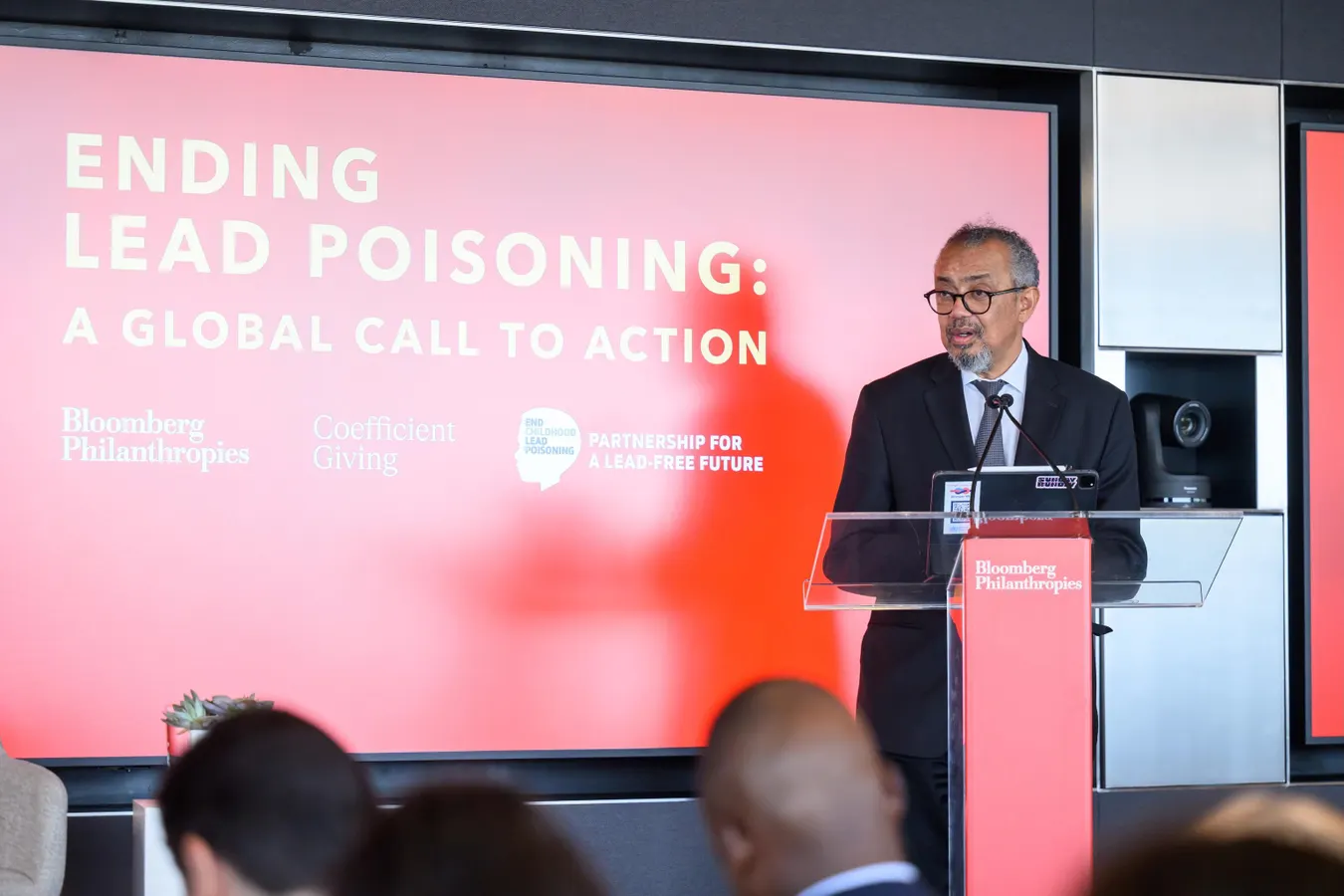

At the “Ending Lead Poisoning: A Global Call to Action” meeting, Tedros Adhanom Ghebreyesus, PhD, the World Health Organizations’s Director-General, said the following about lead poisoning: “The burden is enormous. Lead exposure is associated with more than 3.5 million deaths every year.” (Photo: Courtesy of Bloomberg Philanthropies)
Courtesy of Bloomberg Philanthropies
It’s time to get the lead out—when it comes to getting lead out of people’s stomachs and blood around the world. That was the very heavy metal message from the recent “Ending Lead Poisoning: A Global Call to Action” meeting during the United Nations General Assembly week in New York City.
Lead Poisoning Is A Continuing Global Problem
Bloomberg Philanthropies, Coefficient Giving and the Partnership for a Lead-Free Future convened the meeting to address the fact that an estimated one billion children today have elevated lead levels in their blood. A report from the Partnership revealed that such elevated levels are present in one out of every two children in many low and middle income countries, leaded to estimated 12 percent loss in lifetime income and resulting in an estimated $1.4 trillion estimated economic cost.
And a study published in the scientific journal PNAS in 2022 found that half the U.S. population were exposed to harmful levels of lead as children. That amounted to over 170 million Americans alive today and around 824,097,690 IQ points lost as of 2015. Think about that the next time you are talking to anyone.
“There is no known safe level of exposure to lead,” Tedros Adhanom Ghebreyesus, PhD, the World Health Organizations’s Director-General, remarked at the meeting. “For young children, the consequences can last a lifetime. Lead can permanently damage the developing brain, affecting a child’s ability to learn, to thrive, and to reach their full potential.” He added, “The burden is enormous. Lead exposure is associated with more than 3.5 million deaths every year.”
Here’s a video of the event:
You could say that health officials aren’t just kidding, though, when it comes the risks of lead exposure. Even though fetuses, infants and young children are at greater risk for lead poisoning due to their absorbing lead more readily and having more rapidly developing brains and bodies, it’s not as if adults are in the clear. Lead can affect the brains of adults too as well as their cardiovascular systems.
Many Products Can Have Lead In Them
Now, lead is a heavy metal that is naturally present in the Earth’s crust but only in small amounts. So, assuming that you are not munching on large amounts of the Earth’s crust each day, the natural environment isn’t the issue here. Instead, it’s the many human-made things around us that still have lead in them.
One of these things is lead-based paint. Such paint used to be quite common in the U.S. However, in 1978, regulations begin banning its use for residential locations at least. Don’t let that paint a picture of safety, though, since many locations such as industrial buildings may still have lead-based paint. And disruption of such paint can lead to lead dust that can be inhaled and contaminate things that may go into your mouth.
Speaking of things that go into your mouth, various food and spices can have lead in them. This includes stuff like chili, tamarind, turmeric and paprika. Cans containing food may be sealed with lead solder as well. And if you are taking some kind of supplement or remedy that doesn’t regularly undergo U.S. Food and Drug Administration regulated inspection, guess what might be hiding in there.
And it’s important to face the facts that cosmetics and other things that you put on your face could have lead in them when they come from unregulated sources. The same applies to other types of consumer goods like ceramic, pottery, glassware, jewelry and toys, which isn’t good. Lead can also be present in batteries and ammunition. Of course, you never want to mistake these last two things for each other.
Finally, the chemistry symbol for lead—Pb—can be a reminder that lead is present in many older plumbing materials. This includes pipes, faucets and soder used before 1986. Such lead can then leech into drinking water. This is what happened in Flint, Michigan, as I covered before in Forbes. Pb can also be a reminder that pollution in general is a problem. Lead can be one of the toxic materials in air pollution too.
There Are Solutions To The Global Lead Poisoning Problem
At the “Ending Lead Poisoning: A Global Call to Action” meeting, Mike Bloomberg, the founder of Bloomberg, L.P. and Bloomberg Philanthropies and the WHO Global Ambassador for Noncommunicable Diseases and Injuries, urged for more testing for lead and tracking of the lead problem, stating “If you can’t measure it you can’t manage it.”(Photo: Courtesy of Bloomberg Philanthropies)
Courtesy of Bloomberg Philanthropies
All of this may sound quite heavy, but there is good news. “This is a tragedy we can prevent,” the WHO Director General emphasized. “That is why WHO is developing a Global Action Plan and a Technical Package called PREVENT, both of which will be presented at next year’s World Health Assembly.”
Mike Bloomberg, the founder of Bloomberg, L.P. and Bloomberg Philanthropies and the WHO Global Ambassador for Noncommunicable Diseases and Injuries, concurred at the meeting, saying, “We know what works.” He talked about “strengthening lead painting laws” and seeing “Encouraging signs across Africa” and the finding that the “number of children testing positive [for lead exposure] fell by two-thirds.” He did urge for more testing and tracking of the lead problem, stating “If you can’t measure it you can’t manage it.”
The Bloomberg Philanthropies Lead Poisoning Prevention Initiative has been working with various partners to prevent lead poisoning across multiple continents via the following three core strategies: “passing and enforcing policies to strengthen regulation, identifying and removing lead sources and improving blood lead testing and data collection.” Kelly Henning, MD, who has led the Bloomberg Philanthropies Public Health program since its inception in 2007, did indicate that one obstacle is “prioritizing lead poisoning, It has not received much recognition. Governments need to recognize it.”
She mentioned to me how the initiative is “helping governments set up lead surveillance programs and identifying source of lead such as battery recycling, spices, cosmetics and ceramics.” Of course, once these sources are identified, as Henning emphasized, they need to be addressed and mitigated. She mentioned progress being made across these fronts such as the government of Rwanda doing “surveys of blood lead levels and using data to increase awareness” and the work of a partner organization—LEEP for Lead Exposure Elimination Project—a non-profit with the goal of eliminating the sale of lead paint across sub saharan Africa.
Before you think that such change will go over like a lead balloon with industry, think again. Adalberto Maluf, MSc, the national secretary for urban environment, water resources and environmental quality for Brazil, told me, “There are alternatives that industry has identified. Industry is willing. Very often suppliers of the items are unaware that they have lead.”
So, it will help to get lead poisoning on the minds of more people around the world. That will in turn help keep lead out of everyone’s minds. And their cardiovascular systems too.














Leave a comment