


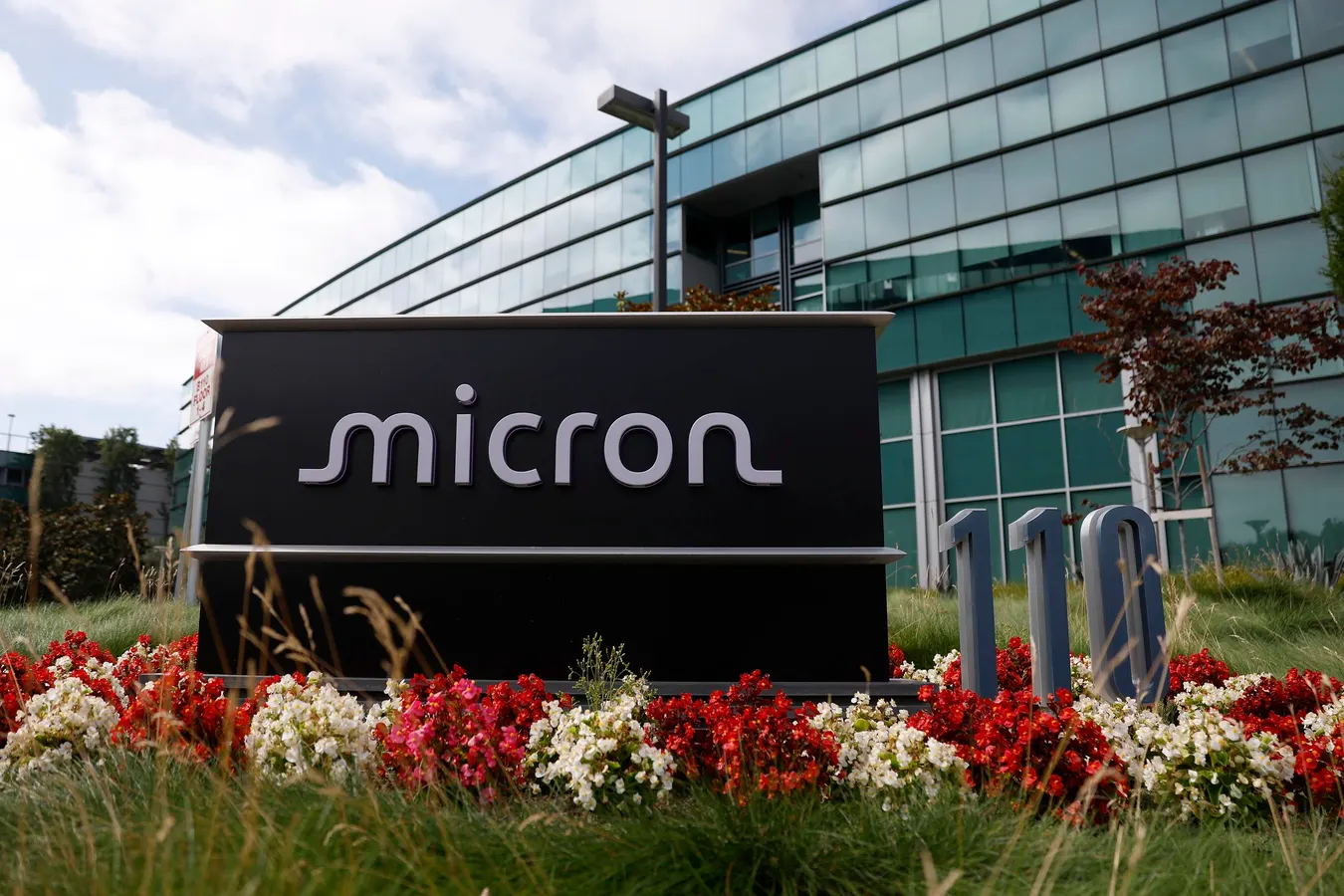

The Micron Technology logo at their headquarters on June 25, 2025 in San Jose, California. Key risks investors should watch for in Micron stock include cyclicality and capital intensity. (Photo by Justin Sullivan/Getty Images)
Getty Images
Micron Technology stock has been on a roll. Shares of the memory chip maker soared 245% in 2025 and as of Sept. 21, it’s up over 260% thus far in 2026. Those returns are much better than the S&P 500 which has produced a 12.7% total return this year and the Nasdaq which is up 16%.
Despite concerns about the cyclicality of the semiconductor industry, experts see more upside ahead. The reason for optimism is the flow of capital into building AI data centers which need more of the memory chips Micron makes – leaving room for price increases that have boosted the company’s results ahead of expectations.
The biggest risk experts cite is the industry’s history of ups and downs. Due to the success of the stock over the last two years, investors’ expectations are very high and any result that falls short of those expectations could send the stock down. The stock’s low valuation could reflect the market’s expectation of disappointment ahead.
Micron Valuation
The valuation of Micron shares is low compared to the industry. On trailing twelve-month earnings, Micron trades at 22.9 times and on forward earnings of $155 a share, the forward P/E is a very inexpensive 6.9x. Large semiconductor stocks trade at a forward P/E of 37.29x.
The only compelling reason not to view this low valuation as a buying opportunity is that memory stocks are always cheapest at the peak. For example, Micron’s forward P/E fell to about 4.5x in May 2018, following which the company’s shares fell about 50% over the following seven months. But history does not always repeat itself.
Current Snapshot Of Micron Technology (MU) Stock
Here is an overview of the current state of Micron Technology Inc. (MU) stock as of the morning of Sept. 21 from Stock Analysis:
- Current Price: $1,041.20
- Market Capitalization: $1.17 trillion
- Price-to-Earnings (P/E) Ratio: 23.54
- Earnings Per Share (EPS): $44.17
- 52-Week Range: $154.65 – $1,255.00
- Dividend Yield: 0.057%
Micron’s rapid increase in value has propelled its market capitalization above $1 trillion – yet its valuation is reasonable. This suggests that if the company can sustain its rapid revenue and earnings growth at a level above investor expectations, the shares could keep rising. However, if the company does not beat expectations and raise guidance each quarter, the shares could fall.
What Drove Micron Stock’s Rally This Year?
The rally this year has been driven by three forces:
- Solid share of high-bandwidth memory. Micron has 24% of this fast-growing market which yields higher margins. HBM’s revenue is forecast to roughly double to $62 billion in 2026. HBM matters because it is priced and contracted like a specialty component with higher margins.
- Memory price increases. DRAM pricing has increased – although the rate of price increases is slowing. Specifically, DRAM prices increased between 93% and 98% in Q1 2026, about 58% and 63% in Q2, with prices expected to rise between 13% and 18% in Q3.
- Strong financial results. The company posted strong growth profitability and a large backlog. Revenue rose 346% to $41.46 billion with non-GAAP gross margin of 84.9%, up from 39% a year earlier and free cash flow hit a record $18.3 billion. Micron has signed 16 customer agreements representing roughly $100 billion of minimum contracted revenue through 2030.
Where Experts Believe Micron Stock Is Heading Next
Experts are bullish on MU stock. Based on 30 Wall Street analysts offering 12 month price targets for Micron in the last 3 months. The average price target is $1,564.44 – representing 50% upside – with a high forecast of $2,200 and a low forecast of $1,100, according to TipRanks.
Wall Street Price Target Consensus And Upside Potential
The consensus rating is a Buy, with an average twelve-month price target clustering between roughly $1,300 and $1,560 depending on the aggregator, and a full range spanning about $361 to $2,200 across some 49 analysts. Recent targets, include Morgan Stanley at $1,200, Raymond James at $1,500 and Susquehanna at $2,000, noted MarketBeat. Goldman Sachs has been the notable cautious outlier, warning that memory remains cyclical.
The Bull Case For Micron Stock
Bulls argue AI infrastructure demand will be more significant and last longer than consumer-electronics restocking. DRAM is a disciplined three-player oligopoly. Long-term take-or-pay agreements — backed by roughly $22 billion of customer financial commitments — give Micron visibility no prior cycle offered.
Management expects tight conditions to persist beyond calendar 2027. And beginning Dec. 9, when CHIPS Act repurchase restrictions lapse, Micron intends to return essentially all excess cash to shareholders, primarily through buybacks. UBS has projected the company could retire roughly 40% of its shares on cumulative free cash flow through 2028.
The Bear Case For Micron Stock
Bears argue peak earnings have historically coincided with peak multiple compression. Micron itself noted “a meaningful moderation in the rate of price increases” in its fiscal Q4 outlook. The stock’s own behavior also suggests risks could loom. Micron has beaten estimates for eight straight quarters, yet its average one-week post-earnings move is roughly −3.4%, and shares fell about 32% in the month following June’s strong report.
Key Risks to Watch Before Buying Micron Stock
The risks in Micron stock include cyclicality and capital intensity; competition and geopolitical instability.
Semiconductor Cyclicality And Capital Expenditure Intensity
Cyclicality is the first and largest risk. In 2018, Micron peaked near $64 in May and fell to roughly $28 by year-end. From 2022 to 2023, the stock halved and the company posted a $2.31 billion quarterly GAAP loss. Across major market shocks, MU’s average peak-to-trough drawdown has been about 34% — double the S&P 500’s — with a worst case of 77% in 2008 to 2009.
Capital intensity could add to this risk. Micron raised its fiscal 2026 capital expenditure to around $27 billion, and management has said quarterly spending will rise further in fiscal 2027, with more than half the increase going to fab construction across Idaho, New York, Japan, Singapore, Taiwan and India. Fabs that begin construction at the top of a cycle arrive with depreciation that can slash margins if chip prices fall.
Increasing Competition
Competition is intensifying. Samsung leads DRAM at 39% share and SK Hynix dominates HBM. Meanwhile China’s CXMT has grown to about 8% of DRAM and is approaching Micron’s wafer capacity, targeting 17% share by 2028 — though it still lags in HBM.
Geopolitical And Trade Restrictions
Geopolitics remains a risk. China’s Cyberspace Administration barred Micron from critical-infrastructure sales in 2023, and the company is reportedly exiting China’s server market. Moreover, the concentration of Micron’s operations in Taiwan carries its own exposure to the conflict between Taiwan and mainland China.
Is Micron Technology Stock A Buy At Current Levels?
The stock is a buy according to Wall Street but the company’s stock will fall if its torrid pace of growth slows down in upcoming quarters. Given the high Wall Street attention aimed at MU stock, short sellers are betting on a slowdown in the growth rate of capital expenditures in AI data centers as well as a drop in the rate of DRAM price increases. Confounding the short sellers is a Sept. 15 prediction from Intel CEO Lip-Bu Tan that the memory shortage could get even worse in 2027.














Leave a comment