


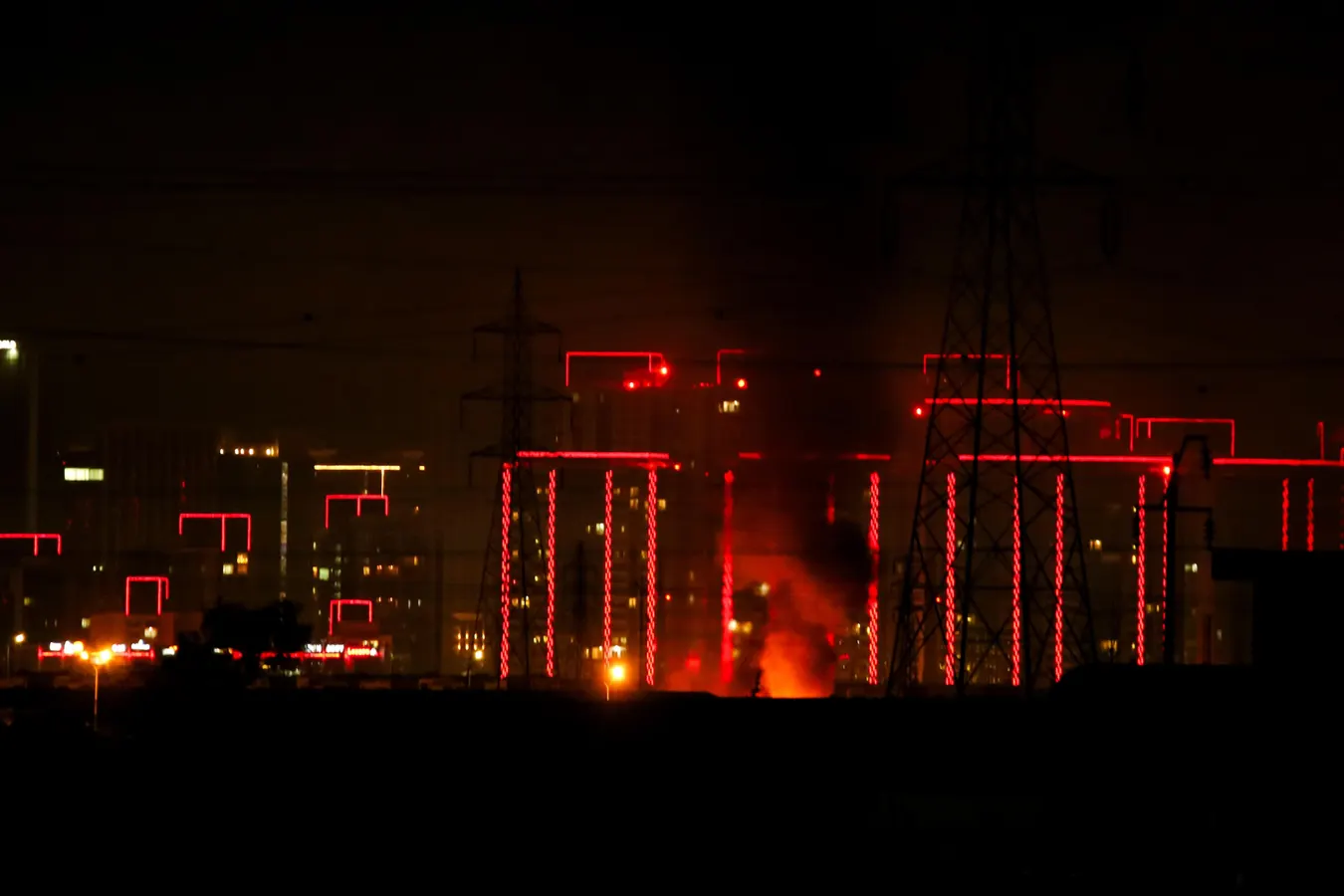

Fire breaks out at Erbil Airport in northern Iraq’s Kurdistan Region following explosions as air defense systems carried out intensive interception operations on March 1, 2026. (Photo by Ahsan Mohammed Ahmed Ahmed/Anadolu via Getty Images)
Anadolu via Getty Images
Iran has frantically lashed out since the joint U.S.-Israeli air assault began on Saturday. Aside from firing ballistic missiles at Israel, Tehran has more broadly targeted the Gulf Arab countries.
Far from solely targeting regional military bases hosting U.S. troops, as its foreign minister repeatedly claimed it would before the war, Iranian ballistic missiles and explosive drones have targeted a wide array of civilian, economic, and infrastructure targets. In another front in this dramatic regional conflagration, Iran’s Iraqi militia proxies have also subjected Iraqi Kurdistan to rocket and drone bombardments that are showing little sign of let-up.
“Iranian retaliation has generally been at the upper bound of what we were expecting,” Alex Almeida, security analyst at political risk consultancy Horizon Engage, told me. “Less focused on U.S. bases and more spread across a range of infrastructure, energy, and civilian targets.”
“Damage and casualties may be lighter than if they had focused on one or two U.S. bases or one specific infrastructure target, but this approach maximizes disruption and puts more pressure on the Gulf states and indirectly on the US to bring the war to a close.”
Lawk Ghafuri, an independent Iraqi political analyst and native Erbil resident, believes the war on Iran will have “severe consequences” for all of Iraq, including the autonomous Kurdistan Region.
“This conflict is unlikely to end soon, especially if the U.S. continues relying solely on airstrikes without deploying ground forces,” he told me. “Without boots on the ground, this war could drag on for months, not weeks.”
“In parallel, attacks on Erbil, Baghdad, and other Gulf states are likely to escalate,” Ghafuri said. “While many of these strikes currently have minimal strategic impact and are largely symbolic, the use of ballistic missiles by Iran-backed armed groups in Erbil could be catastrophic.”
Already, Iraqi Kurdistan’s capital city, Erbil, has endured three days of repeated drone and rocket barrages by Iran-backed Iraqi militias operating from federal Iraqi territories south of the autonomous enclave. Many of these munitions are targeting the American troop base on the grounds of Erbil International Airport, where they are swiftly intercepted by air defense systems.
“The city of Erbil has been targeted with more than 70 missiles and drones, while other parties have struck locations in southern and western Iraq,” Iraqi Foreign Minister Fuad Hussein said on Monday, the third day of this war.
Iraqi Kurdistan has endured militia drone and rocket attacks several times since 2020. It also endured a spate of Iranian ballistic missile attacks. Iran’s direct, unprovoked missile barrages against Iraqi Kurdistan, between September 2018 and January 2024, in particular, thoroughly debunked its repeated claims that its missile program was merely defensive. Those attacks included two strikes on the private residences of prominent businessmen in the region, which Tehran falsely claimed were Mossad bases without producing any evidence.
At present in Erbil, the strikes have already led to flight cancellations and schools being temporarily closed until at least Wednesday. The region’s Khor Mor gas field temporarily halted operations for fear of militia drone strikes on the site. As a result, the region’s residents have once again experienced lengthy electricity outages amid these repeated bombardments. The precaution was logical. Iraqi Kurdistan previously experienced such outages late last November after a militia drone strike hit Khor Mor, causing an enormous fire that once again spotlighted the autonomous region’s urgent air defense requirements.
Today’s strikes on Erbil feel different than their predecessors. Iran’s March 13, 2022, and January 15, 2024, ballistic missile strikes shook the city but lasted minutes, if not seconds. Most previous militia drone or rocket attacks were one-off strikes that also ended quite quickly. However, this time around, bombardments have continued for days. On Sunday night alone, this contributor heard repeated explosions and intercepts for more than two hours straight.
“The retaliatory strikes on the Kurdistan Region have still been heavily focused on greater Erbil and the presence there,” Almeida said. “The Iranians also seem to have real suspicions that the Kurdistan Region has been used by the Israelis as a launchpad for covert action operations into Iran, using Iranian Kurdish elements, which has driven some of their targeting of sites in the greater Erbil area in the past.”
“We have seen some attacks on infrastructure, energy, and Iranian Kurdish groups based in Kurdistan,” he added. “These have been limited so far, and nothing close to the tempo of the strikes going into the Gulf, where we’re seeing hundreds of drone and short-range ballistic missile launches per day.”
Ghafuri noted that so far, there isn’t any indication that Iran has directly targeted Iraq, including Erbil, but noted that “the frequency of attacks by Iran-backed groups is extremely high” to the extent that “residents in Erbil hear booms almost hourly.”
“Importantly, these attacks will not necessarily stop if the regime in Tehran collapses,” he said. “Without decisive action from the government in Baghdad, the violence is likely to continue.”
Both analysts see a risk that the militias will broaden their targets. Already, Iranian Kurdish opposition groups have reported attacks targeting their positions throughout the region.
“In terms of threats to Erbil city, the biggest risk comes from their fixation on alleged Mossad safe houses in Erbil,” Almeida said. “So, villas and walled compounds along the Pirmam road in the city’s northwestern quadrant.”
“With the U.S. and Israel stepping up strikes on militia targets in federal Iraq, it’s likely we’ll see additional escalation against Kurdistan and in the Gulf before we get the first potential off-ramp around the middle of this week,” he added.
“That will depend on how the U.S. and Israel assess the progress of the air campaign, the Trump administration’s tolerance, and how the Gulf states are bearing up against the Iranian strikes and threats to Hormuz.”
Ghafuri noted that while the militias are mainly targeting bases in Iraqi Kurdistan for the time being, that could change.
“If these groups see no impacts for a long time, they will start targeting U.S. companies, mainly oil and gas companies, as in this sector, many American companies are operating,” he said.
Such an escalation could prove catastrophic for the autonomous region.
“It will have severe consequences on the Kurdistan Regional Government – but I will focus on the main threat, which is ruining the image of Iraqi Kurdistan as a hub for foreign investors in the future, and make the current investors in the region think twice before resuming operation,” Ghafuri said.













Leave a comment