


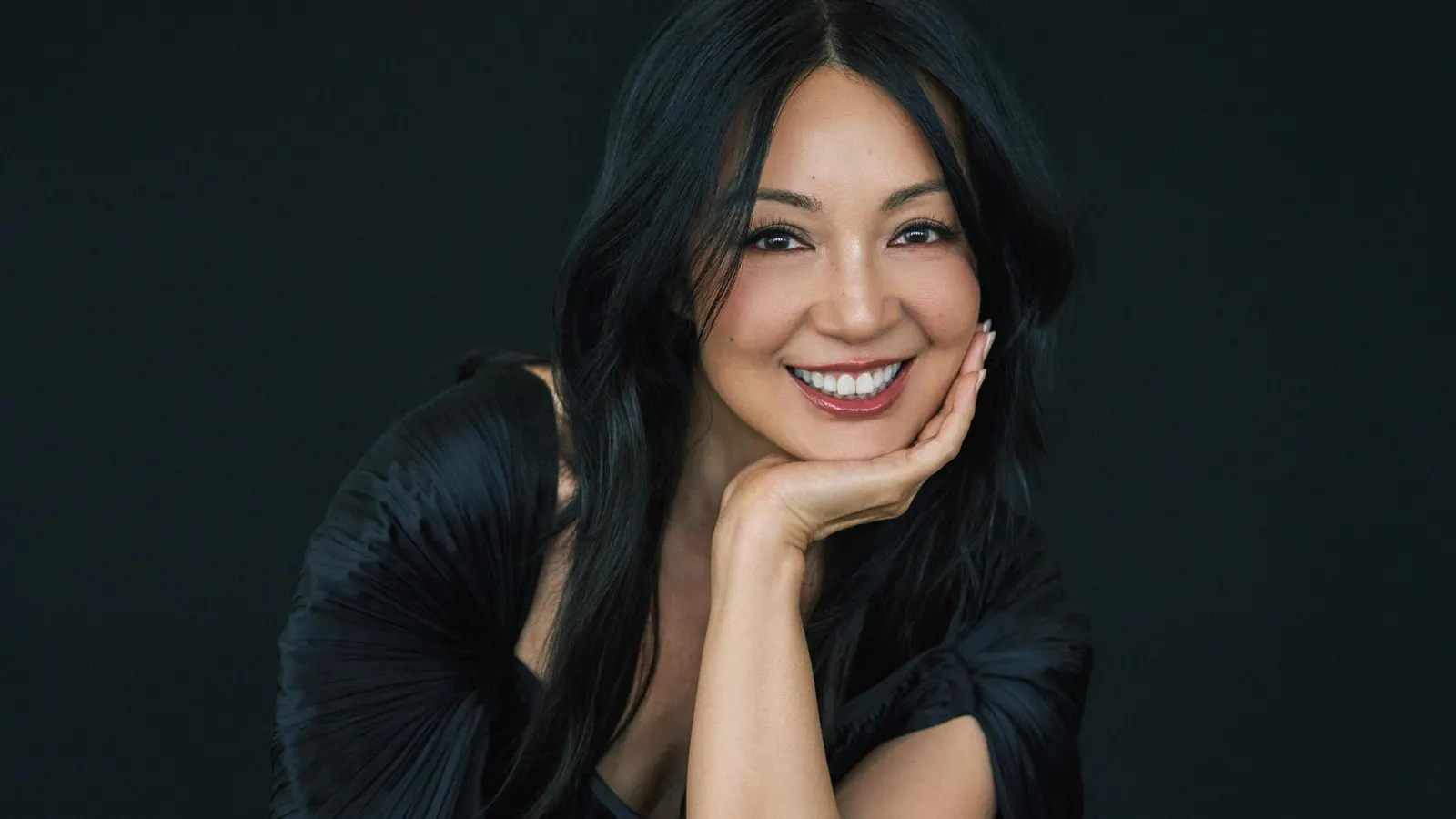
You could say cooking is in Ming-Na Wen’s blood.
The Annie Award-winning actor known for Mulan, Agents of S.H.I.E.L.D., and The Book of Boba Fett grew up completely immersed in her family’s Pittsburgh-based restaurant, Chinatown Inn, which has been in constant operation for the better part of a century.
While she ultimately pursued a career in show business, Wen never forgot her deep culinary roots. Reminiscences of that upbringing, both warm and complicated, informed the writing of her autobiographical cookbook, Have You Eaten Yet?: Family Recipes from a Restaurant Daughter (now on sale from S&S/Simon Element), described as “the ultimate love letter to food and family.”
“It started off as a social media thing, where I’d be posting my food,” she shared with me over Zoom. “I want to say this was eight years ago, and my fans wanted the recipes. I was like, ‘Oh…I don’t have recipes.’ So, a few years later—because I was still posting my food and they were still requesting recipes—I talked to my manager about it. He’s like, ‘You should write a cookbook!’ And I was like, ‘Yeah, whatever…’ But he got me a literary agent whom I love. She and I hashed it out, and it’s taken about five years for it to come to fruition.”
Despite some familial pushback, Wen was able to include the recipes for a number of popular Chinatown Inn dishes—from fan favorite egg rolls (and homemade duck sauce for dipping) to traditional pork meatballs known as Lion’s Head.
“I’m really breaking the taboo here,” she confessed. “Like when a magician gives away some other magician’s trick.”
Ming-Na Wen Discusses Her New Cookbook, Disney’s Mulan, and Star Wars TV Shows
Weiss: Have You Eaten Yet? is much a memoir as it is a collection of recipes. What was the personal story you wanted to tell here?
Wen: That was the other problem that took so long, because I grew up with two chefs in the family. When I was a kid, I got to set the table, wash the dishes, and that was kind of it. [My parents] were just like, “Get out of the kitchen. Mom and dad are handling this.” I went to Carnegie Mellon for the drama program there and then, when I was a career woman, setting my course to be an actor in New York City and making it on Broadway, I started really cooking for myself. The love of cooking and sharing meals with friends and family became a big love of mine because I grew up as a foodie with my parents. In a way, this book became a retrospect. Not to quote Mulan, but a “reflection” of my life through food, and it’s been a really interesting journey. I thought I was just going to write a bunch of recipes for my fans and share it with them, just connect with them in another way. And now, my understanding about my upbringing as a restaurant daughter, my culture, my resentment with the restaurant growing up, that all made me who I am and made me be able to forge ahead and create a success for myself in my acting career, too.
Weiss: When you say “resentment,” what do you mean by that?
Wen: I don’t know if you have any friends who were restaurant kids, but you basically live and breathe the restaurant in a way. It becomes another member of your family. For a while, we lived upstairs from the restaurant. I’d work on the weekends instead of hanging out with my friends. I’d be waiting tables and bartending as a teenager, which was completely illegal, but we did it anyway because there’s no child labor laws when you are a restaurant kid. And it took away my parents a lot. They were working every single day. They took maybe two or three days off out of the year. One day for Christmas and a day for New Year’s Eve. So I grew up feeling like it robbed a lot of family time. But when I was writing the cookbook, I realized that was sort of my perception of my upbringing. There’s some reality to it, but at the same time, it made me persevere and learn life skills that really helped me in show business. Because I really understood business, just by osmosis through them; from living in it every single day and seeing them working so hard to provide for the family.
Cover art for ‘Have You Eaten Yet?: Family Recipes from a Restaurant Daughter’
Courtesy of S&S/Simon Element
Weiss: Your family’s restaurant remains open to this day. What, in your opinion, makes it such a Pittsburgh institution?
Wen: It’s the only remaining establishment of the original Chinatown. It opened in 1943 by my dad’s father, and then he took over. He’s my stepfather, but I consider him my real dad, of course. I can’t even imagine the amount of food that has been served out of that restaurant and how much we have provided for the community, educating Pittsburghers about Chinese food. Our restaurant evolved a lot from the chop sueys of the old days, trying to appeal to the more bland American palate, to then introducing Szechuan and Cantonese staples. I’m very proud of that legacy.
Weiss: And I’m guessing there are some of the restaurant’s recipes in your book?
Wen: Yes, against my brother’s wishes.
Weiss: I was going to ask if there was any pushback on giving away the family secrets…
Wen: These were very secret, guarded recipes. In a way, I think they’re still guarded recipes for the restaurant because they cook in huge batches, and there’s always something different—a certain temperament or marination—when you’re cooking in such big batches. But I’ve been able to work tirelessly in breaking down the recipes and making them available for people who can cook in small batches—like our famous egg rolls, for example. It’s the restaurant’s recipes based on the ingredients, but it’s really my recipes based on my memory of the food.
Weiss: What recipe was the most difficult to adapt for the home cook?
Wen: The egg rolls, because I was giving away a lot of secret ingredients in it, and the Duck Sauce, which is so essential. I have tried so many Duck Sauces in so many restaurants, [but] they’ve never topped our Duck Sauce. And that’s because of the ingredients used. It took me a while to get the exact balance of flavors, and [the same goes] for the mustard, too. But the egg rolls were definitely a huge challenge.
Weiss: What dish should people try first after getting the book?
Wen: If you are a well-equipped and experienced chef, I would say try making my mom’s wontons, because they’re the utmost delicious wontons. It takes some skill, but it’s also really fun to share with your family or friends by making it together. I would highly recommend that. A comfort food would definitely be the Lion’s Head dish and if you are a vegetarian, you can always try the Mapo tofu without the meat. You can also try my vegetarian sandwich, which I stole from another restaurant. I do that a lot, just like my parents did. I will eat at a restaurant, love something, try to dissect it, then go home and recreate it.
Ming-Na Wen’s mother’s wonton recipe in ‘Have You Eaten Yet?’
Courtesy of S&S/Simon Element
Weiss: The answer to this next question doesn’t necessarily have to be a specific dish—what does comfort food mean to you?
Wen: It makes everything calm down and your belly full. You’re just having a great taste experience where you feel safe. I can’t describe it any other way. It’s just that sensation of you feeling nourished … It’s also a reminder of home; a reminder of family and love and special moments.
Weiss: Coming from a Jewish background, I heard the question “Have you eaten yet?” many times from my mother and grandmother over the years. Did you play around with any other titles?
Wen: I played with one that my publisher knocked down immediately. When I remodeled my home, I had my dream kitchen and then had a secondary kitchen built. I was showing my mom both and she’s like, “Why do you have two kitchens?” I’m like, “In case we want to entertain, we don’t want to mess up the main kitchen.” She just looked at me and goes, “You don’t cook.” I don’t know if Jewish moms do it, but they will humble you in three seconds. And I was like, “Mom, come on! I do cook. I cook for you all the time, and you love my cooking. What are you talking about?!” So that was going to be the title of my cookbook, You Don’t Cook, and my publisher said no. Then I was watching some C-dramas because I was trying to learn more Chinese when working on Karate Kid: Legends. I noticed in every other scene, the Chinese person, if they’re coming to their home, would be like [in Chinese], “Have you eaten yet?” I realized my mom says that all the time; when my friends come over, when family comes over, when I come home. She doesn’t ask me how I am. She doesn’t give me a hug. Her way of showing love is asking me if I’m hungry. I just thought that was the perfect way to invite my fans. They’re the ones that inspired the cookbook. It was my way of giving the message out to my extended family, my fans, that this is my way of showing love.
Weiss: As a ‘90s kid who grew up watching all of the Disney Renaissance movies, I have to ask about Mulan. How would you characterize the movie’s legacy?
Wen: It’s been so rewarding. That’s the number one character I’ve played that has been so generational in having the same impact, which is fascinating to me. I guess that’s why it’s a classic. It’s a great pride that Disney took the risk of telling a very Chinese story [based on] folklore from China. Being able to Disney-fy, so it can still inspire and tell a wonderful story about a young girl finding her true potential, her own sense of who she is, and what her self-worth is. It’s a beautiful story and I’m just so grateful that it continues to have such a a positive impact.
Weiss: Did you get caught up in the Mulan Szechuan Sauce craze about 10 years ago when Rick and Morty brought it back into the cultural consciousness?
Wen: Do you remember trying that?
Weiss: No, I don’t think so…
Wen: It’s terrible! [laughs] It’s a really bad sauce. But for me, anything that makes people connect in some way to the movie, and makes them want to watch the movie, I’m all for it.
Weiss: I also have to ask about Star Wars. How surreal was it joining that universe in The Mandalorian and The Book of Boba Fett?
Wen: I grew up loving Star Wars. It was—and still is—my religion. Every time I get on a plane, I pray to God, Buddha, and the Force—no kidding, I do that—to take me safely from one location to another. When I see my collection of Fennec Shands…I used to collect all the Star Wars toys and everything, and now I have my own character. I got to fulfill a very big dream I had for a long time. And I’m so thankful the fans love the character. I keep bugging [soon-to-be Lucasfilm Co-President] Dave Filoni, “You gotta bring Fennec back! When are you bringing her back?! I miss her!”
(L-R): Fennec Shand (Ming-Na Wen) and Boba Fett (Temuera Morrison) in Lucasfilm’s THE BOOK OF BOBA FETT, exclusively on Disney+. © 2021 Lucasfilm Ltd. & ™. All Rights Reserved.
François Duhamel / Lucasfilm Lt
Weiss: Did you get a chance to check out The Mandalorian and Grogu movie?
Wen: Of course, I was there at the premiere. The craziest thing is being able to interact with a real Grogu. He’s such a diva. He has a bigger entourage than Pedro [Pascal], for sure.
Weiss: Was it hard keeping Grogu a secret before the show premiered?
Wen: It was very difficult. I’m so relieved now that I don’t have to constantly [keep it under wraps]. I’ve had to do it for 10-11, years between Marvel’s Agents of S.H.I.E.L.D., Mandalorian, and Book of Boba Fett. We can’t all be Tom Holland and get away with it.
Weiss: That does it for my questions. Anything to add?
Wen: The book comes out Oct. 6 and I’m going to be back home [in Pittsburgh] for a book event Oct. 8, so it would be wonderful if there’s a mention of that. But otherwise, just wait for me to be a goddess [Hera] in [Season 3 of] Percy Jackson. That’s coming up next.
**This interview was edited for length and clarity**









Leave a comment