


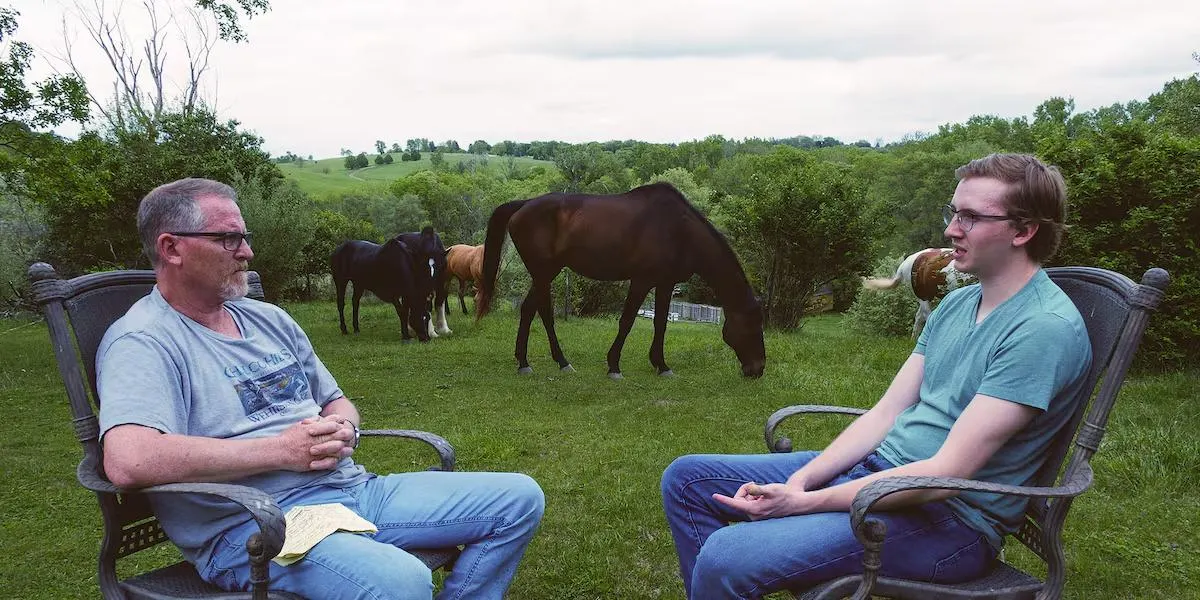

Randy and Nick Beaulieu, from the documentary “My Omaha”
PBS, 2026
For filmmaker Nick Beaulieu, My Omaha began as one kind of documentary and gradually became something much more personal. What started as a journalistic exploration of his hometown evolved into an intimate examination of family, politics, race, community and his complicated relationship with his father. Along the way, Beaulieu found himself not only documenting Omaha, but reconsidering his own place within the city and the communities that shape it.
I recently had the opportunity to speak with Beaulieu, and we discussed the unexpected evolution of My Omaha and the challenges of turning a deeply personal story into a film that could still maintain the observational qualities of a documentary. He talks about the difficulty of portraying his father fairly, the role of editors and collaborators in shaping a personal story, and what he learned from spending years immersed in the project.
Beaulieu also reflects on Omaha’s divisions and the possibility of finding common ground with people whose political or personal views differ from our own. He discusses how making the film changed him as a filmmaker and as a person, the lessons he learned about storytelling, and why he hopes to continue making personal films. Ultimately, he describes My Omaha as an act of love—one that brought him closer to understanding his father, his hometown and himself.
The following interview has been lightly edited for clarity.
Rick Ellis: Let’s start sort of at the beginning. For most documentaries, there’s the documentary you think you’re going to make when you start, and then there’s the one it turns into. When you first started the project, how did you see the documentary being framed, and how did that evolve over the years as you were filming it?
Nick Beaulieu: Initially, I saw it as a purely journalistic venture. I wanted to be very observant, and I didn’t see it as something that was going to include my own story or anything that would be personal. Then I realized, for a lot of different reasons, that if I took it in that direction, it would end up becoming something much more personal, emotional, and interesting.
So that was really the biggest twist: I ended up making an incredibly personal film from a starting place where I did not think we were going to go in that direction.
And I think what’s cool about that is that we retain some of that journalistic energy throughout the whole movie while still having a very vulnerable story. So it ended up working out, but it was also challenging because, in some ways, we had to find a way to personalize a lot of moments that weren’t shot to be personal. We used a lot of different tools and tricks to do that, but that was definitely the biggest curveball for me.
Ellis: As a filmmaker, how do you find the right tone? You’re telling your own story, but sometimes I suspect it’s easy to get lost in that story because it is your story. To get the perspective that the audience needs, they need more than just how you’re feeling?
Nick Beaulieu: Yeah, I think it’s a big trap when making something personal to telegraph your feelings because you can. You have the tool to say, in your voice-over, for example, exactly how you’re feeling and thinking.
But it’s much more effective and much more powerful if you can find a way to show it without telling it. So I think that was always what we were after: How can we convey this frustration or this regret, or whatever emotion you want to name, without just coming out and saying, “That’s how I feel”?
We used the voice-over to help move us along and convey information that helped the pace and flow. That was really achievable just by working with great editors and collaborators who were able to be a good second voice and offer another opinion.
The way I looked at it was that no great filmmaker—or, I know a lot of filmmakers edit their own movies—but if you think about a novel, even the best novelists who are working independently need editors to help them shape their stories and their vision. I looked at this the same way. I really needed other opinions and voices to help out.
The Difficult Conversations With Dad
Ellis: I suspect it was a similar quandary when dealing with your dad, because you obviously have these personal feelings about him, which may or may not be accurate or relevant to the story that you’re trying to tell. You want to tell his story as fairly as possible. For me, that would be really difficult sometimes, not letting those emotions get in the way of that.
Nick Beaulieu: Definitely. There was so much that I wanted to include about him that we didn’t have time for. That was challenging—leaving out moments that were very sweet or just revealing about his background that I thought would be cool.
But it isn’t a movie about my dad. It’s not a biography of my dad. So I couldn’t do that, which was hard.
But you surprise yourself by how emotionally removed you can get from these things when you’re working on a movie. You have to be so ruthless about the story and the pacing and all these things that you reduce everyone, including yourself, to characters.
And then, once you do that, slowly, the actual reality of the film comes back to you. You’re like, “Oh, yeah. That is me. That is my dad. This is my life.” The emotion comes back, but you kind of have to harden yourself during the making of it just to get through it.
Seeing The Film As A Legacy Of Sorts
Ellis: Without giving too much away for people who haven’t seen it when they read or see this interview, in some ways, the film ends up being a legacy for your dad. This is the way that a lot of people who don’t know him otherwise will think of him. Were you conscious of that as you were editing and putting the film together? Did you think, “This is 50 years from now; people are going to be watching this film, and this is how they’re going to see my dad”?
Nick Beaulieu: Yeah, for sure. That was on my mind.
That’s why I was so glad that we have scenes—not to spoil it, but scenes at the very end—that I think help round out a great picture of him.
It’s tough because, yeah, if I was to be totally honest, I did think about that. But I think I also just tried to make the best movie for here and now and hope that it will continue to resonate and be honest.
But yeah, it’s not easy making something personal because it can’t be perfect as far as a total depiction. I wouldn’t say that this film is the best way to understand who my dad was in the totality of his life.
But is it who he was? Isn’t it a depiction of our relationship, what we struggled with, and what the country struggled with? Yeah, absolutely. So, yeah, it’s a challenging negotiation.
Ellis: I think most people, if you’re online at all, hear from people who have issues with their family politically. They’re not talking anymore. “I don’t want my grandkids to see this,” whatever it is. And I think most people, when they have those conversations or complaints, hope that there’s some magical way that it can all get fixed.
I think the arc of this film is that it’s possible to improve things, but you can’t fix some things. Some things just are what they are, and you have to learn to live with them.
Nick Beaulieu: Yeah. I mean, I think you can’t—no one can change another person, especially not in the ways that they think they can or want to. That’s where the heart of a lot of these conflicts is, right? They want someone to be different; they want them to change, instead of finding a way to love them, respect them, or tolerate them as they are.
And I think that’s what this movie is about: How do you get to that place?
That’s sort of what I think the country needs. We can’t just alienate or write off, for example, anyone who votes for Trump because you hate Trump. And I think conservatives can’t write off or alienate people who have views that they think are immoral or that they hate. It’s just not a way to have a civic society.
I think that just comes down to remembering what we all have in common—that we’re all human. And it takes having an experience with someone to remind yourself of those things and let some of those stereotypes or feelings retreat a little.
Ellis: Let’s talk a little bit about Omaha, which frames this entire conversation. You obviously had some sense of what Omaha was because this is where you grew up. But coming back in the process of doing this film, what did you learn about the community and how it sees itself?
Nick Beaulieu: Yeah, it’s an interesting question. There’s not really one thing I can say to generalize about Omaha because it’s made up of so many different people who are also different, and they all come at these problems or issues in different ways.
But I think there’s a tremendous amount of pride that people have about Omaha and where they live and about the community.
I think what I really learned from making this movie is what it means to be part of a community. When I started making this film, I didn’t really feel like I belonged to any community in Omaha.
When you grow up in the suburbs, I think a lot of people can relate to this. Your community is your school, your church, or your sports team. It’s a very minor thing.
But making this film made me learn about the Black community and what that type of community means when you have a community based on shared culture, geography, and shared experiences.
And it was so familial, in a way that I had never witnessed between strangers before. Neighbors were so family-like.
Making that movie and seeing how proud people were of Omaha in that sense was very moving to me, because I started the movie from this kind of cynical place of thinking, “You’ve got these two sides of Omaha that don’t acknowledge each other. One side isn’t really acknowledging the other’s problems, and the other is sort of consumed by it.”
But at the end of the day, I think there are so many people who just really want to see Omaha be better and improve. There are just a lot of people who have different ideas about how that’s done.
Ellis: You mentioned starting the project being a little cynical. Aside from the whole relationship with your dad and that part of the film, what impact did this have on you personally? When this is all over, how has it changed you?
Nick Beaulieu: It was humbling in a lot of different ways. It’s humbling as a filmmaker just to learn how to make a movie, but I would say personally, too, it made me much more patient and empathetic toward people that I don’t see eye to eye with.
It also taught me the sort of price you pay for being authentic and honest and transparent about who you are and your viewpoints.
Along the way of making this film, I ran into resistance, and I ran into people who weren’t fans of the work or doubted it. That was lonely and tough, and it chipped away at my confidence and self-esteem.
But then you push on and you get through it. And that teaches you something about what it means to live a life where you make your own choices for yourself, rather than trying to make other people happy or appease someone else’s expectations.
So I’m glad I got that from the experience. And I feel much more confident, I think, going into whatever I want to do next.
Ellis: Well, it sounds like not only did you improve your technical expertise over this project, it taught you how to be a certain kind of filmmaker. You sort of learned on the job, I guess.
Nick Beaulieu: Oh, absolutely. Yeah. Every aspect of filmmaking.
It’s insane. There are scenes in My Omaha that I shot where I didn’t even have the microphone on, and I had to go find the audio from another person. That’s how amateurish I was at the beginning of making this movie.
So, yeah, the technical aspects came a long way. But really, what’s more important is how you understand story and storytelling. I think I learned a lot about what makes a good film and what makes a good story by being in this world for as long as I was making this.
Ellis: If you had the expertise and experience you have now, but you got it from a different project, would you decide to make this film again? Is this something that resonates with you in a way that makes you say, “Okay, I want to do this now with this skill set”? Or was this just a story that you told?
Sometimes people tell stories because they don’t know how difficult it’s going to be. I’m wondering if that was the case with you, if that makes sense.
Nick Beaulieu: Oh, well, yeah. It’s hard to answer.
I mean, I think if I knew how long and arduous this was going to be, it’s hard to say if I would have signed up for it. But I’m glad and happy to have made something that feels like it really matters to Omaha.
I often thought about maybe making two films out of the story because that did present itself as an opportunity. There’s an Omaha story, and there’s a story about me and my dad. But I think they both would have been lesser films on their own, as opposed to marrying them together.
If it was just about me and my dad, I think it wouldn’t have had as much impact without being tied to a location. And then if it was just about Omaha, I think it lacked a certain amount of narrative personalization that was helpful.
So it’s just strange to think about how this came to be. It’s one of those “life just works in mysterious ways” types of things that happened.
And I think that’s probably going to happen again with the next film. I think that’s kind of how I work: I just follow instinct and curiosity to an unexpected place. Basically, that journey is the film.
I think that’s a good path because it means stuff is interesting. I’m not so much a fan of stories where you know everything going into them, like a recreation or retelling of a story.
Those can be interesting to some degree, but they’re not my favorite. I want to be surprised, and I want to surprise myself as a storyteller, too.
And I think that’s what I’ve done and what I’ll probably keep doing.
Ellis: Can you talk a little bit about what you’re working on? Or is it still a secret? You don’t want to talk about it yet?
Nick Beaulieu: Well, yeah, it kind of is. Although it’s so early to even say what the next thing is.
I’m still—like, I don’t know. It’s such a commitment to make something. I’m hesitant to speak it into existence yet.
But I do see myself making more personal work because I fell in love with that genre and fell in love with a lot of the filmmakers in that space whom I admire and appreciate.
So, yeah, I think I’ll probably find a way to make another personal piece and find ways for stuff from My Omaha to come into that film, too.
Because I like when personal films reference each other and build on each other. They’re kind of like their own world and ecosystem.
So that was a gift of learning about that genre by making this.
Ellis: One of the things I struggle with is when I’m writing stuff, I tend to be very personal. I tell a lot of personal stories and use that as the framework for what I’m writing about.
Sometimes that can be a dangerous process because you don’t need to tell the audience everything. The temptation is to use everything you’ve got, and you have to save something for yourself.
I’m wondering how that process works for you as a filmmaker, particularly if you’re looking at doing additional films in this genre.
Nick Beaulieu: I think you just have to always ask yourself, “What is best for the film?” and separate what is interesting to me from what is interesting to an audience.
You have to choose things where you meet in the middle on that, as opposed to just making stuff that’s interesting to you.
It can be a real bias and a blind spot. There were scenes in My Omaha that, in rougher stages, were much longer and where I waxed much more poetically about a certain thing.
To me, it sounded and looked beautiful. It was heartfelt and vulnerable and yada yada, but we didn’t need it. It was too much. It was too long and weighed the film down.
Movies require a certain cutthroat nature when it comes to their beat-by-beat storytelling because, as soon as someone starts to lose interest or get bored, you lose them.
You have to sustain someone’s interest for 90 minutes. Every frame of that movie needs to be thought about and accounted for in this way, especially with people’s attention now.
I mean, a lot of people can’t even finish a 10-minute YouTube video. And we’re talking about the fact that this movie, in this next stage, is mostly going to be watched at home, whether it’s on YouTube, the PBS app, or broadcast.
So, yeah, just trying to be very focused on the whole as opposed to the individual moments is what I would try to tell myself.
The Moment When The Film is Revealed To The World
Ellis: Toward the end of the film, you’re showing this footage to someone. I suspect whether it’s the first time, family seeing it, or people in Omaha seeing it, that’s a scary moment. No matter how confident you are, the last thing you want to hear is someone go, “I don’t know. I’m not sure if this works.”
Because at that point, you’re pretty much committed. There’s nothing you can do to change it.
Nick Beaulieu: Oh, yeah. I was definitely nervous showing it to people initially.
The first person I showed it to, before we actually locked the cut, was Leo Lewis. Fortunately, he immediately responded well to it.
And not only to his scenes and the scenes about North Omaha, but really to its whole message, which was such a relief and made me very excited.
Then I showed it to some supporters and kind of little test audiences in Omaha to make sure that I got Omaha right. When you make a movie about a place, the people who live there are going to be tough when it comes to making sure that authenticity comes through.
But I passed that test. Then the final test was family.
I showed it to my brother, my sister, and my mom first, and they all liked it. I felt like once that happened, I was like, “Okay, I am good to go with this.”
Whatever else happens, whoever else has opinions or critiques or this or that, I can live with that.
But the fact that I had the buy-in from those stakeholders and their belief in it made me feel pretty good.
Ellis: There’s a point in the film where you talk about how you see your dad, when you think of your dad. There’s a specific point where that’s how you see him.
I’m wondering, does that answer change by the time the film is over? You’ve had all these chances to talk to him more as an adult to another adult. Or is it still the same, because the example you use is from when you were a child?
Now that you’re an adult and you had an opportunity to talk, even though it was difficult, does that answer change for you? When someone says, “Hey, how do you see your dad?” what’s the image you have of him?
Nick Beaulieu: Yeah, you know, it’s interesting. I hadn’t honored that in a while.
I think the first thing I think about now is him doing this film with me. I think about him showing up to the interviews and being a participant in this.
And then, while making the movie, I was thinking so much about my dad and seeing him through this filmmaking lens and in the world of the film.
Now that it’s been done for a while, his entire life before that is sort of beginning to reemerge again in my head and in my consciousness in a way that I’m really glad about, because that’s a much broader version of him than just this basically two-year window we had of making the movie.
So there isn’t one particular thing that comes to mind for me. It’s different things every time.
And new things still happen. I had a dream about my dad a year ago, a couple of days before I premiered the movie in Omaha for the first time, that was so vivid it almost felt like a visitation.
I wrote about it on my Substack because it felt very divine in a way. He was being very encouraging and supportive in a way that felt like it was giving me a sense of peace before a very nerve-wracking moment, which was putting the film out to Omaha.
So, you know, I think about that now. Even after he’s gone, there are new things that make me think about him.
Ellis: I mean, this seems like a good spot to wrap it up with just the observation that, at the end of the day, this film is really an act of love.
It’s an act of love for you to want to try to figure out your dad’s opinions and have a connection. And it’s an act of love from him because he doesn’t know what he’s getting into. He’s trusting you to be fair with him and to put his story out in a way that isn’t hateful.
And that requires a lot of love on someone’s part.
Nick Beaulieu: Yeah, thanks for saying that. For sure.
I mean, his only motive and drive to do this was out of love for me and care for me. That is a generosity that I’ll always be grateful for, and I can never really repay him for.
The only way I could do it was by returning that love in the way that I expressed my feelings and thoughts about him back into the movie.
And the best feedback I get—I mean, when I showed this in New York this week for the first time, so many people came up and they were so complimentary about my dad. They said how much they loved my dad.
And that means a lot.
When people say stuff like that, it makes me feel good about how hard this was.
So, yeah, it’s just wild how long of a ride it’s been and how we ended up in this place. But I feel very grateful about it.
My Omaha is premiering on PBS and the PBS App on Monday, October 5th, 2026.








Leave a comment