


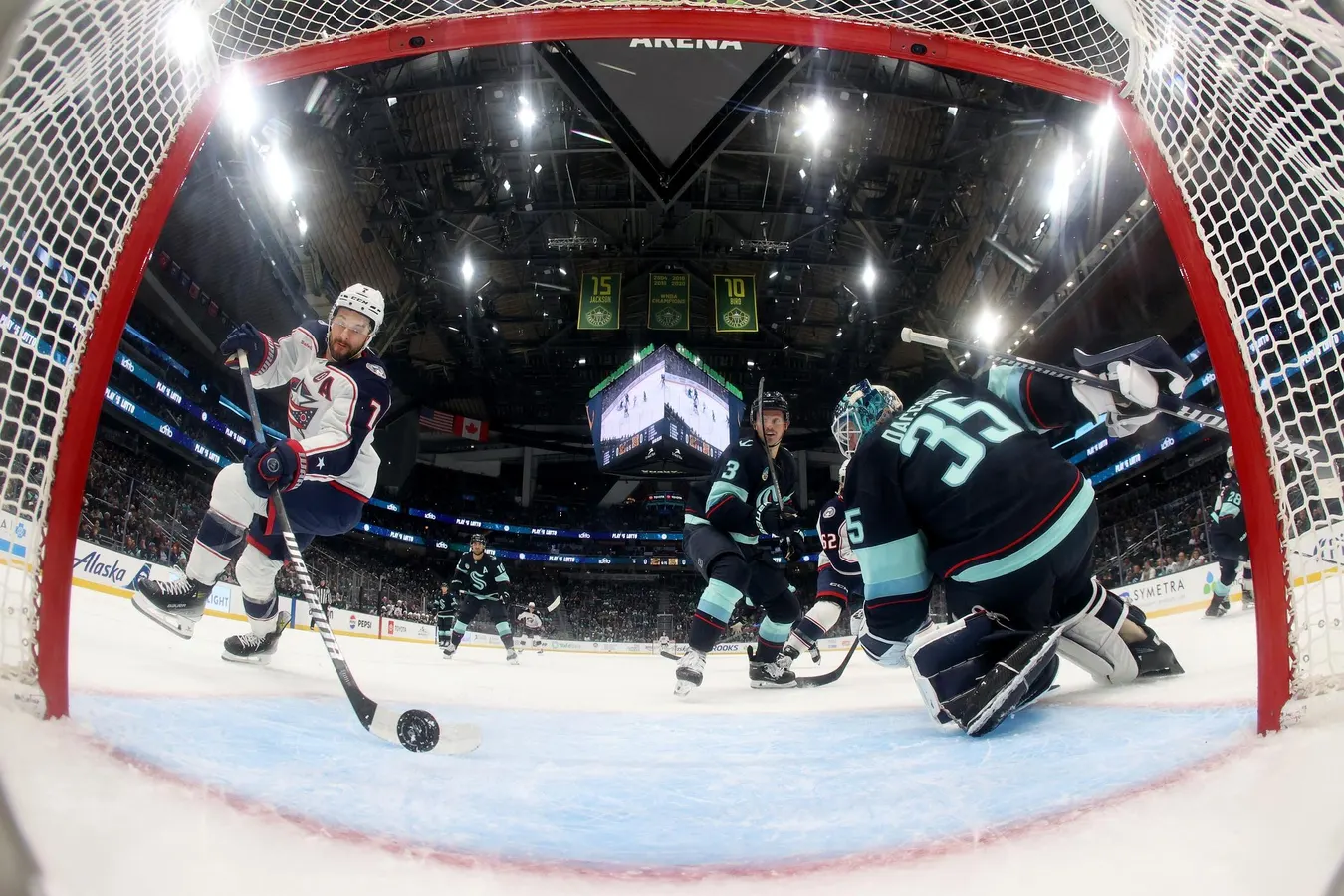

The Columbus Blue Jackets are among the first four NHL teams to have local broadcasts produced by NHL Productions, a new initiative that follows the collapse of FanDuel Sports Network. (Photo by Steph Chambers)
Getty Images
For decades, National Hockey League teams collected local media-rights revenue while regional sports networks handled nearly everything else, including producing games to distributing them to fans.
But when FanDuel Sports Network collapsed this year, that arrangement unraveled, leaving several clubs scrambling to find a producer for local broadcasts.
The solution came from the NHL itself.
Beginning this season, the Columbus Blue Jackets, Carolina Hurricanes, Minnesota Wild and St. Louis Blues will have local broadcasts produced through NHL Productions, marking one of the league’s most significant steps into the local media business.
Distribution Flexibility
The move will give teams flexibility to distribute games across cable, streaming and over-the-air television, while also allowing them to exercise more control over broadcast quality, promotion and fan access. It also positions the NHL as a media company, not simply a league that licenses media rights.
“We’ve taken this slogan of ‘controlling the asset,’ which is something we’ve never done,” David Proper, the NHL’s chief media officer, said. “Giving control of that asset to the teams opens up a lot of opportunities—interaction with fans, better promotion, better access.
“By getting control of the asset, they’re able to produce the games the way they want, with the messaging they want and the promotion they want.”
Regional Sports Network Model
League-controlled media operations are not new.
Major League Baseball created MLB Local Media, which took over producing broadcasts for nearly half the league after many RSN deals collapsed. The NBA operates NBA TV and produces league programming, but local broadcasts remain largely RSN-produced.
But many fans relied on the regional sports network model, agreements signed team-by-team to produce and air games in local markets in exchange for guaranteed rights fees
Those NHL, NBA and MLB franchises sold local TV rights to entities like FoxSports networks, Bally Sports and, most recently, FanDuel Sports Network, which paid for production, advertising sales and distribution. The benefit to teams: predictable revenue with little responsibility for production or distribution.
Its stability, however, depended on a cable television ecosystem that was rapidly shrinking.
The Main Street Sports Group emerged from Diamond Sports Group’s 2023 bankruptcy and provided games under the banner of FanDuel Network. In 2026 they also stumbled under financial pressures. That left teams searching for new ways to get their games to fans.
Enter the NHL
NHL’s Broadcast Experience
The NHL already has a history of distributing games through NHL Center Ice, a cable and satellite package, and NHL GameCenter Live, which later became NHL.TV.
In 2021, the league signed agreements with the Walt Disney Company and Turner Sports for television, streaming and media rights through the 2027-28 season. Games became available across ABC, ESPN networks, Hulu and ESPN+, which replaced NHL.TV as the league’s U.S. out-of-market streaming service.
Those products, however, focused primarily on distribution as opposed to the production of local broadcasts.
The league has already embraced a production role through NHL Productions, which supports major events and programming including the Stadium Series, Winter Classic, NHL Draft and NHL Awards.
The NHL had planned to expand that operation into local live game production closer to 2028, but the collapse of FanDuel Sports Network accelerated the timetable, Proper said.
What’s Coming
Teams will now pay production fees to the NHL, but the league will discount the amount, Mayer said. This will make the teams’ costs comparable to previous RSN agreements, but with greater potential return on the investment from advertising and other sponsorship revenue.
“We are taking all the innovation, all the things that are building the infrastructure are really being handled at the league level,” he said. “We’re adding cameras, we’re adding new graphics, music. We’re bringing in technology [like] NHL Edge, which is our puck and player tracking, that we think is going to be a huge add-on for the fans.”
Proper said a production that costs $65,000 per game might actually cost a club about $50,000, with the league absorbing some infrastructure and development expenses. Amounts will vary by team and market.
Teams, however, must still build distribution networks and advertising partners, with the league assisting in some areas.
“Your broadcast used to be about one thing, and that was your rights fee,” Proper said. “Now, when we look at the production…you need to look at all the ways you can take that production and generate additional value that you may not have otherwise been able to generate.”
Changes Bring Challenges
Such changes are not without challenges.
The old model allowed teams to sit back and collect a fee with little overhead. In the new model, teams lose guaranteed rights-fee revenue, and they must now actively find and create revenue.
“Taking control of the production requires that we make additional investment in that part of it,” Todd Sharrock, the Columbus Blue Jackets’ vice president of communication, said. “We’ve gone from no production cost to having some production costs that are not insignificant. That financial landscape presents some challenges that are two pronged–you lose some of that revenue from rights holder fees and then now we’re paying to produce the games.”
Even as production plans are in place, distribution remains unresolved. Fans still don’t know exactly where games will air, whether they’ll need multiple subscriptions or how much access will cost.
“We’re just still finalizing exactly where games will be shown, but the goal is to make them as accessible or more accessible than they’ve ever been,” Sharrock said.
Team Benefits
Mayer said team benefits include greater control over storytelling, and better integration between cable, streaming and over-the-air television which may provide greater access to fans who have faced the expense of stand-alone apps or cable bundles, as well as blackout restrictions, depending on each team’s distribution agreements.
Sharrock agreed that league resources and the ability to create more storytelling opportunities for fans will make its product better.
“We are going to pour everything that we that we have into that,” he said. “There is no greater priority for us than to have fans that want to watch our games be able to watch our games.”
NHL Evolution
Instead of just replacing regional sports networks, league executives said they believe they are building an infrastructure that could eventually serve more clients inside–and outside–hockey.
“We see this as a future business opportunity for the NHL—not only to serve our NHL clubs, but outside clients, not only in sports but in entertainment,” Mayer said. “If we have the production infrastructure, why wouldn’t those same streamers come to us to get the job done for them?”













Leave a comment