


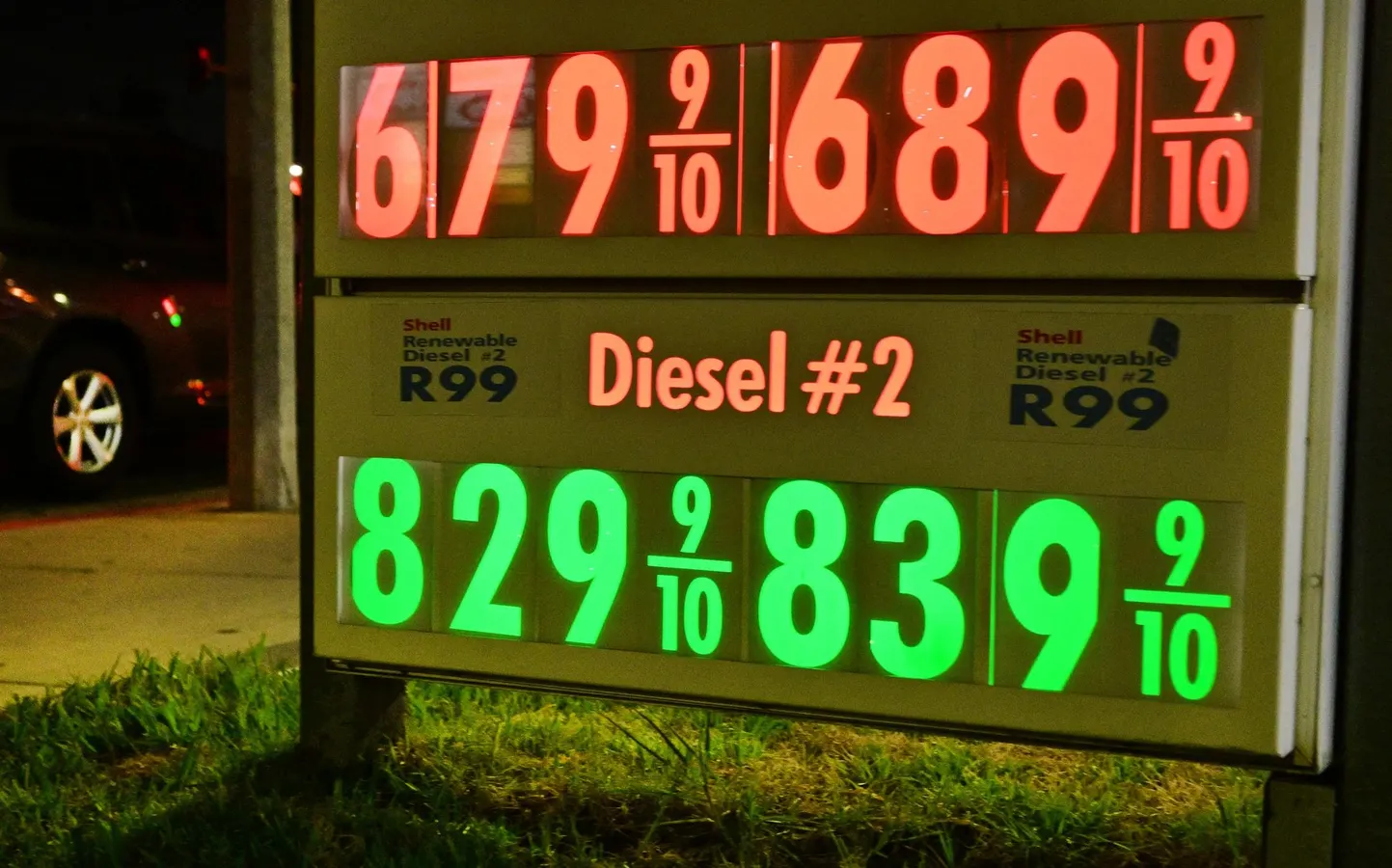

Diesel prices are displayed above $8 per gallon at a gas station in Los Angeles, on September 17, 2026, as prices reach record highs across the United States. Average diesel prices in the United States struck a record high of just under $6.27 a gallon on September 15, the motorists’ association AAA said, pressuring President Donald Trump ahead of midterm congressional elections.The price of the fuel used largely in road hauling, agriculture and construction hit $6.2694, according to the association, as the Middle East war tightens supplies and Ukraine strikes Russian refineries. (Photo by Frederic J. BROWN / AFP via Getty Images)
AFP via Getty Images
The rebound in crude moving through the Strait of Hormuz has not delivered the relief at the pump that a simple supply recovery story suggests would happen. President Donald Trump argued on October 5 that gasoline and diesel prices are no longer being driven by the bottleneck at Hormuz since flows have been restored to pre-war levels. He says the real price pressure now sits in refineries, with capacity in short supply thanks to Russian plants hit by Ukrainian drone strikes and U.S. capacity depletion in places like California.
Energy Secretary Chris Wright continues to predict that prices will “absolutely” drop as Hormuz flows recover, and pump prices have in fact declined slightly over the last week. Both statements by the Administration capture part of the market, but neither fully explains why Brent remains at the $100/bbl mark, more than 40% above pre-March 1 levels, or why the national average price for gas at the pump sits at $4.36 as of this writing on October 7. Nor do they explain why diesel remains well above all-time record highs reached during the Biden administration.
Gas And Diesel Flows Remain Constrained
The physical recovery in crude oil flows from the Middle East is real. Data compiled by Kpler show Middle East exports, including volumes diverted via Saudi Arabia’s west coast and the east coast of the UAE, running near or above pre-war levels. Seven-day averages of crude clearing the Strait of Hormuz itself have reached roughly 3/4th of the pre-war baseline thanks to the successful efforts of the U.S. Navy.
Despite those promising numbers, Saudi Aramco CEO Amin Nasser nonetheless warns that the system remains strained. He estimates nearly 3 billion barrels of supply have been lost since the Iran Conflict began in March, and about 1 billion barrels have been drawn from global stocks. Nasser predicts that rebuilding inventories while still meeting recovering demand could take up to two years even after the Strait fully reopens and confidence returns.
US President Donald Trump (R) and Saudi Crown Prince Mohammed bin Salman (L) speak with Aramco CEO Amin Hassan Nasser at the King Abdul Aziz International Conference Center during the Saudi-US investment forum in Riyadh on May 13, 2025. Saudi Arabia on May 13 promised billions of dollars in deals with the United States from defence to artificial intelligence as it threw a lavish welcome for President Donald Trump on the first state visit of his second term. (Photo by Brendan SMIALOWSKI / AFP) (Photo by BRENDAN SMIALOWSKI/AFP via Getty Images)
AFP via Getty Images
That gaping inventory hole helps explain why high prices for gasoline, diesel, and crude oil remain hard to kill.
Other key factors contribute to the troubles:
- The wider market remains extremely tight. Commercial stocks were severely drained to help prevent a crude price blowout during the peak of the disruption.
- Middle Eastern refined product exports have not recovered along with crude flows. Product cargoes through the region have run at roughly half of pre-war levels in recent days, with refined products accounting for just about 11 percent of Hormuz flows compared to more than 20 percent pre-war.
- Russian diesel output is down by almost 30 percent due to repeated strikes on domestic refineries, forcing Moscow to restrict exports.
- Chinese exports also remain restrained as Beijing prioritizes domestic stocks.
The net result is a worsening diesel shortage heading into winter, when heating needs and freight demand invariably rise. It is key to remember that consumers do not buy crude oil – they buy gasoline, diesel, jet fuel, and various other products that are refined from crude streams.
Multiple Factors Keep Gasoline, Diesel Prices High
Damaged or offline Middle East and Russian refineries have widened crack spreads even as crude flows have been restored, leaving U.S. refining margins highly elevated. California’s loss of roughly 284,000 barrels per day of refining capacity adds a regional premium for Golden State consumers to bear.
Issues in logistics and supply chains only compound the price problems. Record high freight costs, war-risk insurance premiums, and inefficient shipping workarounds have kept delivered cargoes trading at premiums well above published Brent index prices.
Rates charged for very large crude carriers (VLCCs) from the Persian Gulf to Asian markets have recently exceeded $1 million per day, up from around $30,000 early in 2026. Freight that once represented roughly 3 percent of the delivered price per barrel now accounts for as much as 27 percent and more in some routes. Tankers are scarce, voyages are longer when cargoes that once cruised out of the Persian Gulf direct to Asian markets must be re-routed via the Mediterranea and around the African continent, and every barrel that does move carries an embedded, elevated security cost.
BANIYAS, SYRIA – SEPTEMBER 13: Fuel tankers carrying Iraqi oil arrive at the coastal storage facilities of the Baniyas Oil Terminal in Tartus province, Syria, on September 13, 2026. Following maritime blockades and escalating tension due to US and Israeli attacks near the Strait of Hormuz, Baghdad has revived overland oil export routes through Syria for the first time in 15 years. Under bilateral agreements between Iraqi and Syrian authorities, long convoys of fuel tankers transport oil across the border crossing to the Mediterranean terminal, where the cargo is offloaded into storage tanks and transferred onto maritime tankers for international delivery. (Photo by Hasan Belal/Anadolu via Getty Images)
Anadolu via Getty Images
Buyers are currently regaining access to Middle Eastern crude, but regaining pre-conflict delivered costs is another challenge entirely. Those premiums flow through to refiners and then to the loading rack and ultimately to the pump. Retail prices then adjust asymmetrically as retailers strive to cover elevated risk: They jump quickly when wholesale markets spike and then drop slowly once the latest shock eases.
Geopolitical risk hasn’t abated despite the recent spate of positive developments. Market participants all know that another major disruption involving Iranian strikes on refineries, tankers, and infrastructure, U.S. retaliation, a renewed disruption at Hormuz, or some other escalation could trigger a fresh round of price spikes with little spare inventory now available to cushion the blow. The emergency releases from strategic reserves, massive inventories already on the water, and other market cushions that existed in March are now all heavily depleted with no real substitute in sight.
Array Of Factors Must Combine For Gasoline, Diesel Relief
Several factors would have to come together for Americans to see pump prices return to something resembling pre-war levels, including:
- Crude flows from the Middle East region – including Hormuz and the Red Sea – would have to remain at or above current levels.
- Middle Eastern and Russian refineries would need to return closer to normal product exports, easing diesel and gasoline tightness that crude flows alone will not fix.
- Global inventories would have to stop falling and start a sustained rebuild, as Nasser recently laid out.
- U.S. refining capacity will need to avoid further losses, and seasonal demand would need to cooperate. Wright’s expectation of significant price declines is plausible if crude recovery holds and no new market shocks arise.
President Trump’s emphasis on refineries correctly identifies why prices for gasoline and diesel are now largely decoupled from the re-normalization of crude oil flows. But depleted stocks, constrained fuel exports, record shipping costs, and a market that still properly prices in the next disruption remain the binding constraints in the way of a fast decline in prices at the pump. What it all adds up to is a hard slog ahead for drivers and consumers.
















Leave a comment