


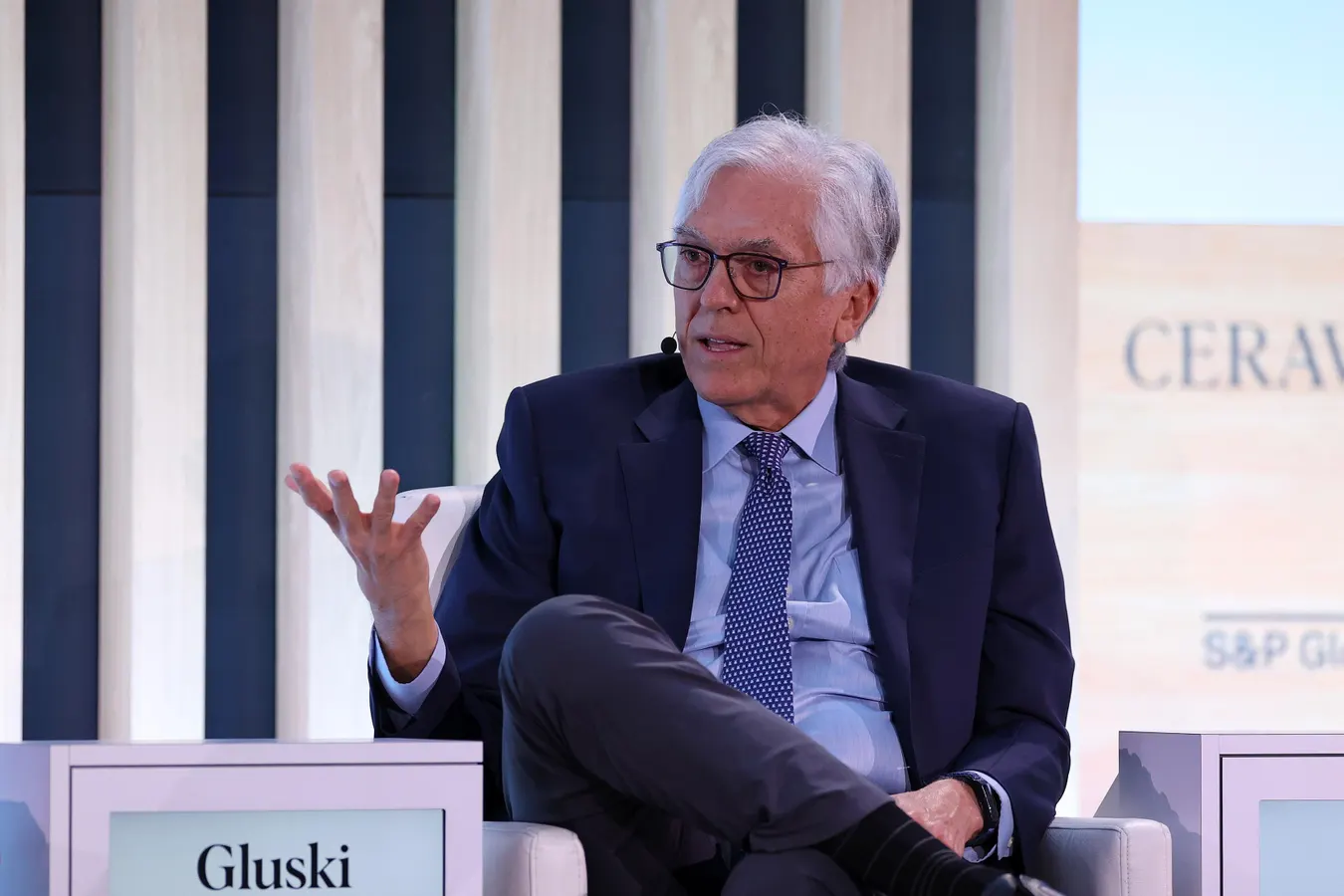

Andres Gluski, president and chief executive officer of AES Corp., speaks during the 2024 CERAWeek by S&P Global conference in Houston, Texas, US, on Friday, March 22, 2024. More than 7,000 people are headed to Houston to attend the conference with a key question in mind: How to meet increasing demand for power amid the transition to clean energy. Photographer: Aaron M. Sprecher/Bloomberg
© 2024 Bloomberg Finance LP
Last week, the Private Equity Stakeholder Project (PESP) ran its familiar stop-the-deal playbook against AES Corporation’s pending acquisition by Global Infrastructure Partners (GIP) and EQT. Joined by consumer advocacy groups Public Citizen and Citizens Action Coalition Indiana, PESP petitioned the Federal Energy Regulatory Commission (Docket EC26-99) to block the $33.4 billion acquisition outright or force BlackRock, which owns GIP, to break up its utility holdings as a condition of approval.
BlackRock, led by founder and CEO Larry Fink, always makes for an easy target to help boost activist group fundraising, but this deal should not be controversial. The opposition’s argument – that the consortium of would-be owners is attempting a hostile takeover of a captive utility monopoly in Indiana and west-central Ohio – is long on rhetoric but short on facts. Hoosiers and Ohioans who depend on AES Indiana and AES Ohio for their power deserve a clearer picture.
The AES Deal Does Not Fit The Opposition’s Model
The private equity horror scenario pushed out by the critics is familiar enough and valid in some cases: a financial acquirer loads a target company with debt to finance the acquisition premium, engineers fees and dividends back to itself, cuts operational investment to service that debt, and exits before the damage lands on customers. That model is a legitimate concern in industries where it has actually played out. But that isn’t what’s happening in Indiana and Ohio.
AES Corporation was not strong-armed into a shady deal. As I detailed in my March column, AES Board Chairman Jay Morse said as much on the day the deal was announced: the company had a significant and growing capital need to fund its infrastructure buildout beyond 2027, and without this transaction, the most likely path forward involved cutting or eliminating the dividend and issuing large amounts of new equity to dilute existing shareholders.
AES has signed 11.8 gigawatts of agreements to supply major technology firms globally, and its regulated utilities in Indiana and Ohio serve 1.1 million customers between them. Building out that kind of capacity requires a scale of investment that quarterly earnings calls and dividend expectations simply cannot accommodate.
AES Deal Is A Private Capital Infusion To Meet Clear Market Needs
Private capital stepping in to meet a demonstrated market need, endorsed by the utility itself, is not predation. The actual structure of the deal tells that story. The consortium is funding the entire purchase price with equity, layering no new debt onto AES to finance the acquisition premium. That is the opposite of the leveraged model critics claim to fear, and the major credit rating agencies have affirmed AES’s investment-grade ratings with a stable outlook, with no downgrades tied to the transaction. That is the shape of a long-duration investment by firms whose returns depend on assets performing well for customers over decades, not on financial engineering and a quick exit.
On the question of customer impact, the terms again speak for themselves. The buyers have publicly committed that transaction costs and acquisition premiums will not be passed on to ratepayers. AES Indiana and AES Ohio will continue as locally operated and managed regulated utilities, subject to the same state oversight they have always been under. Management stays in place. Technical personnel stay in place. There is no financial engineering-based debt play. There is no short-horizon exit built into the deal. And there is no basis for the panic the well-funded opposition groups are peddling.
These advocacy groups present themselves as champions of ordinary customers who happened to notice a troubling utility deal in the Midwest. But Private Equity Stakeholder Project is an organization founded specifically to oppose private equity transactions across every industry, as its stated mission. When PESP files a FERC complaint against a deal involving private capital, it is doing exactly what it was created to do.
A Major Capital Infusion Into AES When It Is Needed Most
But when we read beyond the talking points, the transaction being protested isn’t the fight PESP was built for. The real story is a utility that needed capital, a management team that said so publicly, a board that voted unanimously to pursue this path, shareholders who endorsed it by nearly 98%, credit agencies affirming the company’s investment-grade standing, and long-term patient investors stepping in to play an important role. Calling that private equity predation requires ignoring most of the relevant facts.
The Federal Energy Regulatory Commission’s blanket authorization framework exists to encourage greater investment in utilities like AES at a time when such investment has never been more urgently needed. The question before the Commission is whether this acquisition serves the public interest. For the 1.1 million customers in Indiana and Ohio counting on grid investment to support advanced manufacturing, large load growth, and reliable power for their homes and businesses, the answer seems obvious.














Leave a comment