


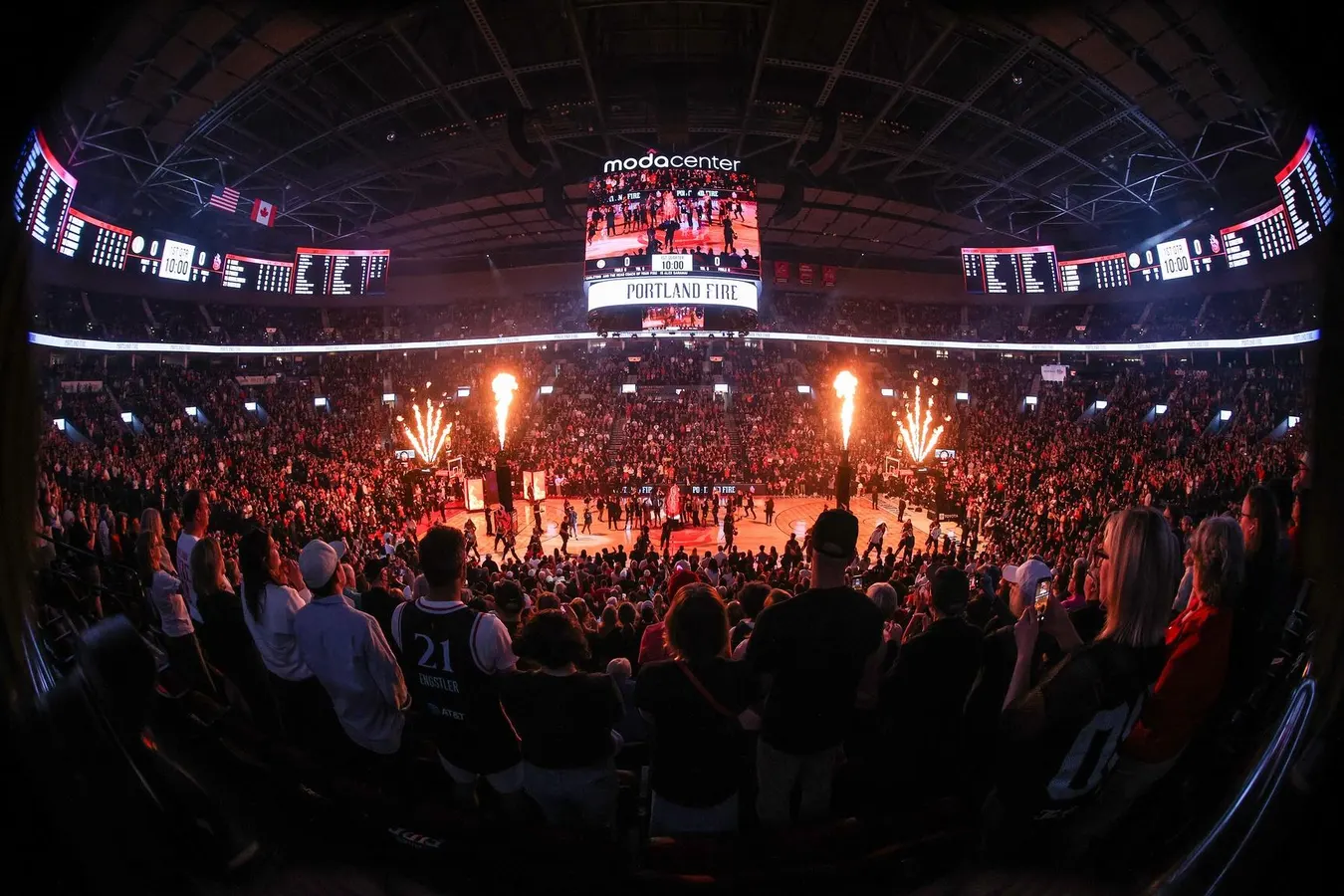

A fan cheers on The Golden State Valkyries during their game against the Indiana Fever at Chase Center in San Francisco on Thursday, June 19, 2025. (Photo by Anna Connors/San Francisco Chronicle via Getty Images)
San Francisco Chronicle via Getty Images
Enes Kanter Freedom has discovered women’s basketball. The former NBA center, who retired in 2022, announced this month that he is declaring for the 2027 WNBA Draft. Enes says he found a loophole in that the league’s collective bargaining agreement limits eligibility to “women” but never defines the word. On Sunday night he sat courtside at the Chicago Sky game wearing a shirt with a dictionary definition of a woman on it. He then antagonized Sky guard Natasha Cloud mid-game, distracting from the play on the court, and was eventually escorted out of the arena. The most ironic part of this display, was that all of this, he claims, is in the name of protecting women’s sports.
Wonderful. Welcome. There’s a lot to do that does not involve a plea of fairness. Because what so many are mobilized against at this moment, a transgender woman taking a WNBA roster spot, has never happened in the 29-year history of the league. Meanwhile, the things that will actually determine whether women’s sports survive and grow have existed for decades – and those issues demand the same energy currently being exerted on hypothetical occurrences.
MONTREAL, CANADA – JULY 12: Marina Mabrey #3 of the Toronto Tempo drives to the basket against Han Xu #21 of the New York Liberty during the first half in the WNBA game at the Bell Centre on July 12, 2026 in Montreal, Quebec, Canada. NOTE TO USER: User expressly acknowledges and agrees that, by downloading and or using this photograph, User is consenting to the terms and conditions of the Getty Images License Agreement. (Photo by Minas Panagiotakis/Getty Images)
Getty Images
First and foremost, these new loud pleas for fairness in women’s sport rest on a premise that has never existed, namely that sport itself is inherently fair. To assume sport is inherently fair is to assume that every girl or boy who plays enters from the same starting line, and that the inclusion of transgender athletes would disrupt an otherwise equitable system. While this seems to be a widely held belief, it is not supported by the evidence. Athletes who are stronger, faster, taller, and born with the right physiology have not only won more than their peers but have also ascended to the highest and most elite levels of their sport, regardless of gender.
A large review of these types of phenomena, a meta-analysis of more than 250 samples across sports published in Sports Medicine, found that being among the oldest in an age cohort reliably predicts selection and success, from youth leagues through the professional ranks. Whether a young athlete ever gets an opportunity also depends as much on their zip code as their talent. Those opportunities often depend on whether their city or town has a rink or a pool or a lacrosse field, or whether their high school hosts a team in that particular sport or only a shorter list of offerings it can afford.
Hingham, MA – January 13 – Central Catholic #4 Caroline Vient and Notre Dame #10 Katherine Chisholm dive for a loose ball during the second half of a girls basketball game. (Photo by Matt Stone/MediaNews Group/Boston Herald via Getty Images)
MediaNews Group via Getty Images
Continued success in their playing endeavors may also depend on whether the club team they may or may not be able to afford, attends the right tournaments where college scout’s visit. Importantly, money does not fully solve these inequities. A family can be willing to pay for gymnastics or basketball and still live several hours from the nearest elite club, and a child with no role models in a particular sport may also be less likely to seek out participation regardless. As a result, elite sport opportunities have long sorted people via their unearned physical advantages layered on top of training, resources, luck, and where they happened to grow up. Fairness, in the sense the current debate is stuck on, has never been an inherent standard that sport can match.
Currently, American sporting culture often treats access and elite participation as a privilege rather than a right, and it is worth being clear about that before anyone is excluded in the name of unsubstantiated fairness. And since no entity would have the power to make sport fully fair, it is worth turning to actual threats to the long-term success of women’s sport.
1. Lack of Coverage.
Women’s sports receive roughly 5-15 percent of televised sports news coverage, and when single mega-events like the Women’s World Cup or the Olympics are removed from the count, those estimates often drop significantly. Previous research has tracked this coverage gap for more than 30 years, and not only has the pattern barely moved, without platforms such as youtube and social media, women’s sport would see minimal gains across media representation. Women’s sports break through for a brief moment around an elite international competition, and then the year-round, in-season and out-of-season coverage of men’s sports resumes. Coverage of women’s sport is also consistently produced with less energy, lower production value, and fewer resources than its men counterparts. Audience size cannot grow for a product that is rarely shown (preferences do not develop in isolation of exposure) and rights deals cannot be accurately sold for a product most audiences do not know exists. The recent growth in WNBA viewership demonstrates what happens when women’s sport is actually put in front of audiences. It has taken three decades to get to this level with WNBA programming, and yet most of the coverage gap across the entirey of women’s sports still remains.
SAN JOSE, CA – SEPTEMBER 17: ESPN camera captures pregame activities before game two of the first round of the WNBA Playoffs between the Minnesota Lynx and the Golden State Valkyries on September 17, 2025 at SAP Center at San Jose in San Jose, CA. (Photo by Matthew Huang/Icon Sportswire via Getty Images)
Icon Sportswire via Getty Images
2. Pay the players.
The WNBA signed a new CBA in March. In the NBA, the players’ share of basketball-related revenue hovers around 50%. WNBA players receive roughly 10% of league revenue. This has historically equated to lower salaries and fewer benefits, meaning that many women spilt their year between WNBA play and oversees contracts in order to make ends meet and maximize their earning potential in a short window of time. This is a burden that NBA players have rarely had to navigate.
3. Fund Women’s College Sport.
The pipeline to every professional women’s league runs through college athletics, and college athletics undergoing immense change due to the House settlement, NIL, roster limits, and direct revenue sharing with athletes. Every one of those decisions can quietly reallocate resources away from women’s programs, and most of these decisions will be made with little to no transparency. Compounding this issue is the fact that Title IX continues to be weakened throughout the NIL era of college sport. Currently, there is little transparency regarding revenue sharing decisions and NIL resourcing at the institutional levels. This lack of transparency is hurting women’s college sport, and women’s teams remain underresourced and unable to maximize the potential benefits NIL affords their athletes.
COLLEGE PARK, MARYLAND – MARCH 24: Zaay Green #14 of the Alabama Crimson Tide and Allie Kubek #14 of the Maryland Terrapins battle for a rebound during the second half in the Second Round of the 2025 NCAA Women’s Basketball Tournament at Xfinity Center on March 24, 2025 in College Park, Maryland. (Photo by Patrick Smith/Getty Images)
Getty Images
4. Build NIL Infrastructure That Women Can Actually Use.
While women’s basketball players have been among the most marketable college athletes in the country for several years, the structures that route the largest NIL dollars are built around football and men’s basketball. As a result, the deals women land are disproportionately social-media driven and individually negotiated with little resourcing spent to assist them at the university level. This has led to a talent-development problem as well as gaps in leveraging women athlete marketability. If you want to protect women’s sports, you should make sure the university’s NIL ecosystem effectively serves a volleyball player in the same way it effectively serves a left tackle.
5. Solve the Dropout Phenomenon.
Previous research has determined that adolescent girls drop out of sport at higher rates, and at earlier ages, than boys, with the average dropout occurring between the ages of 11-14. Girls often exit sport when they stop believing they are good enough and stop seeing sport as something that will benefit them long-term. Girls from lower socioeconomic backgrounds also participate at lower rates, report less parental support, and face more structural barriers, including fewer facilities in their neighborhoods, no transportation to venues, and no awareness that programs exist. As girls move through adolescence, the sport options available to them narrow considerably compared to what is offered to boys, and the dropout rate follows. In one national dataset, sports club participation after age 15 fell by 42 percent for boys and 60 percent for girls. Importantly, very little effort has been given to designing intervention protocols and policies that help keep girls in the game.
ARLINGTON, TX – JUNE 28: Minnesota Lynx guard Olivia Miles (5) dribbles past Dallas Wings guard Azzi Fudd (35) during the WNBA game between the Dallas Wings and the Minnesota Lynx on June 28, 2026, at College Park Center in Arlington, TX. (Photo by Adam Davis/Icon Sportswire via Getty Images)
Icon Sportswire via Getty Images
6. Fund Medical Research.
Medical research and protocol focused specifically on girls and women is lacking substantially. Women and girl athletes tear their ACLs at substantially higher rates than men and boy athletes. Roughly 1 in 29 women/girl athletes will sustain an ACL injury compared with 1 in 50 men/boy athletes, equating to a risk for women and girls that is roughly 1.5 times higher. ACL tears can often be season-ending and sometimes career-ending injuries, and they often impact those women athletes in leagues with the greatest chance at visibility and revenue growth (such as soccer and basketball).
Funding for research that can assist in better understanding and resolving some of these gaps is far too limited. Most of what sport science currently knows about training load, return-to-play, and injury prevention was established based on men’s bodies and applied to women and girl athletes by default. While the injury rates are documented, the research base and funding to address them is far too limited.
CLEVELAND, OHIO – APRIL 07: Head coach Dawn Staley of the South Carolina Gamecocks cuts down the net after beating the Iowa Hawkeyes in the 2024 NCAA Women’s Basketball Tournament National Championship at Rocket Mortgage FieldHouse on April 07, 2024 in Cleveland, Ohio. South Carolina beat Iowa 87-75. (Photo by Gregory Shamus/Getty Images)
Getty Images
7. Fix Sport Industry Workplace Culture.
Women remain a minority of the people employed to lead, coach, and cover women’s sport. Before Title IX, more than 90 percent of women’s college teams were coached by women. Today, across the seven most powerful NCAA Division I conferences, women only represent 47.5 percent of coaches for women’s teams, with recent measures indicating continued declines. Roughly one in ten head coaching positions for women’s teams turns over each year, and fewer than half of those openings are filled by women. And for the women who do work in the industry, they often describe a consistently hostile environment. Overall, women are more likely to voluntarily leave the coaching occupation due to these cultures. In addition, women coaches continue to be overlooked for coaching positions at the highest levels of men’s sport, despite unparralleled success. Men have access to leadership roles across the entire sport industry ecosystem. Women remain restricted to the women’s sport industry segments. The sport industry culture was built by men for men, and the ecosystem continues to prioritize a set a unwritten rules that largely benefit men.
Sport Has Never Been Fair
Researchers, physicians, coaches, and the athletes themselves have been raising each of the aforementioned agenda items for decades. None of the issues that continue to plague women’s sport growth are new in any capacity. The component that is new is this sudden arrival of a large and vocal constituency insisting that it wants to protect women’s sports. So far, that constituency has produced legislation, cable segments, and a draft declaration from a retired NBA center. None of those items solve the realities of what women’s sports continue to be held back by. Instead, that energy should shift towards calls for better television deals, more equitable revenue-sharing agreements, Title IX enforcement and policy interpretation updates that match the current ecosystem, interventions to keep girls in sport past middle school, and meaningful funding for research on women’s and girls athletes. The women and girls who play these sports have been clear about what they need for decades, and any focus on a fictional level of fairness is a waste of time, energy, and resources.













Leave a comment