


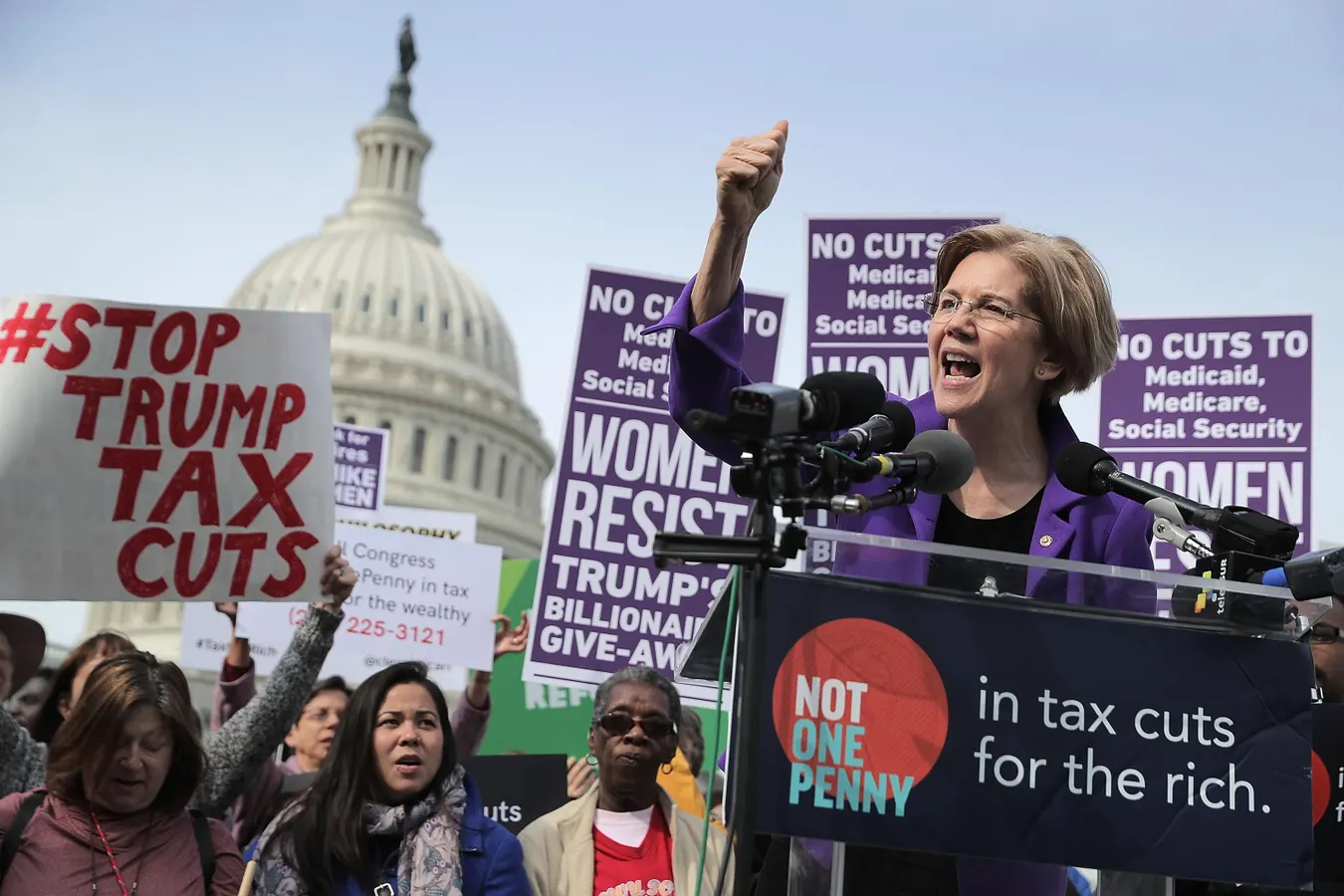

Warren Tax Scrutiny
Getty Images
Billionaire entrepreneur and media personality Mark Cuban has been no stranger to publicly addressing taxes in the U.S. He has been seen on X sparring with politicians over the proposed California billionaire tax, all the way to what it means to pay his “fair share” in taxes. In fact, when a critic asked in 2024 whether he or his companies pay more than they legally owe or if they are engaging in tax avoidance, Cuban wired the IRS $288 million and posted about it, writing, “I pay what I owe.”
These sentiments have been increasingly echoed throughout the political environment as many high-profile politicians like Senators Elizabeth Warren and Bernie Sanders, Representative Ro Khanna, and Mayor Zohran Mamdani have turned up the dial on their criticism of wealthy taxpayers and corporations not paying their fair share of income taxes. Many of these criticisms have directly led to proposals to increase taxation on these specific classes of taxpayers, with no direct taxes being levied on others.
Senator Warren has perhaps been the most outspoken about this issue. According to The Washington Post, Warren stated that anyone who “paid even a penny in federal income tax last year” paid more than Tesla, Southwest, Disney, Live Nation, HP, United, PayPal, CVS Health, Palantir, Citigroup, PG&E, and 3M combined, since all of them reported $0 in federal income tax. She capped it with a now-familiar line: “It’s time for big corporations to pay their fair share.”
Social media posts like Warren’s are designed as a form of public shaming. However, a natural question arises as to whether these aggressive actions actually work. A recently published academic research paper examines this question, and the results are consistent with public shaming leading to lower tax avoidance.
What Counts As Legal Tax Avoidance?
Taxpayers rarely pay taxes at their exact statutory tax rate. Instead, they are afforded opportunities to lower their income tax liability by way of legislative grace – tax legislation introduced and passed by Congress designed to address economic, social, and/or equity considerations. These actions are often referred to as tax avoidance, as the taxpayers are legally lowering their tax burdens in a way that was designed by U.S. policymakers.
Tax avoidance differs from the more nefarious term of “tax evasion”, which is the lowering of tax burdens through illegal means. These illegal methods can range anywhere from not reporting all income, overstating deductions, or simply falsifying tax forms. Engaging in tax evasion can lead to penalties and fines and, in extreme cases, imprisonment.
The public controversy over the amount that wealthy taxpayers and corporations pay in income taxes might be misleading. To date, Mark Cuban has never been formally accused of tax evasion, and the vast majority of companies that pay little or no income taxes are named by Senator Warren are subject to an IRS audit every year with no major legal actions. In fact, many of the reasons why these taxpayers pay less than the statutory tax rates are because they are doing things that the government wants them to do.
Thus, a natural question arises as to why people publicly shame these taxpayers and whether the public shaming impacts their subsequent tax-related decisions.
Does Online Criticism Alter Tax Avoidance?
A recently published academic research paper in The Accounting Review titled “Social Tax Discontent and Individual Tax Avoidance,” by Andrew Belnap (University of Texas at Austin), Kevin Standridge (University of Arizona), Jacob Thornock (Brigham Young University), and Braden Williams (University of Texas at Austin) seeks to examine the question about whether public frustration over other people’s tax avoidance impacts a person’s own tax avoidance. The study specifically uses social media as a means to examine this public frustration.
To measure that, the authors built a “social tax discontent” score from approximately 500,000 geolocated, tax-related tweets posted between 2014 and 2022. The authors then used a language-classification model trained to identify posts expressing frustration or criticism about somebody else’s tax avoidance. They used county-level measures of IRS-reported non-wage income and economic activity provided by governmental organizations like the Bureau of Economic Analysis and Bureau of Labor Statistics. This approach allowed the researchers to estimate how much avoidance is happening.
“Public criticism of tax avoidance appears to matter,” the authors write. “When people are exposed to more social disapproval of others’ tax avoidance, they appear to engage in less tax avoidance themselves.” The effect was concentrated in business income, where taxpayers have the most reporting discretion, and it was driven specifically by criticism directed at other taxpayers rather than general complaints about the tax system.
Two other patterns stood out to the authors: (1) The reduction in tax avoidance was strongest among criticism aimed at wealthy taxpayers specifically, and (2) It was concentrated among higher earners, particularly those with adjusted gross income above $100,000. In other words, the people being publicly criticized are also the people most likely to respond to it.
Before beginning their analysis, the authors were not sure if this was the result that they would find. They stated, “If people constantly hear that wealthy individuals or companies are avoiding taxes, they might conclude that everyone does it, which could normalize avoidance and reduce their own willingness to comply.” A finding like this goes against the results that ultimately prevailed in the data.
Instead, the evidence points the other way. “Our evidence suggests that the moral-condemnation effect dominates the normalization effect: public criticism appears to reinforce the idea that tax avoidance is socially unacceptable,” the authors write. In terms of the economic magnitudes, they estimate that “a one-standard-deviation increase in social tax discontent is associated with approximately a 0.2% increase in reported non-wage income,” with estimates across specifications ranging up to about 0.3%. Applied to the study’s average county-year of roughly $1.4 billion in non-wage income, even a small percentage shift adds up to a meaningful dollar amount.
That’s a notable finding on its own, since nothing about tax rates, audit odds, or penalties changed. The behavioral shift came entirely from social media pressure.
For the tax authorities, the authors argue that these findings suggest that this represents an additional lever that they can pull to help enforce the tax laws. As noted by the authors, “Discontent with others’ tax avoidance activities expressed on digital platforms may influence taxpayer behavior, which implies tax authority and politicians’ efforts to manage taxpayer beliefs and leverage social norms can complement traditional enforcement tools. As jurisdictions adapt to a more digitally connected and socially visible world, understanding the mechanisms through which social forces shape individual tax-paying behavior becomes increasingly critical.”
The Implications Of Online Criticism Altering Tax Avoidance
A key outcome from this manuscript’s findings is that it changed the narrative over the aims and directive of public shaming of wealthy taxpayers and corporations’ taxes. Thus, when Cuban answers a critic by publicizing exactly what he paid, or when Warren singles out specific companies by name for paying zero income taxes, the exchange can now be viewed as more than just political theatre and instead, it is a public friction to form more meaningful and measurable changes.
However, none of this settles whether current wealth tax or pied-à-terre tax are good tax policy. What this study adds is evidence that the louder, messier fight happening on social media over who is and is not paying their “fair share” may be doing some of the work that legislation is designed to do — nudging taxpayers toward reporting more taxable income and less tax avoidance.















Leave a comment