


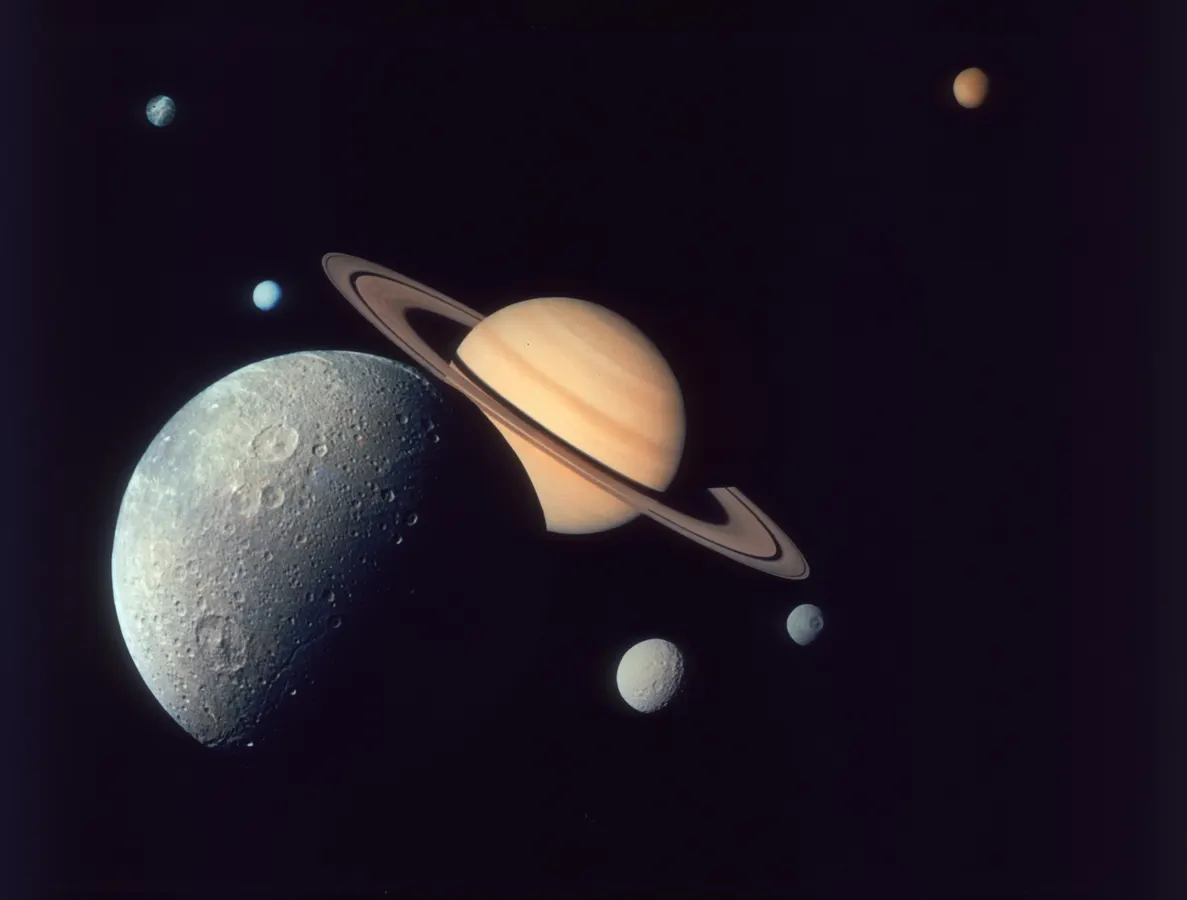

Just as Saturn is ringed by hundreds of globe-shaped moons, giant planets across the Milky Way might be surrounded by exotic exomoons, including some that are habitable, astronomers predict. (Photo by Space Frontiers/Hulton Archive/Getty Images)
Getty Images
Astronomers are counting down to using the just-launched Roman Space Telescope to scan the Milky Way for alien moons that might be habitable, says one of the telescope’s chief scientists.
Professor B. Scott Gaudi, who heads a team leading NASA’s Roman Galactic Exoplanet Survey, told me in an interview that the galaxy likely hosts trillions of alien moons, with some orbiting in the perfect temperate zones of their star conducive to life.
“In our own Solar System,” he says, “all of the giant planets have a lot of moons,” and NASA estimates there could be 400 billion star systems sprinkled across the Milky Way.
During the upcoming galactic survey, using the most powerful and advanced camera even launched into space, astronomers might discover up to 200,000 planets, Gaudi predicts, including free-floating planets and moons that have been ejected from their star system.
Gaudi, the Thomas Jefferson Professor for Discovery and Space Exploration at The Ohio State University, told me his team will search for habitable moons in nearby sectors of the galaxy.
Awarded the NASA Outstanding Public Leadership Medal in recognition of his “outstanding leadership as the ExoPlanet Program Analysis Group Chairperson having significant impact on NASA’s search for exoplanets and life in the universe,” Gaudi is likely to be at the global forefront in conducting these searches.
In a pathbreaking paper that he co-authored, titled “Predictions of the Nancy Grace Roman Space Telescope Galactic Exoplanet Survey. III. Detectability of Giant Exomoons of Wide Separation Giant Planets,” he said: “The presence of an exomoon may impact the habitability of its host planet and exomoons may themselves be habitable.”
The Earth’s Moon, he told me, enhances the planet’s habitability by stabilizing the spin of the globe on its axis.
Without this effect, a wobbly spin could trigger radical changes in climate – even ice ages – that would make the Earth less habitable.
But the counter-argument, Gaudi says, is that the Earth’s rotation around its axis has been slowed down by the Moon over the past 4 billion years.
Originally it is estimated that the Earth spun much faster, completing one day in about 10 hours, which would have made its rotation much more stable, just as the stability of a gyroscope increases with its speed.
“The detection of moons with masses similar to the giant moons in our Solar System is possible with Roman,” says Gaudi, who has written a torrent of papers on the leading-edge technology and future discoveries of the Roman Space Telescope.
Some astronomers predict that as space-based telescopes become more powerful and sophisticated, they could set out to detect life-friendly moons inhabiting nearby stars, like the fantastical floating moon-world Pandora in the blockbuster film Avatar.
“If Pandora existed, we potentially could detect it and study its atmosphere in the next decade,” astrophysicist Lisa Kaltenegger said in a press release issued by the Harvard-Smithsonian Center for Astrophysics, where she was based then.
“If Pandora existed, we potentially could detect it and study its atmosphere in the next decade,” said astrophysicist Lisa Kaltenegger, director of the Carl Sagan Institute at Cornell University. Shown here is the fantastical moon-world Pandora, from the blockbuster firm Avatar, recreated by Walt Disney in Florida. (Photo by Gustavo Caballero/Getty Images)
Getty Images
“So far, planet searches have spotted hundreds of Jupiter-sized objects in a range of orbits,” added Kaltenegger, who is now director of the Carl Sagan Institute at Cornell University.
“Gas giants, while easier to detect, could not serve as homes for life as we know it. However, scientists have speculated whether a rocky moon orbiting a gas giant could be life-friendly, if that planet orbited within the star’s habitable zone.”
Just as Jupiter hosts rings of giant satellites, she predicted alien Saturns and Jupiters could also be orbited by titanic moons.
“Some of those [moons] may be Earth-sized and able to hold onto an atmosphere.”
Kaltenegger said the atmospheres of alien moons can be examined via a telescope’s spectrograph, which can detect life-connected chemical elements like oxygen, ozone and methane, along with water vapor.
She proposed that astronomers start these searches at Alpha Centauri, just four light years distant, and host of the Avatar moon Pandora.
In a fascinating paper she wrote titled “Characterizing Habitable Exo-Moons,” Kaltenegger predicted astronomers will soon begin detecting a spiral of habitable moons. “Transmission spectroscopy of Earth-like exomoons is a unique potential tool,” she said, “to screen them for habitability in the near future, especially for M [dwarf] stars.”
Professor Gaudi says despite the discovery of 6000 exoplanets that have been confirmed so far, along with the recent detection of 10,000 more candidate moons, comparatively little is known about their companion moons.
Professor Scott Gaudi says despite the discovery of thousands of exoplanets, comparatively little is known about their companion moons. Shown here is an artist’s conception of habitable-zone planets similar to Earth. (Photo by: Universal History Archive/ Universal Images Group via Getty Images)
Universal Images Group via Getty Images
The moons of the icy giants in the Outer Solar System, he says, have “orbits that are roughly circular and coplanar to the equator of the planet, likely indicating that they were formed concurrently with the planet in a circumplanetary disk.”
The imminent survey of the Milky Way by Roman Space Telescope astronomers, he adds, might quickly deepen and expand understanding of the physics of planet and moon formation across the cosmos.
He says Roman Telescope scientists will use an array of methods to detect exoplanets and exomoons, including searching for transits of planets across the face of their star, partially eclipsing its light in a repeated pattern of orbits.
Nearby planets might be directly imaged via the Roman Telescope’s cutting-edge 300-megapixel camera.
Some astronomers will also deploy the more experimental method of gravitational microlensing derived from Albert Einstein’s General Theory of Relativity.
After he spelled out how massive objects, like a cluster of galaxies, a single galaxy, or even a sole star can warp the fabric of spacetime, Einstein hypothesized that these objects could form fantastical lenses that magnify stellar systems aligned behind them.
These colossal, telescope-like lenses, fortuitously sprinkled across the cosmos, can help astronomers detect and map out distant galaxies gravitationally magnified.
Single stars can be used in gravitational microlensing to search for planets and even moons that are aligned with and pass in front of another star.
Professor Gaudi told me most searches will be conducted via detecting transits in a star-planet-moon system. Transits that transpire in relatively nearby sectors of the galaxy, he says, might allow scientists to use spectrographs to peer into the atmosphere of a passing planet to characterize its chemical make-up and search for potential biomarkers like oxygen and H20.
While transit searches to date have detected mostly giant planets that closely orbit their star, Gaudi says, the Roman Space Telescope, combined with using microlensing, will be able to detect more small rocky planets, and potentially their moons, that orbit farther away from their host star.
Could it be possible to directly capture images of a super-size moon with the telescope’s gigantic camera?
Launch of the Roman Space Telescope aboard a SpaceX Falcon Heavy rocket. (Photo by Joel Kowsky/NASA via Getty Images)
NASA via Getty Images
It might be possible to directly image giant moons with the next generation Habitable Worlds Observatory, Gaudi predicts.
One of the outstanding features of the Roman Space Telescope survey of the galaxy, Gaudi told me, is that its data and endless stream of images will be freely and openly released to scientists in real time, as soon as it is collected.
Gaudi says while conducting his own searches, he is planning to use an array of AI tools to filter and characterize the best planet and moon candidates from the raw data and imagery.
If the Roman Space Telescope’s mission is extended in five years, that could present the opportunity to do more refined searches for giant moons around giant planets in the galactic survey, he says.
But that will depend on how much fuel the telescope has five years from now. It might be possible to robotically refuel the observatory, which is already equipped with a docking mechanism for robotic service missions, he says, to extend its lifetime into the 2030s.
Across a series of increasingly sophisticated space telescopes and surveys, NASA ultimately aims to zoom in on habitable planets as it searches for biosignatures, or traces of life, and technosignatures, or signs of an advanced civilization, Bertrand Mennesson, the Roman Telescope’s Deputy Project Scientist, told me in a recent interview.
For decades, Dr. Mennesson has helped spearhead the search for off-world life, after he obtained a doctorate in astrophysics and space techniques at the University of Paris VII.
Since the turn of the century, he has helped guide NASA’s Jet Propulsion Lab in developing a succession of leading-edge observatories.
While aiding in the Roman Telescope’s countdown to launch, he has also served as science co-chair of the Habitable Worlds Observatory Technical Assessment Group.
An artist’s illustration of a transiting exoplanet and exomoon about to partially eclipse their star. (Photo by Future Publishing via Getty Images)
All About Space
The next-generation Habitable Worlds telescope, NASA scientists say, will focus on finding Earth doppelgängers that inhabit their star’s habitable zone.
The futuristic observatory will be able to directly image nearby twins of the Earth as photons from their sun bounce off their planetary surface and pass through their atmosphere.
As it surveys the galaxy, the Habitable Worlds Observatory will seek out “the fraction of the planets being habitable, and the fraction of these habitable planets being actually inhabited,” Dr. Mennesson told me.
“We will design future missions to objectively answer whether life as we understand it is rare or common in the solar neighborhood.”
The Habitable Worlds super-telescope, he says, will search for biosignatures “that may indicate that life, as we understand it, exists.”















Leave a comment