


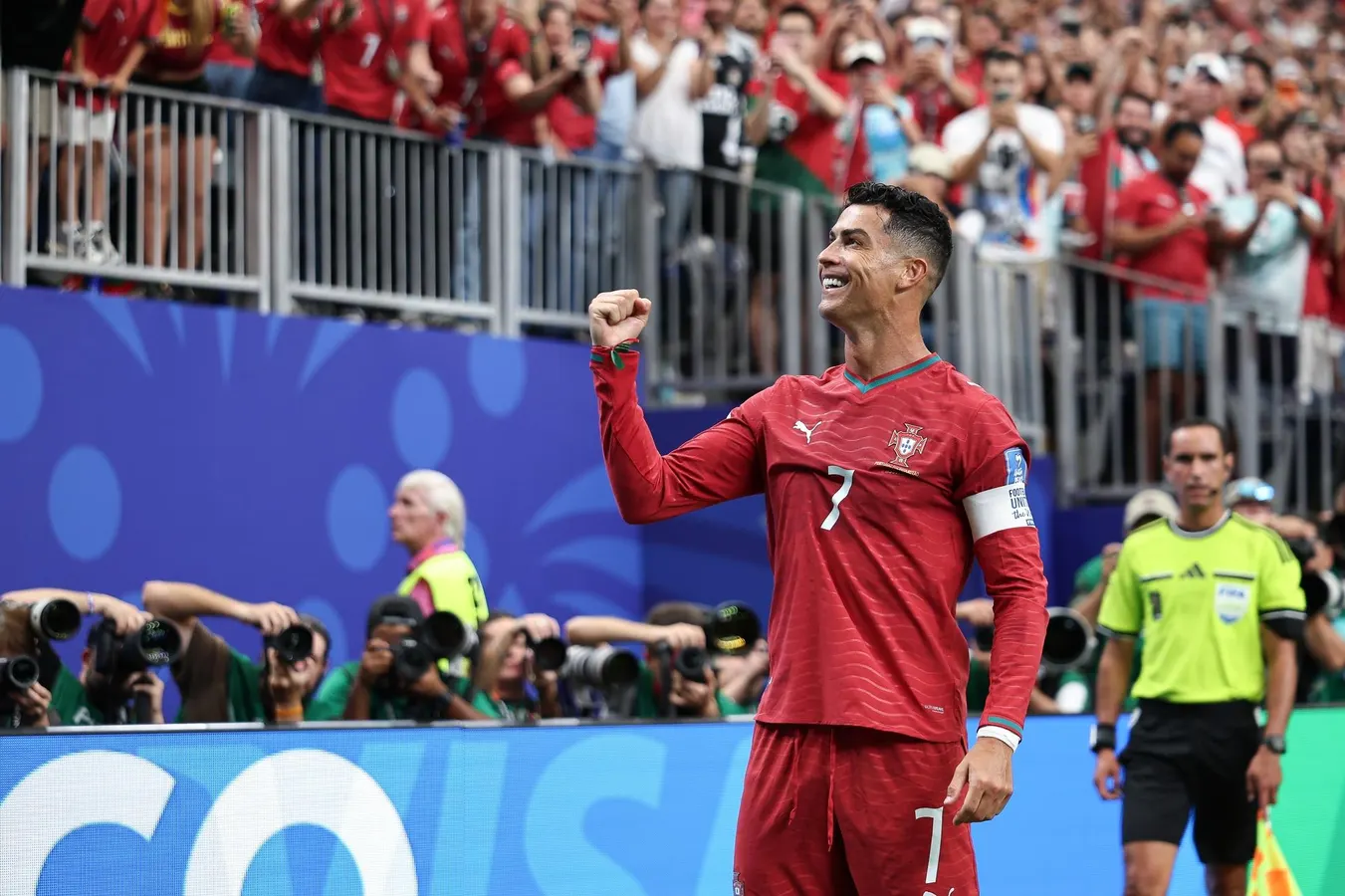

HOUSTON, TEXAS – JUNE 23: Cristiano Ronaldo #7 of Portugal celebrates after scoring his team’s third goal during the FIFA World Cup 2026 Group K match between Portugal and Uzbekistan at Houston Stadium on June 23, 2026 in Houston, Texas. (Photo by Omar Vega/Getty Images)
Getty Images
Every World Cup eventually becomes a story about time. Not the 90 minutes of a game or the additional time signaled by the fourth official. Instead, it serves as a reminder that even the greatest careers are finite.
At the FIFA World Cup, no player embodies that reality more than 41-year-old Cristiano Ronaldo.
For two decades, the Portugal star has existed as soccer’s ultimate exception. He has defied age, ignored conventional wisdom and extended a career that many believed should have ended years ago. After Portugal’s opening match at this tournament, the conversation surrounding Ronaldo was no longer whether he belongs on the field. It became a debate about what role the five-time Ballon d’Or winner should play as Portugal pursues another major international trophy.
Portugal arrived in North America with one of the deepest and most talented squads in the competition. Unlike previous generations, this team is no longer entirely dependent on Ronaldo, who remains one of the highest-paid athletes in the world with a big social media following. The roster is filled with young, dynamic attacking talent capable of carrying the load when needed. That reality, however, has not diminished Ronaldo’s importance, but it has changed it.
The transition was evident in Portugal’s opening 1-1 draw against DR Congo. Ronaldo started the match and struggled to make the impact. He found himself in positions that once seemed automatic scoring opportunities, but the finishing touch that defined so much of his career was missing. Questions emerged about whether age had finally caught up to one of the game’s greatest players.
Then came Portugal’s match on Tuesday against Uzbekistan. Ronaldo answered his critics with two goals in Portugal’s 5-0 win, reminding the world that his greatest gift has never been speed or athleticism alone. In doing so, he became the first player to score in six World Cups. While the explosive winger who terrorized defenders for Manchester United and Real Madrid is long gone, the elite goalscorer remains. His movement inside the penalty area, instinct for finding space and ability to deliver in crucial moments continue to make him a dangerous offensive weapon.
“I’m back! I’m back,” Ronaldo shouted into the camera after the final whistle.
Ronaldo’s goals gave him 10 career World Cup goals. Messi has 18 after a hat trick in Argentina’s opener against Algeria and two more on Monday against Austria that made him the tournament’s all-time leading scorer.
For younger fans, it may be difficult to remember just how dominant Ronaldo was at his peak. He was not merely a scorer, but a force of nature. He combined athleticism, skill and relentless determination in ways rarely seen in the modern game. For Portugal, he led his country to the 2016 European Championship, cementing his legacy as the most influential player in the nation’s history.
A decade later, Ronaldo is a different player. Time has reduced the explosive acceleration that once separated him from everyone else. The ability to create chances entirely on his own has become less frequent. What remains is a veteran striker who relies on positioning, experience and instinct. He’s had to adapt his game learn to share with his teammates. Fortunately for Portugal, those qualities can still decide big games.
Most elite players call it quits before reaching their late 30s. Ronaldo has not only surpassed that benchmark, but has remained a starter for one of the world’s best national teams. That achievement alone places him in rare company.
International soccer can be unforgiving. National team managers are judged by results, not sentiment. Portugal’s younger attackers offer greater mobility and pressing ability, while Ronaldo provides a proven finishing presence and invaluable leadership. The challenge for manager Roberto Martinez is not deciding whether Ronaldo should ride the bench, but determining how to maximize his impact throughout a demanding tournament.
Ronaldo no longer needs to carry Portugal on his shoulders. This team is talented enough to share that responsibility. But as his brace against Uzbekistan showed, writing off Ronaldo remains a dangerous mistake. Time may eventually catch every athlete, but Ronaldo continues to prove that he is not ready to surrender to it just yet.
Clemente Lisi is the author of “The World Cup: A History of the Planet’s Biggest Sporting Event, 2026 Edition.”












Leave a comment