


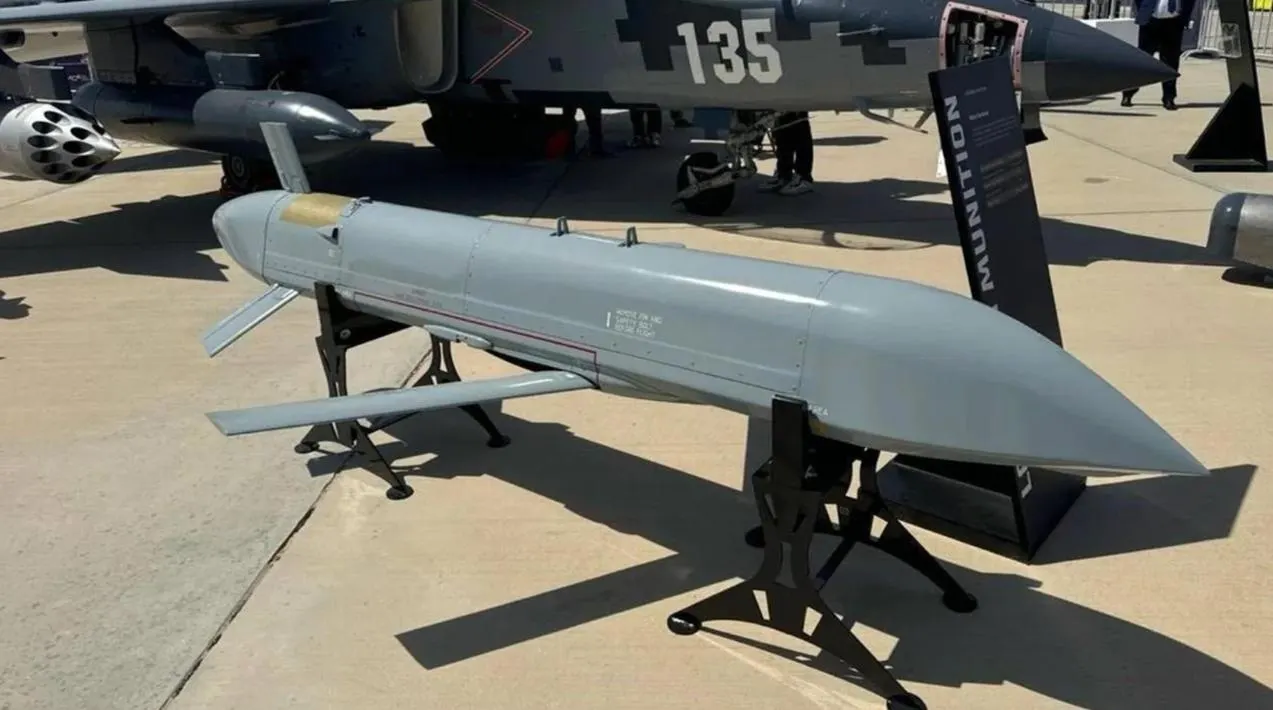

Image captured from a social media post depicting a Russian Dan-T loitering munition at an airshow.
Social Media Capture
Since the start of Russia’s invasion of Ukraine, both countries have introduced a number of new technologies to the battlefield. Among these technologies, loitering munitions have been used extensively by Russia for both tactical and strategic strikes. Russia’s primary loitering munitions have been the Geran series, which are based on Iranian Shahed designs. In the past year, Russia has introduced several new loitering munitions, most recently the Dan-T. This jet-powered loitering munition was unveiled at the El Alamein International Airshow in Egypt in September 2026 and has already been incorporated into Russian attacks. The Dan-T provides Russia with a new capability that adds to its diverse arsenal of long-range strike weapons.
Specifications Of The Dan-T Loitering Munition
The Dan-T is a jet-powered loitering munition that resembles a small cruise missile. It has a slender cylindrical fuselage with swept wings and a conventional tail, rather than the broad delta-wing shape characteristic of the Geran family. Released images of the aircraft make it appear to be over 3 m long with a wingspan of approximately 2 m. It has a launch weight of 268 kg, making it significantly smaller and lighter than conventional cruise missiles. The Dan-T is reportedly powered by a domestically produced Russian MD-120 turbojet engine. The system is also being outfitted with upgraded electronics intended to improve its resilience against Ukrainian electronic warfare systems.
Unlike many Russian loitering munitions, the Dan-T is designed to be air-launched from either fixed-wing aircraft or helicopters, including the Su-34, Su-57, and Mi-28, and can also be integrated with foreign aircraft. A ground-based launching system has also been developed, increasing the tactical utility of the weapon. After release, the Dan-T operates as a fire-and-forget weapon, autonomously navigating to a pre-programmed target using a combination of inertial navigation and satellite guidance. It reportedly flies at low altitude while following the terrain and avoiding obstacles. As it approaches its target, the Dan-T abruptly gains altitude before diving vertically onto the target from above.
Image captured from social media post reportedly showing an employee from Rostec describing the capabilities of the Dan-T loitering munitions.
Social Media Capture
The Dan-T has a reported range of 450 km and a maximum speed of 500 km/h. This makes it considerably faster than the propeller-driven Geran-2, while the jet-powered Geran-3 provides a closer comparison in speed and the newer Geran-5 can reach approximately 600 km/h. However, all three Geran variants have greater ranges than the Dan-T, with the Geran-5 capable of traveling nearly twice as far. The Dan-T makes up for its shorter range with a 130 kg warhead, which is larger than those typically carried by the Geran series. Its range, speed, and payload remain significantly below those of Russia’s conventional cruise and hypersonic missiles, but the Dan-T is considerably less expensive and requires fewer resources to produce.
Development And Deployment Of The Dan-T Loitering Munition
The Dan-T is reportedly based on the Dan-M aerial target, a jet-powered drone used to train Russian air-defense units by replicating incoming aircraft and cruise missiles. The Dan family of drones was originally developed by the Kazan-based Sokol Design Bureau, while Rostec, the Russian state-owned industrial conglomerate, is responsible for marketing the Dan-T for export. The Dan-T retains the basic aerodynamic configuration and jet propulsion of the Dan-M but modifies the platform for one-way attack missions. The Dan-M’s recovery parachute and Luneburg lens, which increased its radar signature for training purposes, were removed to provide space and weight for a warhead and combat guidance equipment. As an aerial target, the Dan-M was designed to be relatively inexpensive and has an established supply chain capable of supporting mass production.
Some analysts speculate that rather than simply being a modified Dan-M, the Dan-T is actually a modified or export version of the S8000 Banderol, which would also explain its public unveiling at an Egyptian airshow. The S8000 Banderol is produced by Russian drone manufacturer Kronstadt and has been used in Ukraine since 2025. The two systems have very similar specifications, physical characteristics, and methods of employment, making them difficult to distinguish in combat. Russia has not publicly clarified the relationship between the two systems, although some analysts suggest that the Dan-T may replace the S8000 Banderol because it is approximately 35 percent cheaper to produce.
Image capture from social media showing that the Ukrainian Air Force shot down 177 Geran-style drones, 1 cruise missile, and 8 Banderol/Dan-T loitering munitions on September 22, 2026.
Social Media Capture
Although Russia first publicly acknowledged the Dan-T in September 2026, Ukrainian sources had identified it as a new Russian weapon a month earlier. At the El Alamein Airshow, Rostec claimed that the weapon had already completed hundreds of successful combat launches. Because the Dan-T and Banderol are difficult to distinguish during attacks, Ukrainian reports often identify incoming weapons simply as “Banderol/Dan-T,” making it difficult to determine how many Dan-Ts have actually been used. Since September, there has been a noticeable increase in reports of attacks involving the two weapons. On September 17, the Ukrainian Air Force reported that Russia launched ten Banderol/Dan-T weapons as part of a large-scale attack involving missiles and more than 150 drones. Three more were reported the following day. On September 21-22, Russia launched another eight as part of a broader attack involving Geran drones and conventional cruise and ballistic missiles.
The Impact Of The Dan-T Loitering Munition On The Battlefield
The Dan-T reflects Russia’s broader shift toward faster, jet-powered loitering munitions. Ukraine has increasingly relied on inexpensive interceptor drones to destroy slower Geran-2s, creating an incentive for Russia to develop systems capable of outrunning them. This has contributed to the introduction of jet-powered systems such as the Geran-3, Geran-5, Banderol, and Dan-T. At the same time, Russia continues to operate slower Geran-2s and other one-way attack drones. The resulting diversity of speeds, flight profiles, ranges, and signatures complicates Ukrainian air defenses by forcing them to contend with multiple threat types during the same attack.
Image captured from social media showing an illustration of the Dan-T loitering munition in flight.
Social Media Capture
However, the value of weapons such as the Dan-T depends heavily on Russia’s ability to produce them in large numbers. Recent reports indicate that Russia wants to produce up to 2,000 Dan-Ts by the end of 2026 and as many as 14,000 in 2027, although these targets may be difficult to achieve. The Dan-T’s use of an established Russian design and domestically produced engine could help support these production goals. By comparison, the Geran-3 relies on a Chinese Telefly JT80 turbojet, leaving its production dependent on continued access to foreign engines. The Dan-T also builds on an existing supply chain and is significantly cheaper and less resource-intensive than a conventional cruise missile, making large-scale production more practical.
As the war continues, Russia will continue to develop new loitering munitions that are faster, more survivable, and better able to penetrate Ukrainian air defenses. These improvements require more sophisticated engines, sensors, navigation systems, and countermeasures, which increase costs and limit the ability to mass-produce the weapons. Therefore, Russia faces a tradeoff between making its loitering munitions more capable and preserving the simplicity that allows them to be mass-produced. The Dan-T represents one approach to that problem, combining the speed and payload of a small cruise missile with the simpler design, established supply chain, and lower cost expected of a loitering munition.















Leave a comment