


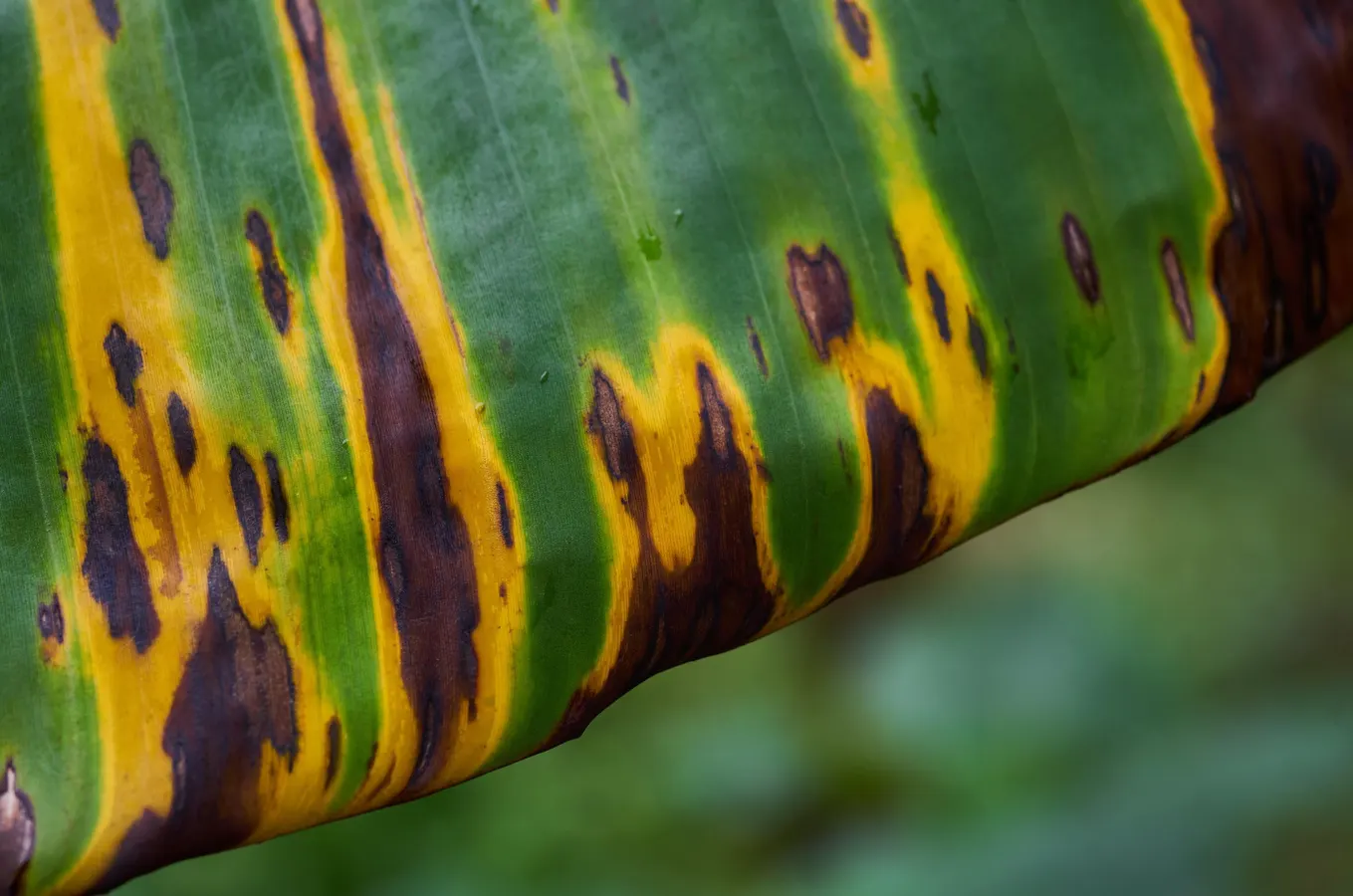

This close-up of a banana leaf showcases distinctive yellow and brown spots, commonly caused by fungal infections.
getty
What would happen if the most consumed fruit around the world—bananas—one day disappeared from grocery store shelves? This is not a science fiction scenario; it is a real threat facing banana producers worldwide. Banana plants from Asia to South America are dying from Panama disease, caused by a soil fungus, Fusarium oxysporum, and there is currently no cure for it.
It is not the first time in history this has happened. Up until the middle of the twentieth century, the majority of commercially produced bananas were different from the ones we eat today. The Gros Michel banana variety (which our grandparents may still remember) was said to be sweeter and more aromatic, inspiring the artificial banana flavoring that most of us would agree differs significantly from today’s bananas. In the 1950s, however, Gros Michel was wiped out from commercial production by Fusarium wilt, forcing growers to switch to the Cavendish variety that was resistant to the disease.
A Perfect Killer
It was not long before the Cavendish plantations too began showing signs of Panama disease. Scientists first reported Cavendish bananas infected with Fusarium wilt in Taiwan in 1968. By the early 2000s, it had spread to Australia, then to Africa, finally arriving in Latin America in around 2019. But it was not the same fungal pathogen this time. While the 1950s outbreak was caused by Fusarium Race 1, the current pandemic is caused by the Tropical Race 4 (TR4) variety, which is even more virulent than the original strain.
The Fusarium TR4 is a perfect killer, designed to seek and destroy every banana plant in its path. The disease is virtually impossible to eradicate: the infection colonizes the plant’s internal vascular system, making it virtually impossible to treat with fungicides, and the fungal spores can persist in the soil for decades.
“There are not many tools available to control this pathogen,” says Li-Jun Ma, professor of Biochemistry and Molecular Biology at UMass Amherst, who studies fungal pathogens within the Fusarium family. Her research has helped identify the key differences between the original Race 1 and the newer TR4 strain, which could provide important clues about how to fight the current banana pandemic.
Interestingly, TR4’s extreme virulence did not arise from gradual evolution, but rather as a deadly combination of factors from different fungal strains. When TR4 found a way to effectively infect one tree, the whole banana population became vulnerable because all commercial bananas are propagated from the same clonal stock—meaning they are virtually genetically identical, and therefore equally susceptible to this virulent pathogen.
“It’s very hard to fight against the fungus,” says Ma. “It is very aggressive and spreads rapidly. And the fact that bananas are a monoculture means that plantations all over the world are endangered.”
Ma’s work showed that TR4’s virulence comes from its ability to produce nitric oxide gas, which weakens plants’ immune defenses. The nitric oxide pathway is therefore a potential vulnerability for TR4.
“When we knock out individual genes in the nitric oxide pathway, we see about a 50% reduction in virulence,” says Ma. “However, removing individual genes may not have the same effectiveness as removing the upstream transcriptional regulation of the whole pathway.”
One way to target the transcriptional machinery essential for fungal virulence is by using a technology called RNA interference (RNAi), which takes advantage of a natural cellular mechanism to suppress specific genes. By engineering plants to produce pathogen-targeting RNA sequences, scientists can turn them into RNAi factories. This approach is already being used against pests such as corn rootworm in SmartStax PRO® corn, and it could potentially work against Fusarium wilt. Ma’s group at UMass is currently looking for collaborations to pursue the development of this technology.
Banana Resistance
A complementary way to fight Fusarium wilt is to make bananas themselves resistant to the disease.
A company called Tropic Biosciences has been working on developing TR4-resistant bananas using a combination of gene editing and RNA interference approaches. They have come up with a clever approach to redirect the banana’s natural RNA-silencing machinery against the pathogen. Using a platform technology called GEiGS® (Gene Editing-induced Gene Silencing), they made small changes to a non-coding region of the banana genome to make it go after Fusarium, without inserting any new genes.
“Banana is unique because it is propagated asexually, and up until recently there has been very little biotechnology,” says Gilad Gershon, CEO of Tropic. “At Tropic, we saw this as an opportunity. Using advanced gene editing technologies, like CRISPR and GEiGS®, we can address critical issues faced by banana growers in a way that is impossible to do with traditional breeding.”
Tropic made significant strides in advancing its TR4-resistant banana program in 2025. Last December, the company shipped plants to establish a mother plantation, with plans for commercial deployment starting in 2027.
“Tropic is in a unique position to bring solutions for this issue,” says Gershon. “We work very closely with the industry, and there’s a lot of excitement about what we’re doing.”
Another company working on fungus-resistant bananas is Elo Life Systems. The company was spun off from Precision BioSciences in 2021, after launching a banana program in a partnership with Dole. Elo’s strategy is to identify multiple disease-resistance mechanisms naturally found in district banana populations and engineer those mechanisms into Cavendish. In April 2023, Elo’s gene-edited bananas entered a field trial on a plantation in Central America.
A Case Against Monoculture
Elo’s approach highlights an important fundamental problem with banana cultivation: bananas are essentially a monoculture. There are over 1000 distinct banana types, yet over 99% of commercial bananas are nearly identical, which is the reason why the Fusarium TR4 pandemic is able to indiscriminately destroy plantations across the globe.
“In the wild, there are many different varieties,” explains Ma. “But commercial banana production heavily depends on one type. Increasing genetic diversity is one way to make the industry less vulnerable.”
Countries like Costa Rica (which is currently TR4-free but acutely aware of the possibility that Fusarium wilt could one day arrive there) are already assessing alternative banana cultivars for commercial production. Genetic diversity of bananas has also been exploited by researchers at Queensland University of Technology who have transferred a naturally evolved resistance gene from a wild banana relative into Cavendish. This transgenic banana has demonstrated strong resistance and was approved for commercial cultivation in Australia in 2024.
Perhaps there is no single best way to save the banana. Preserving our favorite fruit will likely require a combination of strategies, such as increasing the genetic diversity of commercial varieties, engineering resistance into the banana plant itself, and targeting vulnerabilities in the Fusarium fungus. With all these tools being developed in parallel, saving the banana could be one of the biggest biotechnology wins.
Thank you to Katia Tarasava for research and reporting on this article.













Leave a comment