


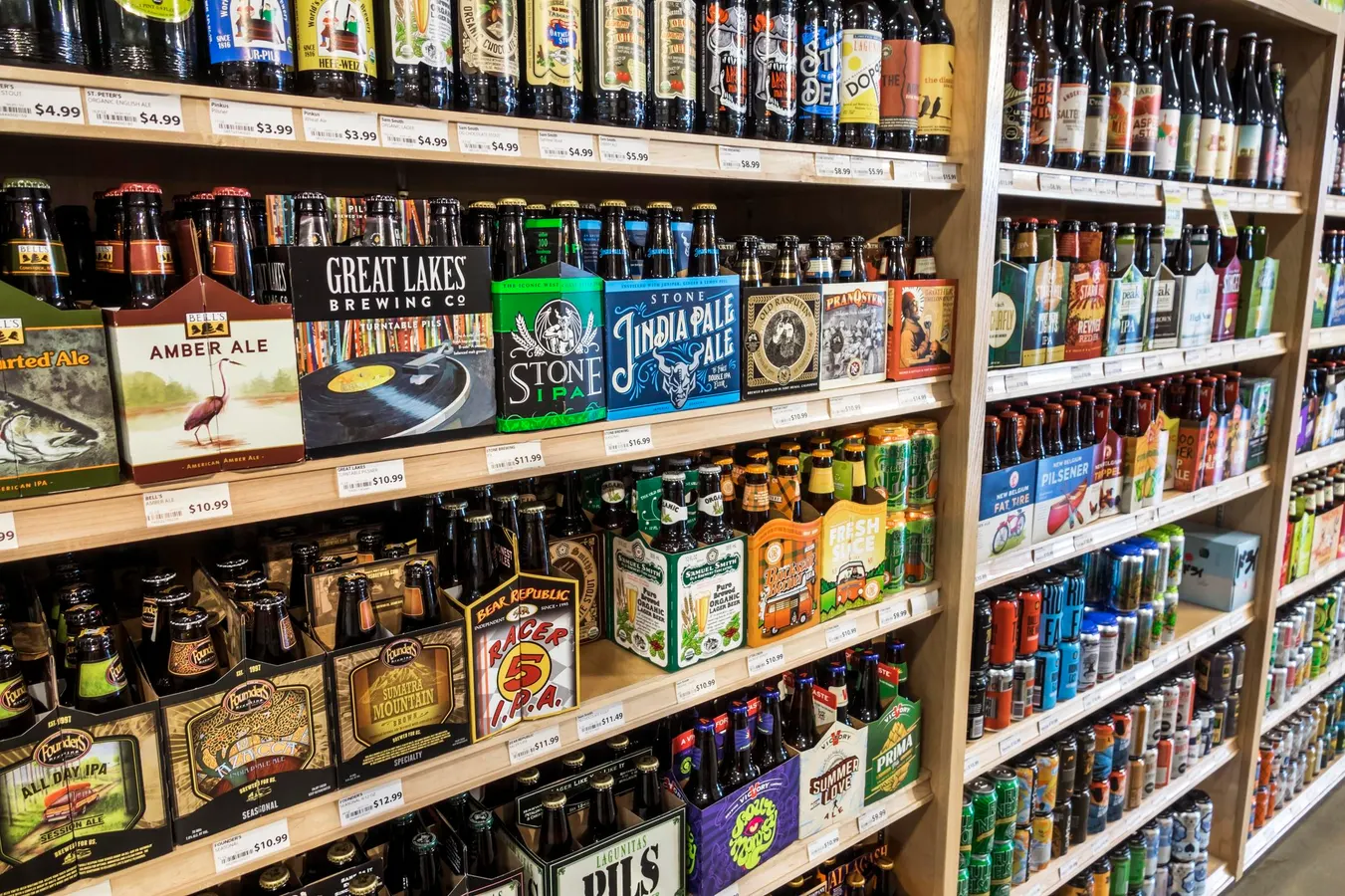

Washington DC, MOM’s Organic Market, craft beer display. This shelf is full of ales and lagers but what exactly is the difference? (Photo by: Jeffrey Greenberg/Universal Images Group via Getty Images)
Universal Images Group via Getty Images
I hear it all the time from beer drinkers: “I only like lagers, not ales. I only like IPAs because all lagers are all the same.”
But both ales and lagers are rich and varied and have a lot of similar factors. They both can be low alcohol to very high ABV, they can yellow to black in color, or they can have flavors of everything from tropical fruit to chocolate. Saying you don’t like a whole group of beers cuts you out from trying some of the best beers on the planet.
So what’s the difference between an ale and a lager? It’s actually quite easy to understand. It all comes down to yeast strain, time and temperature. Let’s explore these three.
Yeast Strain
Yeast is one of the main drivers of beer, because, after all, if we don’t have yeast, we don’t have beer. Yeast eats the sugars in unfermented beer (called “wort”) and creates carbon dioxide and ethanol (alcohol) from it. It can also create organic byproducts that can add flavor and aroma to beers, depending on fermentation method and yeast strain.
Glass with trappist Westvleteren – Trappist ales have lots of flavors of clove and pepper thanks to their unique yeast strains. (Photo by: Arterra/Universal Images Group via Getty Images)
Universal Images Group via Getty Images
Ales are usually fermented with Saccharomyces cerevisiae. Cerevisiae has its roots in the Latin word for beer which is cervisia. Depending on the strain used, “sacc C” adds more organic byproducts into the beer. These are called esters and phenols. Have you ever had a German wheat beer called a hefeweizen? The beer is bursting with flavors of banana and clove. Those flavors and aromas are solely from the German ale yeast strain thanks to esters (banana aroma/flavor is from an ester called isoamyl acetate) and phenols (clove aroma/flavor is from a phenol called 4-vinyl-guaiacol). Esters in low amounts give beer a soft fruitiness of pear, apple, banana.
Lagers are fermented with Saccharomyces pastorius, named after Louis Pasteur, whose work in beer yeast and spoilage was instrumental to the industry. Lager yeast gives off esters as well but in very low amounts so it is not usually detected by humans. So that means lager yeast does not usually add any flavor/aroma to most beers and you get more flavors/aromas of the other ingredients in the beer like malt and hops.
Temperature
Ales ferment warmer than lagers in a broader range of temperatures from 50F to some instances of 95F (Saison Dupont, the famous beer from Belgium, is fermented at this temp). Most American ales like hazy IPAs, porters and stouts are fermented around 68F or room temperature. If the beer is fermented warmer than 70F, this can help make more esters. If the beer is fermented color, it can reign in ester production. German ale styles like kölsch and altbier are ales that are fermented colder so there’s only a light hint of fruitiness.
Lagers are fermented colder, usually around 45-55F. It’s that simple.
Time
The ending factor is time. All ales and lagers go through a primary fermentation that’s roughly the same time period depending on the beer. Primary fermentation usually takes about 10-14 days. After this, ales are done fermenting and can be packaged for sale.
Lagers go through the lagering process. The word “lager” comes from the German “lagern” meaning “to keep/to store.”
Fort Collins, Colorado, The lager cellar at the Anheuser-Busch brewery. It is one of 12 breweries the company operates across the United States. (Photo by: Jim West/UCG/Universal Images Group via Getty Images)
UCG/Universal Images Group via Getty Images
Lagers will be chilled to near freezing temperatures, usually around 32F for a period of weeks to months depending on the lager style. This helps clarify the beer as well as condition the beer and dial in flavors and aromas characteristic of the beer style. After this period, lagers will be packaged for sale.
As you can see, it’s really only three factors that create ales or lagers. Next time you think you may not like a beer, ask for a sample at a bar/brewery or buy a single at a reputable bottle shop. You may be surprised.
And as always, be sure to drink responsibly and to share pints with the people you care about most. Cheers!












Leave a comment