


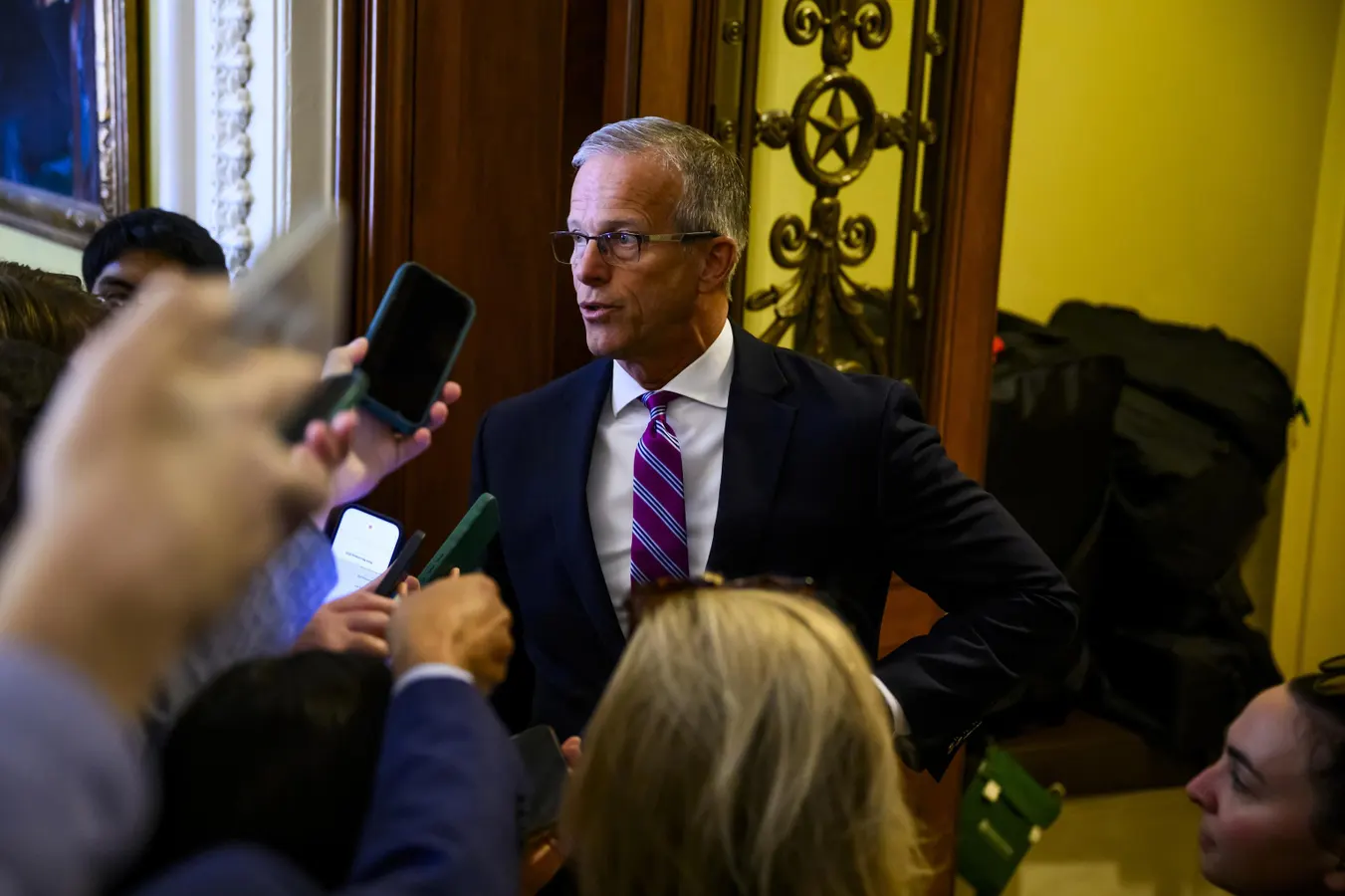

Senate Majority Leader John Thune, a Republican from South Dakota, speaks with reporters outside the Senate chamber at the US Capitol in Washington, DC, US, on Monday, Sept. 14, 2026. In response to a question, Thune said he is “open to exploring” a ban on exports of diesel fuel to address record-high prices. Photographer: Pete Kiehart/Bloomberg
© 2026 Bloomberg Finance LP
Diesel prices soared to all-time record highs in recent days, topping the $6 per gallon mark for the first time due to impacts caused by the wars in Ukraine and Iran. This price blowout has led to calls among political figures for an export ban on the refined fuel which have historically normally come from the Democrat side of the aisle. But Republican Senate Majority Leader John Thune took the bait when asked about it on Tuesday, saying he is “open to exploring” a ban as one of several options to address the issue.
“We’ll be looking at any proposal that is a viable solution, but I do think if we have the supply in this country and we’re exporting it right now that might be one way of getting at it,” the South Dakota Senator told reporters. “If that would take pressure off of prices, you know, I’m open to exploring it.” Thune’s response is not exactly an endorsement of a ban, but it isn’t a rejection, either.
Interior Secretary Doug Burgum did reject a ban when asked a similar question during a G20 symposium in Houston. “We would consider an export ban if we thought that actually might lower prices, but that’s not the case,” Burgum told reporters.
Why A Diesel Export Ban Wouldn’t Work
Jason Isaac, founder and CEO of the American Energy Institute, says a ban would be a bad approach. “A ban on diesel exports won’t bring down pump prices,” he told me in an email. “It will disrupt supply chains and hurt American producers. Diesel is a global commodity, and restricting American exports won’t insulate us from global market dynamics.”
Therein lies the rub. Like it or not, diesel is a global commodity, one for which Russia had long been the leading global exporter prior to its ill-considered war with Ukraine. But Ukraine’s use of drones to attack Russia’s oil infrastructure has done such extensive damage to Russia’s refining capacity that the Putin government now finds itself a net importer of the commodity, mainly from India. The dearth of Russian exports is the main factor which has led to the global diesel shortage and resulting price spike.
That is why, when I reached out to Institute for Energy Research President Tom Pyle for his thoughts, his first response was, “The best thing President Trump can do to lower diesel prices is leave the markets alone and double down on ending the wars in Ukraine and Iran. An export ban will do nothing but disrupt markets and ultimately lead to even higher prices.”
Pressed for more details, Pyle adds, “most U.S. diesel production, and roughly fifty-five percent of the country’s refining capacity, is concentrated along the Gulf Coast. Pipelines and other transport links from the Gulf to fuel-short regions such as the East and West coasts are limited and already running at or near full capacity. The bottled up diesel on the Gulf Coast will not move to other U.S. markets any faster, but it will depress local prices, likely prompting producers to cut runs. Those cutbacks would shrink overall fuel supply, lift global prices, and ultimately pump prices higher at home. Furthermore, these refineries have been running at a record-setting ninety-five percent utilization rate for over 14 weeks. If they can’t export diesel, the logical thing for them to do would be do shut down for maintenance, reducing supply even further.”
In other words, an export ban would be a classic self-defeating “solution” to a problem Congress would be best advised to stay out of. Unfortunately, that reality is not likely to convince some policymakers to resist the impulse to “do something” to address the matter, a pressure which becomes especially hard to resist in the leadup to a major election.
Export Ban Proposals Have Come Before
This is not the first time a ban on diesel or other petroleum-related products has arisen. One good example is the 1975 ban on exports of crude oil, which congress enacted as a response to the Arab Oil Embargo of 1973-74. That ban did not really achieve its stated goals and likely had a dampening effect on domestic oil production while it was in place. But it did allow 1975 members of congress to boast to voters back home that they had “done something” to address high gasoline prices.
Representative Ro Khanna, a Democrat from California, during the National Action Network (NAN) 35th Anniversary Convention in New York, US, on Wednesday, April 8, 2026. A horde of 2028 Democratic presidential hopefuls will descend on a Sheraton Hotel in Midtown Manhattan this week for Al Sharpton’s National Action Network conference, nearly two years before the first primary votes will be cast. Photographer: Victor J. Blue/Bloomberg
© 2026 Bloomberg Finance LP
California Democrat Cong. Ro Khanna seems always eager to ban such exports whenever the opportunity presents itself. Khana ran with a bill in 2022 which would have banned exports of gasoline and other refined products “during any seven-day period where the national average gas price is $3.12 a gallon or higher.” The Biden White House opposed that scheme, thus avoiding what would likely have become major disruptions to the domestic refining and distribution systems described by Pyle above.
Not to be deterred, Cong. Khanna moved to introduce a similar bill in April. His bill could die on the vine this time, too, but Khana will be able to tell the voters back home he tried to “do something” about high gas and diesel prices this time, too.
An Export Ban Is A Simplistic Approach To A Complex Problem
America’s oil and gas production, transportation, refining, and retail sectors are all extremely complex markets with thousands of interrelated parts. While simplistic proposals like a blanket export ban make for effective sound bites for politicians to deploy, the impacts they would have as they cascade through these markets would be likely to do far more harm than good for consumers.
The current blowout in diesel prices was caused by wars raging on two continents. Ending those wars – not an export ban – is the only real solution to the problem.















Leave a comment