


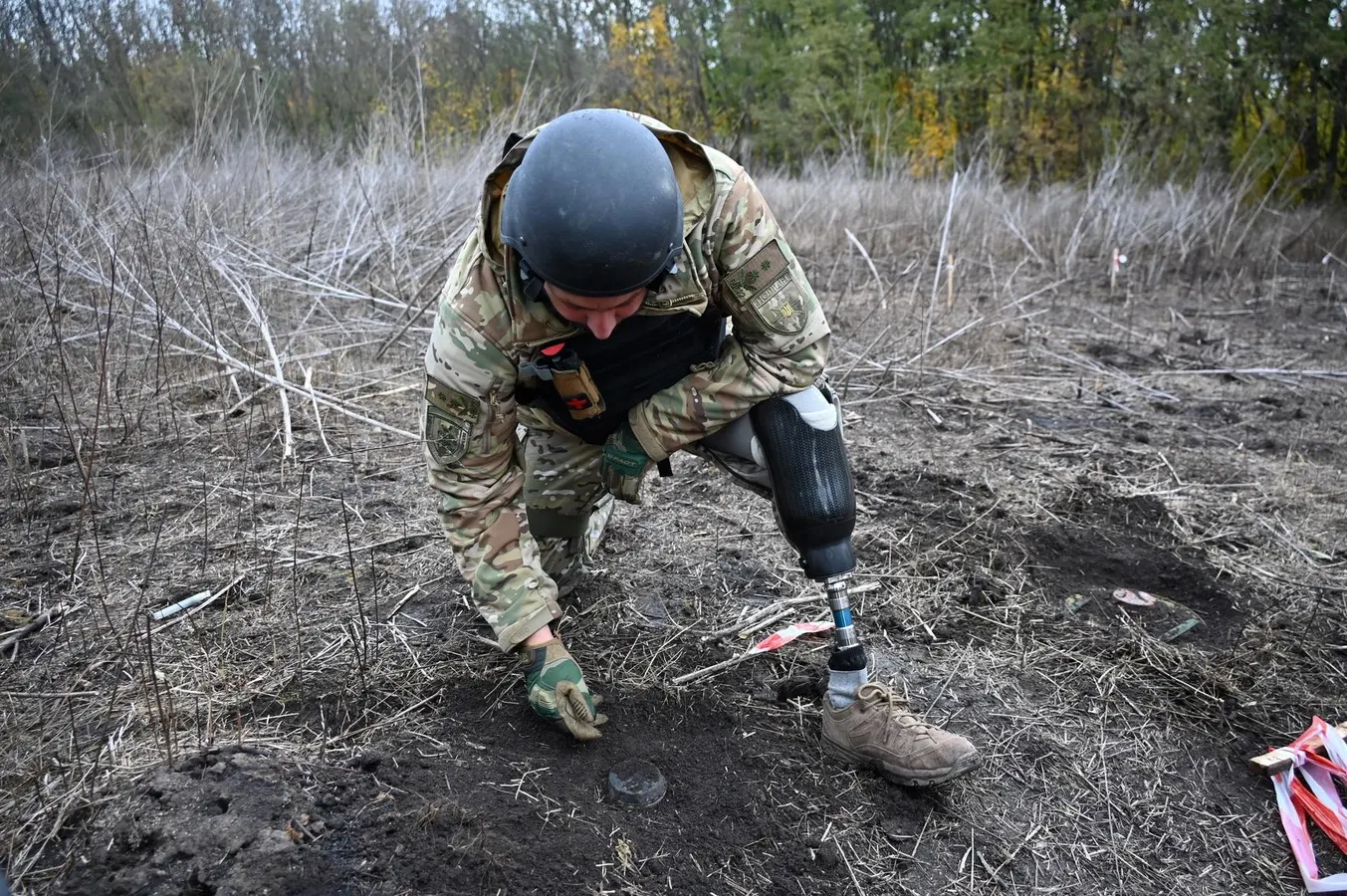

Lithuania is combining battlefield feedback, technical founders, state urgency and foreign industrial demand. The next test is whether successful companies leave behind domestic ownership, intellectual property and procurement influence.(Photo by SERGEY BOBOK / AFP) (Photo by SERGEY BOBOK/AFP via Getty Images)
AFP via Getty Images
Most defense startups are valued on the assumption that conflict will continue. Broswarm is building for what comes after.
The small Vilnius company is developing a drone-mounted radar system intended to map buried landmines and unexploded ordnance.
Its commercial thesis is counter-cyclical: demand should expand when active fighting subsides, displaced communities return and governments have to convert contaminated territory back into farms, roads and construction sites.
“Our time will come when the war ends,” Ernestas Zvaigzdinas told me in Vilnius.
That is not a pacifist slogan. It is a market forecast.
Reconstruction Starts Below The Surface
Ukraine faces the world’s largest current explosive-ordnance contamination challenge.
UNMAS estimated that more than 139,000 square kilometers—roughly a quarter of the country—were suspected of contamination in mid-2025.
The agency says every dollar invested in humanitarian demining could return four dollars in economic benefits through growth and employment.
Those figures explain why demining is not a specialist footnote to reconstruction. Land cannot be farmed, insured, financed or developed until someone can establish that it is safe.
The World Bank’s 2025 assessment put Ukraine’s wider decade-long recovery need at $524 billion.
Demining sits inside that larger capital problem: an enabling investment required before other projects can begin.
Broswarm’s founders expect investor attention to shift toward that constraint when the political conversation moves from sustaining the war effort to rebuilding the country.
Detection Is Not Clearance
Broswarm’s X-SAR system combines airborne synthetic-aperture radar, drone navigation and software intended to reconstruct subsurface objects. The company says it can identify both metallic and plastic-cased threats.
That is a company claim, not yet an independently demonstrated clearance standard.
Drone-mounted ground-penetrating radar is scientifically plausible. A peer-reviewed engineering study demonstrated a lightweight UAV-borne radar design for detecting buried mines.
But performance depends on soil, moisture, vegetation, flight stability, target depth and false alarms. Detecting an anomaly is also different from certifying land as clear.
That distinction should shape the market. New aerial tools will probably enter humanitarian demining as one layer in a system that combines survey, geospatial analysis, manual verification and clearance.
Broswarm says it does not yet have independently validated test-lane or customer results that it can share publicly.
The United Nations is already testing that model.
In 2025, UNDP transferred a Ukrainian aerial detection system to the State Emergency Service after field trials. The precedent does not validate Broswarm’s technology. It shows that public mine-action institutions are willing to integrate aerial detection when evidence supports it.
Small Firms Have A Funding Problem
Broswarm says it was founded in 2023 by Ernestas Žvaigždinas, Karolis Žvaigždinas, Ramūnas Augulis and Mindaugas Talaikis.
Public funding coverage records an initial $100,000 ScaleWolf investment in 2024 and a later €800,000 round. Broswarm says total funding to date is €1 million.
The Lithuanian Defence and Security Industries Association says Broswarm won the 2024 NATO Innovation Challenge.
The company also says it has a procurement-funded R&D cooperation with the Lithuanian Ministry of Defence, which commissioned the development of a prototype airborne mine-detection technology.
That is a useful technical credential, but it is not the same as a large procurement contract or independently validated deployment.
The founders described a familiar gap. The company is too small to compete directly for the largest European and American programs and lacks the networks and grant-writing machinery of major contractors.
“Probably the future is us collaborating with a prime,” one founder said. “We, as in Lithuania, don’t have that network or penetration into the defense market.”
Ernestas Žvaigždinas said primes capture most of the defense market because they have the resources to endure long, bureaucratic procurement cycles, even when technical advances begin inside much smaller teams.
The eventual partnership may be necessary. Prime contractors can provide certification, production, integration and access to government buyers.
The question is whether collaboration lets the smaller company scale—or merely transfers its technology upward before it captures much of the value.
The Peace Dividend Has A Long Tail
Humanitarian demining demand will not disappear with a ceasefire. It expands when people can safely return.
The market also extends far beyond Ukraine. Cambodia, Angola, Bosnia and other contaminated states have spent decades clearing mines and explosive remnants.
The commercial challenge is that humanitarian budgets are fragmented, procurement is slow and customers need evidence that a new system improves safety rather than simply producing more data.
Broswarm therefore has to prove three things at once: that the radar works under real soil conditions, that its maps reduce the cost or risk of technical survey, and that mine-action organizations can integrate the output into accredited land-release processes.
Its founders say they have avoided designing a platform that humanitarian operators could not realistically afford. They use commercial components where possible and describe affordability and cost-effectiveness as part of the product architecture.
That is sensible. It is not yet proof of a scalable business.
A Different Kind Of Defense Company
Broswarm is interesting because it sits between categories. Its technology is born from defense innovation, but the primary economic case is humanitarian recovery.
Its sensor could have military or border-security applications, but its stated market is land that must return to civilian use.
That makes the company a test of whether Europe’s defense-technology boom can create firms whose value survives the end of active conflict.
Most defense investors are currently pricing deterrence, ammunition, drones and military readiness. Broswarm is pricing the backlog that war leaves behind.
If its technology survives independent testing, the company will not need permanent war to justify its market.
It will need governments and donors to recognize that peace begins with the expensive, dangerous work of making land usable again.
The defense boom is measured in what countries buy while wars continue. The peace dividend will be measured in what they can rebuild afterward.













Leave a comment