


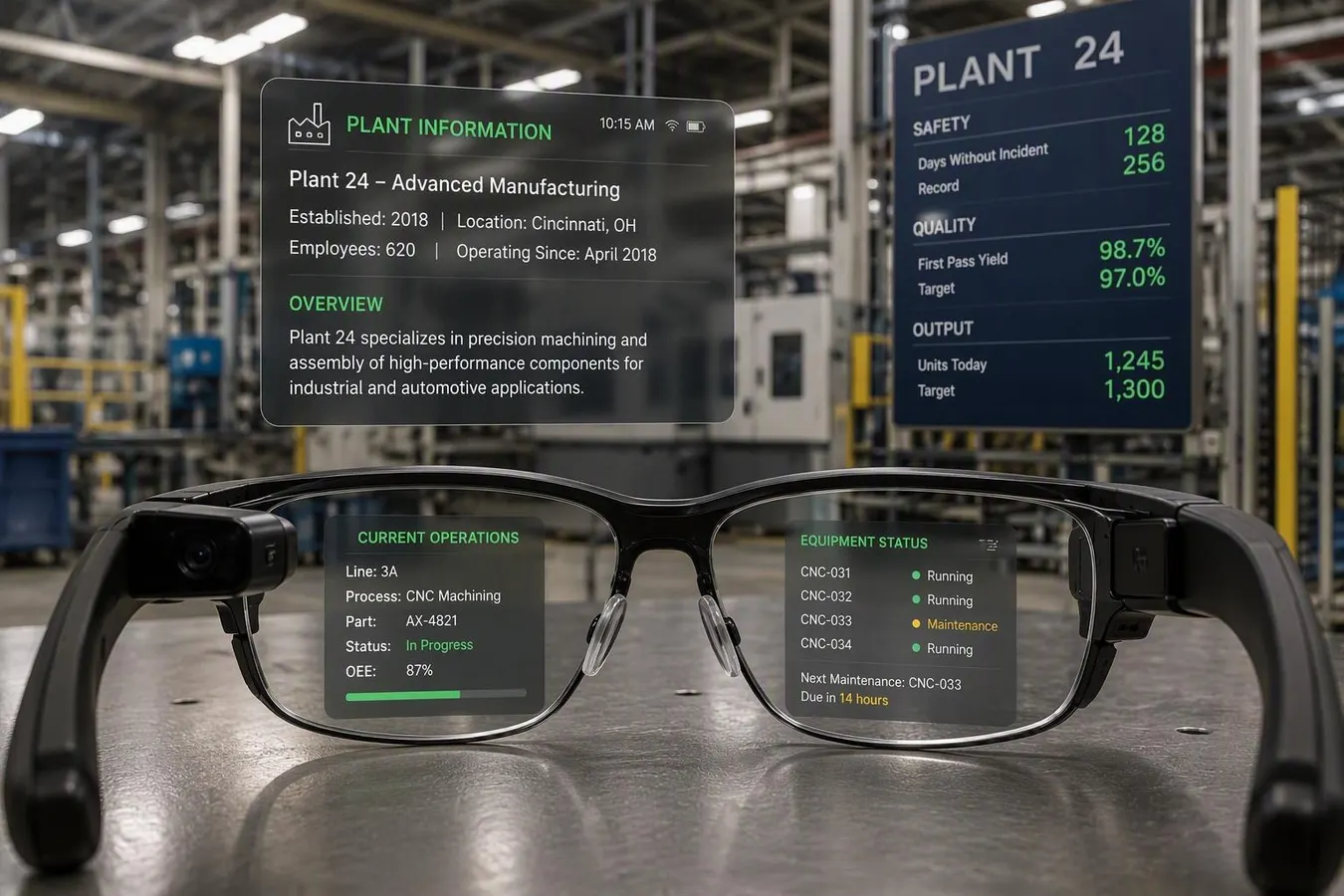

Smart glasses could become the next practical factory interface by keeping instructions, manuals, expert help, and plant knowledge in workers’ line of sight while their hands stay on the job. But manufacturers should start with focused pilots and clear rules on privacy, safety, recording, and data use before bringing the technology onto the shop floor.
AI
The Next Factory Interface May Be A Pair of Glasses, If We’re Smart About It
Growing up, we had a clunky family computer in our den. In seventh grade, I crippled it with a virus from a music-sharing site. It was out of commission for days, and I was banned from using it for a month.
By college, I had a laptop of my own. I could burn albums, research without setting foot in a library and create presentations wherever I happened to be. Soon after graduating, the first iPhone put a computer in my pocket.
I’m not reminiscing for nostalgia’s sake. Technology that moves with you changes the way you work. Ask anyone who was in sales in the early 2000s. The ability to give a presentation, update an estimate, check inventory and submit an order without returning to the office was a massive advantage. Information finally traveled with the person who needed it.
Manufacturers are approaching a similar moment with wearable technology.
Factory work is physical. People stand at machines, repair equipment, check parts, train new workers and troubleshoot problems with their hands full. Phones and laptops are useful, but both pull people away from the work in front of them, while smart glasses could keep their hands and attention on the job.
Where Glasses Could Help
In January, Siemens announced a collaboration to bring industrial AI to Meta Ray-Ban AI glasses, with hands-free audio guidance and safety information for shop-floor workers. A few months later, a Siemens executive said the company was still testing the technology in its own factories. After years of demonstrations, lighter hardware, better voice recognition and AI that can search voluminous technical manuals may finally make smart glasses useful enough for everyday factory work.
A maintenance technician could look at a machine and pull up the manual without putting down a tool. A newer employee could see instructions during a changeover, while a quality inspector could compare a part against the standard without walking back to a terminal. An experienced worker could record how they solve a difficult problem, before that knowledge leaves with them. Even the simplest case of identifying an unknown part without consulting a reference book or pulling out a phone to take a picture and run through AI could be time saving and useful.
Training may be the strongest use case. A 2026 Deloitte and Manufacturing Institute study projects 2.3 million openings across manufacturing and related technician jobs between 2025 and 2030. Glasses won’t create experienced technicians, but they could put good instructions and plant knowledge in front of newer workers while they do the job.
At Boeing, technicians have used smart glasses to navigate intricate aircraft wiring installations for almost a decade. AR smart glasses overlay digital schematics onto the area of an aircraft the technician sees, providing step-by-step visual instructions. This translates to faster assemblies, with fewer errors. Technicians trained using the technology also score 90% accuracy on their first attempts, compared to just 50% using printed manuals. The system decreases ramp-up time for new employees from one year to about one week. Likely the strongest selling point for manufacturers facing a growing talent gap.
BMW offers an example from vehicle repair. In 2019, BMW equipped all 347 of its U.S. centers with smart glasses that let technicians connect with expert engineers through a hands-free video link. This was dealership service rather than factory production, but the problem was familiar: a technician who needed expert guidance got it in real time, without stepping away from the equipment.
In its warehouses, DHL rolled out a program using smart headsets equipped with vision picking software, to guide employees with visual and audio cues as they fulfill orders. The tech has increased order accuracy to 99.6% and is integrated into DHL’s warehouse management system, automatically keeping inventory up to date while allowing new hires to be productive from their first day. A factory could apply that approach to replenishment, kitting or parts selection.
Glasses won’t be the right answer everywhere, though. If a QR code opens the correct setup sheet in seconds, stick with the QR code. If a fixed screen gives an operator a better view of several data points, keep the screen. Glasses and other wearables earn a place when they save workers from searching, walking away from the equipment, handling another device or waiting for expert help that might otherwise take days.
The Rules Need To Come First
The moment a worker puts a camera, microphone and AI tool on their face, the rules change. The device may capture another employee, a customer’s part, a proprietary process or a conversation that has nothing to do with the task. Manufacturers need to decide what the glasses can record, where the data goes, who can see it and how long it is kept.
Wrap wearables into existing company policies. Hardware will change quickly, while the basic rules on confidentiality, information security, safety and employee recording will remain. Treat each pair of glasses as a managed company device with authentication, approved software, security updates, encryption and a way to remove access. NIST’s guidance for enterprise mobile devices offers a useful starting point.
Make clear where the glasses can and cannot be used. Wearing the device, using its AI functions and recording may require different rules. Customer work, research and development, computer screens and proprietary processes may need tighter limits, while restrooms and break rooms should be off-limits for recording. Workers should know when a camera or microphone is active, who owns the footage and whether a recording made for training or troubleshooting can later be used in a performance review. In the back office, there likely won’t be utility for the glasses immediately. Consider banning recording devices in your company where they don’t have direct applicability through new policies in your employment handbook.
Safety has to be judged work area by work area. A device that blocks peripheral vision, distracts someone near moving equipment or interferes with protective gear does not belong there. OSHA requires appropriate eye and face protection where workers face relevant hazards. AI guidance also needs limits, especially for lockout and tagout, electrical work and critical quality decisions where a qualified person must remain responsible.
Start With One Useful Pilot
The sensible next step is a small pilot built around one recurring problem, such as troubleshooting one family of machines, supporting a second-shift maintenance team or guiding a changeover on one line. The people who will wear the glasses should help design the test with operations, safety, IT and HR because they will be the first to notice whether the device fogs under protective equipment, misses commands in a noisy area or offers an answer that sounds right but is not.
Then measure whether workers find answers faster, make fewer errors and spend less time away from the equipment. Ask whether they trust the guidance and understand when the device is recording. The rules should be in place before the first camera turns on, then revised with what the pilot teaches.
I don’t know whether (or when) smart glasses will become as common on factory floors as smartphones have become everywhere else. But manufacturers don’t need that answer today. They need to find the jobs where hands-free information would genuinely help a worker, test the technology in the real conditions of the plant and draw clear boundaries before it spreads.
Looking back, every device that changed the way I worked did so because it put useful information closer to the moment I needed it, and glasses can do that on the factory floor. If they help someone solve a problem without stepping away from the machine, and workers trust the way the technology is used, they will earn their place.














Leave a comment