At Roya in Austin, Texas, chef Amir Hajimaleki shares his family’s heritage and Iranian home cooking with his personal touches.
Richard Casteel
Cooking and sharing food is in chef Amir Hajimaleki’s DNA. Born in Tehran during the war between Iran and Iraq, his family moved to the U.S., settling in Austin, Texas, when he was just nine years old. After graduating from the Texas Culinary Academy’s Le Cordon Bleu program, he opened his first restaurant, District Kitchen + Cocktails, in 2013. Over the next few years he became a successful restaurateur, opening Oasthouse Kitchen + Bar, Keepers Coastal Kitchen and Daisy Lounge, alongside his brother, Ali.
Still, he held a lifelong dream of owning a restaurant that honored his Iranian heritage. After years of planning, Roya finally became reality in February 2026. This concept honors his family heritage with dishes he’d been serving at exclusive pop-up dinners across the Austin area since 2018, using fresh, locally sourced ingredients.
To Hajimaleki, Roya is more than just another restaurant to run. It’s a chance to share recipes and hospitality inspired by his childhood in Iran, in a way that’s both deeply personal and approachable for the average diner.
Amir Hajimaleki, chef owner of Roya, grew up in Tehran before moving to Austin, Texas as a child.
Richard Casteel
Showcasing Iranian culture beyond stereotypes
“Roya is deeply personal for me, it’s a way to honor my family, my roots, and the traditions I grew up with,” he says. “I’ve been able to learn more about Iran’s beautiful history and culture through Roya, and the best part is I get to share what Persian culture is to our Austin community. Although I’ve loved growing up in Texas, I also felt a disconnect from my culture, which I am very proud of. This is what brought me to opening Roya. This project keeps me connected to my culture and allows me to share it with others.”
At its core, Roya is about the art of hospitality that’s central to Persian culture.
“I wanted Roya to feel like being welcomed into someone’s home, while offering a perspective beyond the stereotypes people often see, says Hajimaleki. “Through the food, the space, and the experience, we hope to share the warmth, generosity, beauty and rich culinary traditions of Iran with our guests.”
And it’s all felt the moment one crosses Roya’s front door, as guests are welcomed by a staircase lined with stunning Persian tiles. The upstairs space, designed by the Hajimaleki brothers themselves, unfolds in deep blue hues, featuring elegant archways, blue velvet banquettes, traditional Persian arts, beautiful rugs, intricate paintings, custom works by Azerbaijani artist Alexei Antonov and pieces by local artist Ed Booth. A horseshoe-shaped bar with gold accents, floor-to-ceiling curtains and dim lighting complete the moody, upscale ambiance.
Roya’s beautiful interiors are filled with Persian art and color, with an elegant yet comfortable atmosphere.
Richard Casteel
A culinary heritage shared across the globe
Persian cuisine rarely gets the headline billing of French, Italian or Japanese food. Yet, for roughly 2,500 years, the kitchens of the Iranian plateau have quietly shaped how a large part of the world cooks, seasons, and even names its food. Its myriad contributions and culinary techniques abound: saffron and dried lime, meat braised with fruit and nuts, fresh herbs by the fistful, pickled meats and vegetables, rose and orange blossom water, sherbets and frozen desserts, and rice cooked with near-religious precision.
Persian ideas and ingredients traveled west to Baghdad and Moorish Spain, east to Mughal India, and north along the Silk Road to Central Asia and the Ottoman empire. Today, ingredients used in Iranian cuisine since ancient times are widespread in western kitchens—pistachios, pomegranates, citrus, melons, chickpeas, onions and garlic, to name just a handful. Rightly so, historians sometimes call it a mother cuisine.
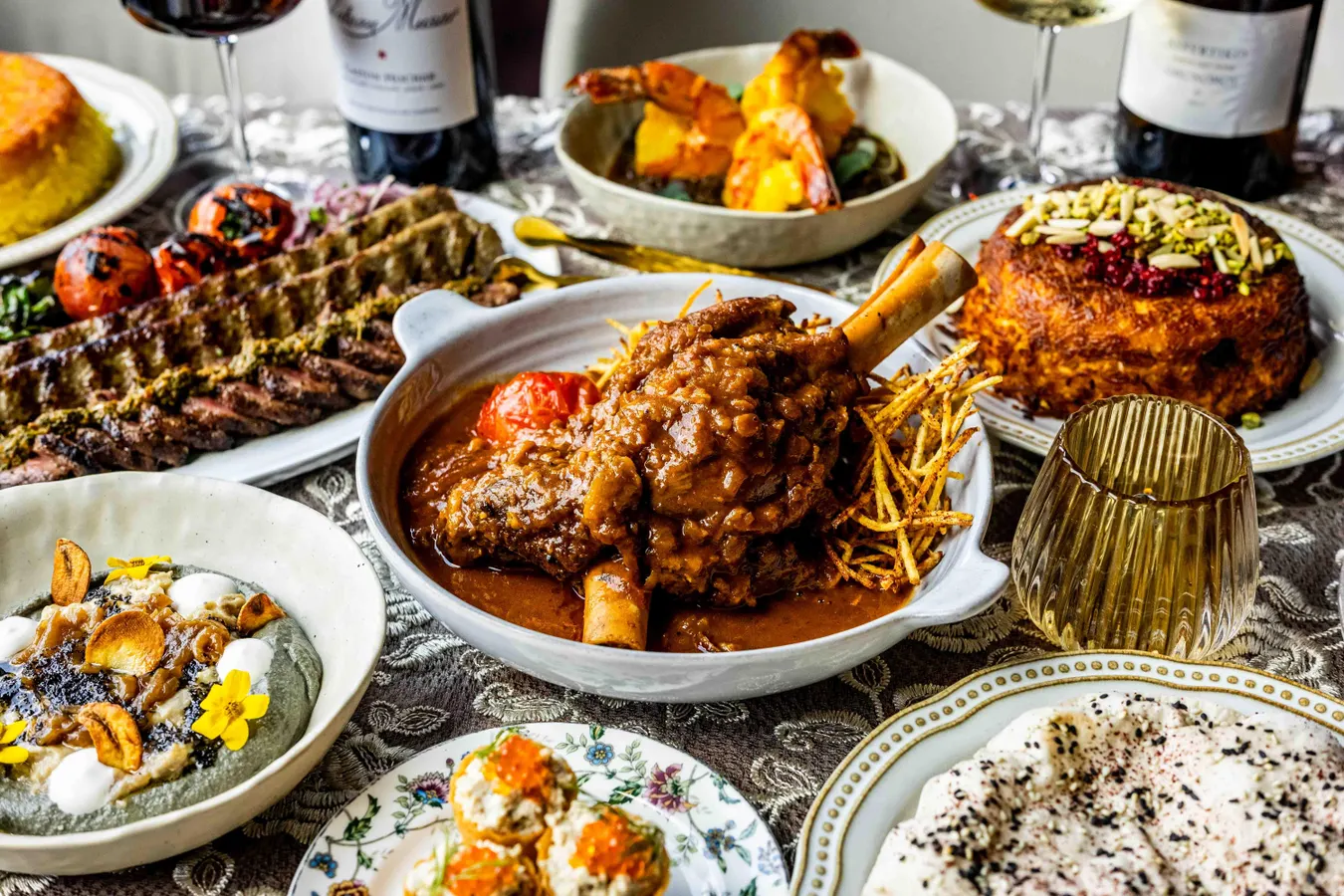
Roya’s menu features traditional Persian dishes to which Hajimaleki has added some minor modern tweaks. There’s the wild mushroom borani, an appetizer spread of garlic labneh with fire roasted mushrooms, black garlic chili oil and pine nuts, served with warm taftoon—a traditional sourdough flatbread, topped with sesame seeds and sumac. Stand-out main dishes include mahiche gheymeh—lamb shank in saffron and tomato, with split peas, dried lime and shoestring potatoes—and Wagyu chenjeh kabob, a stew of Australian Wagyu with Roya’s fenugreek seasoning and tarragon chimichurri. Persian cuisine is famous for its sweets, and at Roya, dessert is not an option, it’s a must.
“The dishes at Roya are inspired by the food I grew up eating with my family,” says Hajimaleki. “I learned by watching my mother and grandmother cook, tasting their food, and understanding the care and hospitality that went into every meal. To this day, I’m fortunate to still have my grandmother with me, and I often call her to talk through dishes I’m developing for future menus. Those conversations keep me connected to the traditions I grew up with and continue to inspire my cooking.”
Shirin Polo, also known as jeweled rice, is a festive dish of crispy rice topped with nuts and barberries.
Richard Casteel
“I’m especially proud to honor the heritage of both my grandmother and my grandfather, who was from Kermanshah. Some of my favorite memories are of the regional dishes my grandmother would prepare from that part of Iran, like aash-e bademjan (a hearty eggplant soup). Over the years, I’ve taken those memories and flavors and interpreted them through my own style of cooking. I also have an incredibly strong mother who made sure I never gave up on my goals and dreams.”
Sofreh—the Persian tradition of a shared table
A highlight of the visit is Roya’s sofreh, a curated dining experience inspired by the Persian tradition of gathering around a shared table. The chefs pick and course every dish for the table as if they were hosting you at their home. While there are signature dishes that often serve as the foundation of the courses, it’s not a fixed menu.
“We tailor each sofreh experience based on the guests, dietary preferences, special occasions, and what’s at the absolute best that day,” says Hajimaleki. “We also see it as an opportunity to introduce guests to the depth and diversity of Persian cuisine. For many of our guests, it’s their first experience with these flavors, so we love sharing iconic dishes like ghormeh sabzi, Iran’s national dish, alongside classics such as koobideh and jujeh kabob. It allows us to tell the story behind the food and the culture while guiding guests through a thoughtful progression of flavors.”
And it’s not all about the food, which is as beautifully presented as it is delicious. Details such as a white lace tablecloth, candles and a pot of traditional tea also accompany the experience of dining at someone’s home. “More than anything, the Sofreh is about hospitality. In Persian culture, a meal is meant to be shared, and a sofreh represents generosity, connection, and welcoming guests into your home. That’s the feeling we’re trying to create at Roya.”
Caviar is a luxury Iranian product, served at Roya in a perfect martini.
Richard Casteel
Roya’s bar complements the experience
The bar at Roya is not an afterthought. It expresses Persian flavors through each craft cocktail like the Babajooni, a Beluga Gold Line vodka martini served with lemon and white sturgeon caviar; the Talla, with turmeric infused bourbon, lemon and honey; and the Ajeel, which combines pistachio and walnut infused vodka, golden currant syrup, lemon and pumpkin seed orgeat. In addition to the craft cocktails, Roya has an extensive wine menu, featuring wines from the Middle East and beyond.
It’s all part of Hajimaleki’s mission of bringing people together through food.
“When in Iran, I realized at a young age, no matter the differences in people—whether its religion, politics or anything else—once they are around a dining table, enjoying a delicious meal brings everyone together. This is why I got into the hospitality business. I think the challenges I went through as a young kid, from the war to adapting to a new country, really shaped me for where I am today.”
And where he is right now is a highly successful restaurateur and chef. But more importantly, he is an exemplary ambassador of his culture and heritage, at a time when they need it the most.



















Leave a comment