


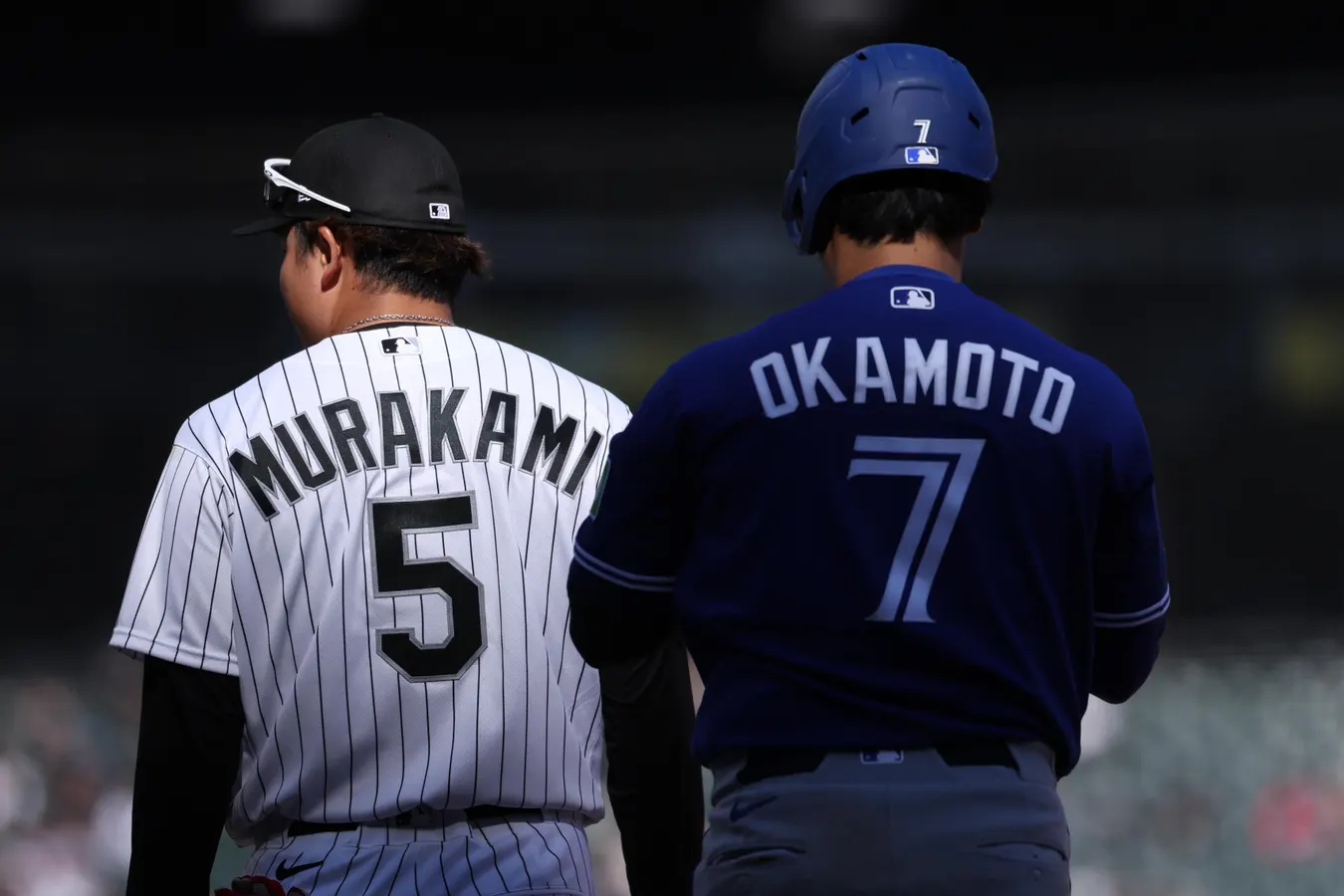

Munetaka Murakami of the White Sox and Kazuma Okamoto of the Blue Jays are two of the three big name Japanese players to come to MLB in 2026. (Photo by Geoff Stellfox/Getty Images)
Getty Images
Despite trade wars and tariffs, Japan exported three of its most valuable commodities to the United States (and Canada) this off-season. This spring, Munetaka Murakami, Tatsuya Imai, and Kazuma Okamoto all left the island nation and headed for the pinnacle of baseball competition. Surprisingly, the market for these three players was softer than expected.
Murakami signed first, one day before his 45-day posting window closed, agreeing on a two-year, $34 million contract with the Chicago White Sox.
Imai went next, agreeing to terms with the Houston Astros, who had never before signed a player directly from Japan. His deal was three years, $54 million, with opt outs after each of the first two seasons.
Lastly, Okamoto agreed to bypass the U.S. and head to Canada to play for the reigning American League champion Blue Jays. Okamoto also waited until the day before his posting period expired, and then signed in Toronto for four years and $60 million.
With the major league season roughly one-third finished, this may be a good time to check on each of these players and see how they are acclimating to life away from the NPB.
Munetaka Murakami
The conversation about the 2026 Japanese player class has to start to Murakami. He came to the White Sox from the Yakult Swallows, where he set the NPB single-season record with 56 homers in 2022. There was a fear among some evaluators that Murakami’s power would not translate in MLB, as the pitching is harder and more advanced. Those evaluators seem to have been wrong.
According to Baseball Savant, Murakami is in the 98th percentile in exit velocity and barrel rate, and in the 99th percentile in hard hit percentage. He is also in the 98% percentile in walk rate (17.9%), but, unfortunately, in the 4th percentile in strikeout rate (32.5%). He is the epitome of three true outcomes, having walked 44 times, struck out 80 times, and slugged 20 home runs, which are the most in the American League as of this writing.
So far, velocity has not been an issue. Murakami is slugging .707 on fastballs, hitting 13 of his homers against the pitch. And off-speed is not really fooling him, as he is hitting .300 on those types of pitches. He is on pace to strike out more than 200 times, but the White Sox would gladly take that if he hits 40 or 50 homers and helps put butts in the seats on the South Side.
However, it may be tricky to calculate paces as Murakami landed in the IL with a hamstring strain and looks to be out for four to six weeks.
Tatsuya Imai
Tatsuya Imai was the name that made front offices think of Yoshinobu Yamamoto. There was hope that this Japanese sensation could be like that Japanese sensation, and his agent, Scott Boras, was hopeful to land something in the neighborhood of the 12 years, $325 million the Dodgers agreed to pay Yamamoto in 2023. That was not to be.
Rather, the player and agent had to settle for a three-year deal valued at $54 million, with escalators based on the number of innings pitched. If Imai can throw 80 innings this year, his $18 million base will actually escalate to $20 million; $22 million if he throws 90 innings; and $24 million if he can get to triple digits.
The 27-year-old is admittedly having a rough time acclimating to life in the southern United States. The travel schedule, the timing and location of meals, the baseballs, and the firmness of the mound have all contributed to his feeling of displacement, and may have contributed to the arm fatigue that landed him on the injured list back in April.
When he went on the IL, Imai had started three games and had a 7.27 ERA. In two minor league rehab starts, he threw five innings, gave up seven hits, six earned runs, and walked eight batters. But the Astros, desperate for pitching, brought him back up. In his three games since being recalled, he has a considerably better 4.79 ERA. In fact, he was part of the Astros’ 18th team no-hitter last week, going the first six innings of no-hit baseball (he did, however, walk four batters (including the first two of the game) against only two strikeouts, and left having throwing only 57 strikes among 97 pitches). Yesterday, he threw six strong innings, giving up just three hits and two earned runs, but suffered a 2-0 loss to Jacob Misiorowski and the Brewers.
His last two outings have been a sign of hope of Imai, who will have to keep on that pace if he hopes to reach any of the innings pitched escalators in his contract, or exercise his opt out at the end of the season.
Kazuma Okamoto
The least noisy entrance among these three players has been from Kazuma Okamoto. He went to Toronto and quietly fit himself right into the lineup at third base. Okamoto has the most stability of the three, with four years guaranteed and no opt outs.
While Okamoto had hits in each of his first six games to start his MLB career, he then began to slide, hitting his nadir after an 0-for-4 on April 17th, leaving him with a .188 batting average, with just two home runs and four RBI. But in the 38 games since, he has shown more pop. Ten homers and 27 RBI, plus five doubles, have improved his slugging percentage to .422.
And, on the other side of the ball, he has more than held his own. FanGraphs shows Okamoto to have a .956 fielding percentage with three throwing errors and two fielding errors, and lists him as #7 among everyday third baseman based on DRS.
At $15 million per season, Okamoto appears to be a bargain for the Blue Jays, and will provide an anchor for the rest of this season and the ensuing three years.
With two months in the books, it does not seem that any of the three teams regrets their decision to sign their respective Japanese player. Okamoto looks to be a mainstay, Imai has shown some promise and could be a fine #3 or #4 starter as he gets used to living and playing in the U.S. And Murakami may be the cornerstone of the next White Sox team to make the post-season.















Leave a comment