


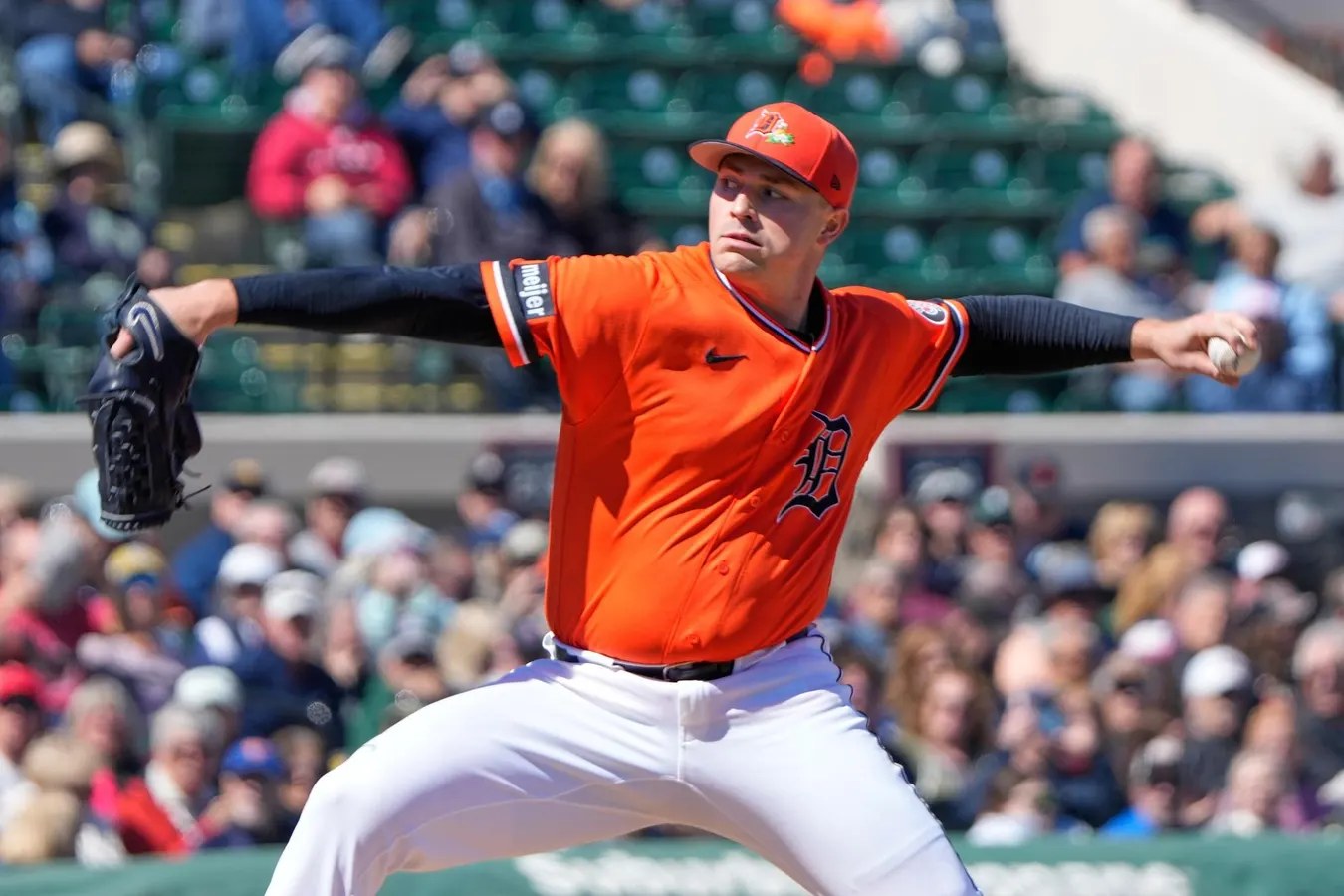

Detroit Tigers starting pitcher Tarik Skubal throws against the Minnesota Twins in the first inning of a spring training baseball game, Monday, Feb. 23, 2026, in Lakeland, Fla. (AP Photo/John Raoux)
Copyright 2026 The Associated Press. All rights reserved
In recent weeks in this space, I’ve rolled out my annual Best Pitches series. Click to see the pitch-specific articles on changeups, curveballs, cutters, splitters, four-seam fastballs, sinkers and sliders. Today, we bring it all together, combining the grades for each pitch in the arsenals of all 86 pitchers who threw 135 or more innings in 2025 to calculate starting pitcher Grade-Point Averages.
We’ve gone pitch by pitch through the arsenals of all starting pitchers to determine the game’s best – and worst – offerings. The pitches have been graded on their bat-missing and contact management results. Each pitch is compared to league average swing-and-miss rates and pitch-specific Adjusted Contact Scores.
Adjusted Contact Score is, on a scale where 100 equals MLB average and the lower the number the better, the relative production a pitcher “should have” allowed based on the exit speed/launch angle mix of every batted ball yielded. An average pitch gets a “B’”, and a sliding scale is applied to each pitcher’s results to approximate a bell curve.
The pitcher GPAs are calculated by taking the grade for each individual pitch and multiplying by its usage rate, and then adding those pitch scores together. The average pitcher GPA should be around 3.00 (a “B”) if I’m doing this correctly – the average came out to 3.06.
One note of caution and context before we begin. In earlier articles here you may have seen me grade pitchers’ 2025 “performance” by placing pitchers in “Tru” Pitching Runs Above Average order. In doing so, I used my batted-ball metrics to determine how pitchers “should have” performed. I measured pitchers’ value by measuring their outputs. Here, I am measuring their pitch arsenals – their inputs. Though there is plenty of output still being weighed here, I look at pitch grades as more of a proactive, scouting measurement. There are going to be some pitchers who look out of place GPA-wise, and that doesn’t take anything away from what they may have accomplished in the past – but it may give us a heads-up about what may happen in the future.
1ST QUARTILE (GPAs of 3.38 to 4.38)
Zack Wheeler, Tarik Skubal, Dylan Cease, Bryan Woo, Drew Rasmussen, Paul Skenes, Hunter Brown, Joe Ryan, Garrett Crochet, Nick Lodolo, Shane Baz, Carlos Rodon, Jesus Luzardo, Robbie Ray, Jacob deGrom, Jose Soriano, Yoshinobu Yamamoto, Shane Smith, Kevin Gausman, Andre Pallante, Max Fried, Freddy Peralta
Wheeler didn’t get to 162 IP, but led all 135 IP+ starters in GPA, as both his four-seamer and sweeper earned “A+” grades and his sinker an “A”. Skubal’s changeup was one of the game’s few “A++” pitches, and he had a pair of “A” or better fastballs in his “A+” four-seamer and “A” sinker. The Blue Jays saw through Dylan Cease’s unremarkable surface numbers and paid for his stuff and true talent level in free agency. Only two of his offerings qualified for pitch grades – his “A+” four-seamer and “A” slider/sweeper combo. Rasmussen’s high placement (nosing out Skenes) might surprise you. His “A+” cutter and “A” four-seamer highlight his strong repertoire. Each year, I pick a pitcher from this exercise that is deserving of his own article. Last year it was Cristopher Sanchez – this year’s it’s Rasmussen (coming tomorrow). Skenes had four “A” or better pitches, led by an “A+” changeup, though his grade was undercut somewhat by a “C+” splitter.
I am very high on Baz entering the 2026 season. He was much better than his raw numbers last season, and though only one of his offerings (his four-seamer) earned an “A”, he had four average or better pitches, including a “B+” changeup and cutter. This method seems to deliver strikingly high or low ratings on extreme sinkerballers (see Logan Webb in the Fourth Quartile). Both Soriano and Pallante place higher than you might think. The former earned “B+” grades for both of his qualifying pitches, his knuckle-curve and sinker. The latter possesses just an average “B” grade four-seamer, and his “A+” sinker and “B+” slider offer hope for overall improvement. Smith very quietly showcased two “A” grade fastballs in his four-seamer and sinker. The rest of this group is a combo of proven vets like Rodon, deGrom, Gausman and Fried and prime producers like Woo, Brown, Ryan, Crochet, Luzardo, Yamamoto, Lodolo and Peralta. Other “A+” or better offerings in this group include Woo’s “A++” four-seamer, Brown’s sinker, Ryan’s four-seamer, Crochet’s “A++” sweeper, Lodolo’s curve, Rodon’s “A++” sinker, Fried’s “A++” sinker and Peralta’s curve.
2ND QUARTILE (GPAs of 3.01 to 3.33)
Chris Bassitt, Andrew Abbott, Luis Castillo, Quinn Priester, Cristopher Sanchez, Taj Bradley, Justin Verlander, Matthew Boyd, Ranger Suarez, Kyle Hendricks, Tyler Anderson, Ryan Pepiot, Framber Valdez, Dean Kremer, Clay Holmes, Casey Mize, MacKenzie Gore, Jeffrey Springs, Sonny Gray, Nick Martinez, Tanner Bibee
Sanchez dropped from the 1st Quartile in 2024, as his “A” grade changeup remained excellent, while his “B” sinker and “C+” slider were much more pedestrian offerings. Bradley was moved by the Rays to the Twins, and was much better than his mainstream numbers. He had four average or better pitches, and his cutter earned an “A” grade. Verlander was better than you think last season. His slider/sweeper combination earned an “A” grade, while the rest of his repertoire was no better than average. Hendricks has retired and Anderson is still looking for work, but both deserve recognition. All of both hurlers’ qualifying pitches were average or better, with both of their changeups earning “B+” grades. There were many other “A” or better offerings in this group, like Bassitt’s curve, Castillo’s four-seamer (an “A+”), Priester’s slider, Suarez’ changeup and curve, Valdez’ curve, Kremer’s splitter, Gore’s changeup, Springs’ changeup (an “A+”), Gray’s sweeper, Martinez’ sinker and Bibee’s cutter.
3RD QUARTILE (GPAs of 2.73 to 3.00)
Gavin Williams, Ryne Nelson, Noah Cameron, Brady Singer, Zac Gallen, Jack Leiter, Nick Pivetta, Michael Wacha, Jack Flaherty, Eduardo Rodriguez, Davis Martin, Bailey Ober, Edward Cabrera, Kyle Freeland, Patrick Corbin, Logan Allen, Mitch Keller, Erick Fedde, Charlie Morton, Lucas Giolito, Brayan Bello, Will Warren
Pivetta seems to stand out a bit in this group, given his exceptional 2025 surface numbers. While his sweeper earned an elite “A+” grade, his overall rating was undercut by a “D+” grade for his curve. Cabrera is one of the most interesting, even polarizing pitchers on this entire list. Both of his breaking balls, his curve and slider, earned “A” grades, but his two fastballs were both near the bottom of the barrel (a “D” four-seamer and “D+” sinker). If he can get his fastballs – which are both thrown hard – to even the average level, he’d reach his exceptionally high ceiling. Other “A” grade pitches in this group include Flaherty’s knuckle-curve, Martin’s cutter and Freeland’s knuckle-curve.
4TH QUARTILE (GPAs of 2.01 to 2.72)
Chris Paddack, Yusei Kikuchi, Sandy Alcantara, Colin Rea, David Peterson, Merrill Kelly, Shota Imanaga, Luis Severino, Bryce Elder, Michael Lorenzen, Zack Littell, JP Sears, Logan Webb, Jose Berrios, Matthew Liberatore, Tomoyuki Sugano, Mitchell Parker, Jake Irvin, Brandon Pfaadt, Miles Mikolas, Seth Lugo
The big story here is Webb. This method simply “misses” him. He’s a regular in the bottom quartile, and his 2025 placement is actually an improvement over the two previous seasons. He gets a ton of grounders, obviously, but they’re hit very hard. His top pitch was his “B” changeup; his vaunted sinker received only a “C+”. The fall of Lugo has been pretty steep. He’s obviously merely pitching to his ballpark at home, allowing tons of thunderous contact. He throws every pitch under the sun – he qualified for six individual pitch grades, and that’s after combining his slider, sweeper and slurve into one. There was only one average offering among all of them, a “B” curve. There are still some quality pitches in this group, like Lorenzen’s “A”+” changeup and Parker’s “A” slider.
Here is a table with all 86 qualifiers’ 2025 GPAs, along with their FIP- and “Tru”-marks.










Leave a comment