


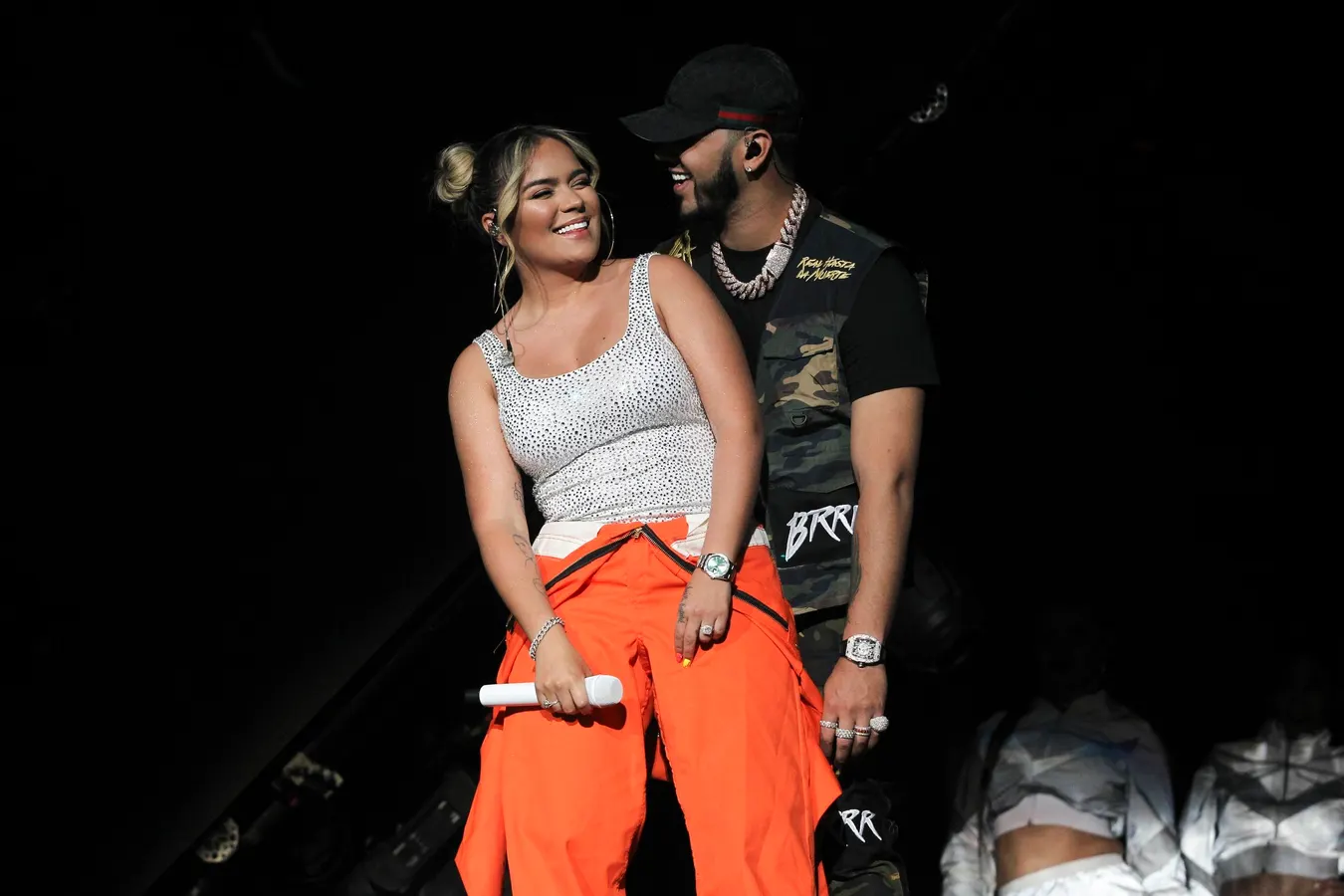

MEXICO CITY, MEXICO – APRIL 05: Karol G and Anuel AA perform during a concert at Arena Ciudad de MÈxico on April 5, 2019 in Mexico City, Mexico. (Photo by Medios y Media/Getty Images)
Getty Images
Latin music is no longer a category inside the global charts. It is increasingly the story of the charts themselves, from Bad Bunny headlining stadiums across continents to regional Mexican acts like Peso Pluma and Fuerza Regida pulling in numbers that once belonged exclusively to English-language pop. For Hispanic Heritage Month, I asked marketing executives working across the genre’s biggest labels and management companies what it actually takes to build a campaign that lands in a moment this crowded. Their answers pointed to a few consistent ideas: know your audience well enough to spot momentum before you manufacture it, understand that “Latin music” is not one market, and remember that some of the most effective marketing still happens far from a phone screen.
Read the Signals Before You Force the Moment
Brenda Carrasco, Senior Vice President of Marketing and Artist Strategy at Warner Music Latina, argues that one of the most overlooked skills in marketing is patience. “We spend so much time talking about speed, virality and first-week results that we sometimes forget artists are not products with expiration dates,” Carrasco said.
She pointed to Warner’s work with Elena Rose as an example. “We paid very close attention to what the audience was telling us, where the music was connecting, what people were sharing, which markets were reacting, and built on those signals rather than trying to manufacture them,” Carrasco said. That approach helped drive the success of Elena Rose’s debut album, Bendito Verano, and, according to Carrasco, built a deeper and more lasting connection between the artist and her fans in the process.
Carrasco was also direct about what she sees as an overused shortcut in the current market: manufactured social spread, the practice of seeding the same story across dozens of outlets within 48 hours to simulate an organic moment. “Repetition isn’t relevance, and distribution isn’t culture,” she said. “Audiences can immediately spot the difference.” She still believes in paid amplification when something real is already happening, but draws a clear line. “You can buy visibility, but you can’t buy cultural relevance.”
“You can buy visibility, but you can’t buy cultural relevance.”
Engaging With The Audience an Artist Already Has
Several executives independently arrived at the same underrated tool: the fans an artist already has, rather than the ones a campaign is chasing. Carrasco frames this as an ownership problem. Artists can rack up millions of followers and streams, but those relationships largely live on platforms the artist does not control. “First-party data, CRM, email, SMS, WhatsApp, ticketing data, fan communities, allow us to understand who the real fans are and communicate with them directly,” she said. In her view, the next stage of artist marketing is less about reach and more about depth. “A follower is valuable. A super fan relationship is exponentially more valuable.”
Clarissa Paez, who leads strategic marketing for Latin music giants Anuel AA, Dani Barranco, DJ Maff and more, makes a similar point from a different angle. “We spend so much energy finding new audiences through digital tools and paid media that we forget the strongest amplifier is often the audience the artist already has,” Paez said. She added that this dynamic is especially pronounced in Latin music, where fans tend to form an unusually strong bond with artists. Her approach starts by thinking like a fan first. “If I were a fan, what would make me want to talk about this artist, post about them, and be part of the story?”
Paez was also skeptical of influencer marketing that lacks a genuine connection to the artist. “The space is saturated, and audiences can tell right away when a post is paid and not personal,” she said. “Influencers still work when they genuinely connect with the artist or the music. Without that, it feels like a transaction.”
One Genre Throughout Many Markets
Maria Ines Sanchez, VP, West Coast, US Latin at Sony Music Latin, pointed to a campaign built almost entirely around giving fans a shared moment before release. Natanael Cano’s album Vol. 1, a collaboration between Rancho Humilde, Sony Music Latin and Sony Music Mexico, debuted at number one globally on Spotify. Ahead of the release, Cano played the complete album live for 3,000 fans at the Pepsi Center. “Giving fans that kind of first-listen moment, together with the artist, created real momentum going into release day, and the results spoke for themselves,” Sanchez said.
“Even though we share a language and, broadly, a culture, there are real differences across regions and audiences, and that has to shape how you plan a campaign,”
Sanchez’s broader point was about the limits of treating Latin music as one audience. “Even though we share a language and, broadly, a culture, there are real differences across regions and audiences, and that has to shape how you plan a campaign,” she said. “What works for a Regional Mexican audience in Los Angeles won’t necessarily land the same way in Mexico City.” The genre’s global rise, from Bad Bunny’s Un Verano Sin Ti topping the Billboard 200 to Karol G filling stadiums on multiple continents, has often obscured just how localized the strategy behind each of those wins actually is. Sanchez’s advice to fellow marketers reflects that reality: collaborate closely across labels, management and artists, and stay adaptable as the genre keeps moving.
Real-World Amplification Still Wins
Alán Hensely, VP of Marketing at Empire Latin, offered a case study in how quickly a moment can travel once it starts organically. Jay Wheeler’s “De Lejitos” went viral before its release, sparked by a preview he shared during a livestream on the platform Kick. Rather than seeding the moment through paid creators, Hensely’s team amplified the livestream clips fans had already flagged as the most shareable. Recognizing the song’s international pull, the team then paired a targeted radio push with a DJ strategy across Spain, Colombia and Chile, equipping DJs with multiple versions of the record for both digital and in-person settings.
That DJ relationship, Hensely argues, is one of the most underused tools in the genre right now. “There is such a strong focus on digital visibility that artists and their teams often overlook the role DJs can play in growing a record,” he said, particularly for high-energy tracks built for clubs, festivals and arenas. A personal message from the artist paired with a curated DJ pack, he said, is often enough motivation for a DJ to add the record to a set, creating a loop where fans hear the song online and then again in person.
Hensely was less convinced by QR code campaigns on outdoor placements like highway billboards, where audiences rarely have the time or convenience to scan. “For fast-moving outdoor placements, a short, memorable URL is often a better option,” he said.
Cultural Moments Do Not Always Require New Music
Paez also pointed to campaigns that succeeded without leaning on a release at all. For Anuel AA’s “Las Más Bonitas Son P#tas,” her team took the campaign into Miami clubs, contributing to a number one YouTube debut and multiple Billboard chart entries. With Cazzu’s Playboy Mexico cover during her pregnancy, the goal was different entirely: creating a cultural conversation around female empowerment and confidence with no new song attached. “Great artist marketing doesn’t always happen online or even around a release,” Paez said. “It’s about creating moments people want to be part of.”
Taken together, these campaigns describe a genre expanding faster than a single, static marketing playbook can keep up with. The executives shaping it are not chasing one formula. They are reading their specific audiences closely, treating regional differences as strategy rather than an afterthought, and recognizing that some of the most durable moments in Latin music right now are still built in a room full of fans, not a just on a social feed.








Leave a comment