


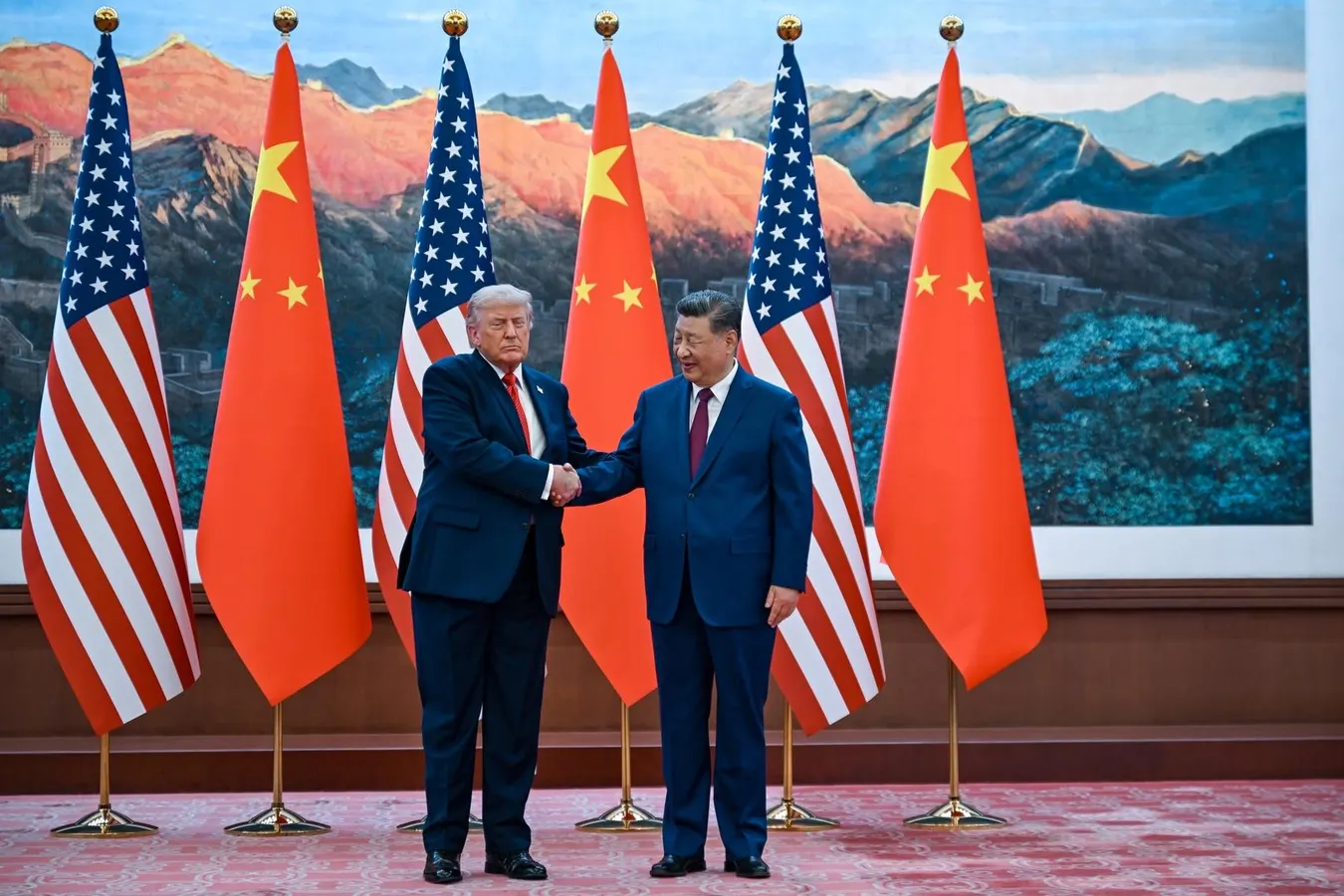

BEIJING, CHINA – MAY 14: U.S. President Donald Trump (L) and Chinese President Xi Jinping participate in a welcoming ceremony at the Great Hall of the People on May 14, 2026 in Beijing, China. It was the latest summit in a series of Sino-American summits with minimal results.
Getty Images
On September 24th, 2026, American President Donald Trump and Chinese President Xi Jinping will engage in direct talks at the White House that could change, or merely reveal, the state of the world’s energy transition and the geoeconomic battlegrounds for energy dominance. Despite low expectations of success, Xi will bring an unusually large business delegation and appears ready to talk business. The agenda contains many flashpoint issues, including Taiwan, national defense, trade, tariffs, and also critical minerals and energy.
While some issues such as Chinese industrial overcapacity and tariffs are likely to yield only a stalemate, with both sides equally incalcitrant, that does not mean the talks are doomed. The international components of energy and critical minerals refining, combined with shared environmental incentives, mean that if any progress happens, it is likely to be here.
What Is At Stake
Critical minerals are foundational to future military equipment, the energy transition, AI, superconductors, semiconductors, and almost every other high-tech item you can imagine. China has a global monopoly on the refining of these critical minerals.
This monopoly has been tremendously profitable for Beijing. According to the International Energy Agency, this monopoly endangers about 6.5 trillion dollars in exposed Western investments and enterprises. Beyond immediate profitability, this dominance creates downstream advantages for all types of Chinese manufacturers. Localizing refining lowers input costs, stimulates innovation in materials science, and removes supply constraints in business planning. This means, for example, Chinese EV companies can produce high-quality cars for cheaper, even after controlling for labor costs.
Beyond profits, dominance in critical minerals gives Beijing unquestioned leverage, making it a sore spot in Sino-American relations. As relations continually cool, China has repeatedly restricted exports of minerals and refining technology to the United States. Despite the tremendous value of this leverage, China must be careful not to utilize it rashly. Withholding supplies will eventually compel the creation of alternative supply chains. China needs to apply pressure without motivating the actions that would render its supply chains obsolete. This demands not only finesse, but cunning and, perhaps most importantly, timing.
A Narrow Timetable
Mining projects are usually measured in decades, defined by massive, consistent, but usually slow-to-ramp-up production. Even massive investments cannot quickly remedy this. As a result, immediate changes in market supply and export availability can have massive, outsized impacts on long-term production and availability. This privileges actors unconstrained by political or news cycles, while also incentivizing timing that exploits it.
American progress in using domestic initiatives to break, or at least mitigate, China’s monopoly is moving forward glacially. Traditional American obstacles involving byzantine permitting endure. The Defense Logistics Agency of the Department of Defense is attempting to overcome this problem via its military prerogatives. The Pentagon has already invested billions in critical minerals. This has shored up America’s military supplies, but remedying America’s wider mineral dependency is slower to materialize.
Shortly after Trump’s second inauguration, Beijing announced a slate of new export restrictions in February 2025. This timing chilled certain investments in American energy while taking the shine off Trump’s energy emergency measures. In October 2025, Beijing unveiled a more comprehensive and strict regime of restrictions. Two months later, Beijing paused the new controls but importantly attached a deadline for their reintroduction; just over two weeks after the scheduled Xi-Trump summit. This is not accidental: China is openly hinting at an October surprise for the Trump administration right before the midterm elections.
Slow progress at home and a looming political calendar make the temptation in the Roosevelt Room obvious. Extend the truce, lock in agricultural purchases, declare the rare-earth issue resolved again, and postpone the reckoning until next year. For a week, it would look good in the polls. It would also be the worst available outcome. A sequence of one-year postponements does not reduce strategic vulnerability; it turns it into a subscription service dictated by Beijing that undercuts American efforts to diversify supply chains.
A Frenzied Global Energy Competition
Because critical minerals constitute a global monopoly with such unique economic characteristics, the Trump-Xi summit will be unusually sensitive to signals relevant to the critical minerals sector. This isn’t theoretical; competition for critical minerals has already gone global, and subtle signals and timing dynamics often produce shockwaves. The world is replete with examples.
These signals matter even more because America’s main strategy to counter China’s critical minerals monopoly is its “mining first” strategy. This strategy posits that defeating China’s monopoly via direct investments in American refining capacity is futile. Instead, the United States should increase the global supply of various raw ores. A drop in ore prices relative to refined materials would incentivize localized refining, which developing countries already want, as it would let them move up the value-added chain and industrialize. America doesn’t need to capture China’s production share, only disperse it. This puts China in the difficult position of defending a global monopoly working against many actors’ incentives while swimming against macroeconomic trends.
In the Democratic Republic of Congo and Rwanda, critical minerals frameworks have been grafted onto a complex conflict with a mosaic of causes and competing actors. Ukraine has also had an array of proposed and enacted critical minerals deals intersect its conflict, helping to redefine its stakes and scope. Small military operations here produce disproportionate results.
Further south, the Angola-Zambia-DRC Lobito Corridor project, designed to connect the rich mines of Africa’s interior to the coasts for exports, has become a focal point for Sino-American competition in Africa. In Eurasia, multiple Central Asian states dream of getting in on the ground floor of critical minerals investment. Here, small changes in investment policy make all the difference and send ripples worldwide.
Elections, even unsurprising ones, can also have huge impacts. In Chile, a widely anticipated electoral victory by the populist right had analysts and energy companies watching closely as to the fate of Chile’s vast lithium and copper deposits.
Any agreement will likely involve give-and-take. The only way there isn’t a give-and-take with reciprocal changes wherein American tariffs are lowered for Chinese export restrictions loosening is with a diplomatic Hail Mary.
Russia may be the wild card for such an initiative. On September 9th 2026, Kremlin spokesman Dimitry Peskov claimed a surprise Chinese-American-Russian trilateral meeting could soon take place on the heels of the Trump-Xi summit.
While China and the United States are the primary actors in this critical minerals drama, Russia can never be discounted. Right as China enacted its first round of 2025 export controls, Russia entered into talks on critical minerals with the US. The talks ultimately went nowhere, but sent a shot across the bow, with Russia trying to signal that any leverage over critical minerals may have to involve the Kremlin. Still, just as China has minimal incentive to offer deep concessions, Russia has minimal willingness to do so.
Russia’s domestic situation is unlikely to yield America any advantages in its talks with China. Russian State Duma elections on September 18-20 ensure that before then, the Kremlin won’t make any gestures that could be interpreted as a concession. Putin’s grip on power and the ruling United Russia party’s parliamentary majority are certain to be maintained. This leaves a brief window from September 21st until Xi’s meeting with Trump on September 24th for Russia to retable its offer. If Russia is going to make an offer to cooperate with America on rare earths under the rationale of diluting China’s monopoly, it will likely be in this narrow timeframe.
Can America Secure A Deal?
None of this bodes well for the United States as Xi arrives in DC. Neither is it necessarily catastrophic. For now, the Sino-American stalemate seems destined for orderly management rather than decisive resolution. Still, if there is an agreement or breakthrough in relations, expect it to occur in energy and critical minerals.
The most important question, therefore, is not whether Trump can extract a concession from Xi. It is whether Washington can use the meeting to buy time without entrenching dependence. A temporary relaxation of Chinese export controls will stabilize American manufacturers, but it does not create a single ton of new American refining capacity, nor does it change the underlying geography of processing.
The existing Sino-American bargain demonstrates the problem. Beijing agreed in early 2025 to address American concerns over shortages of rare earths and other critical minerals, while the United States obtained broader economic concessions, but China’s expanded October 2025 controls remain scheduled to return when the current suspension expires on November 10. A new agreement that simply extends that arrangement would therefore be useful but dangerous. If Washington uses a new agreement to justify procrastination, Beijing will have accomplished something far more consequential than winning a negotiating concession: it will have preserved the structural advantage that makes concessions necessary in the first place.
















Leave a comment