


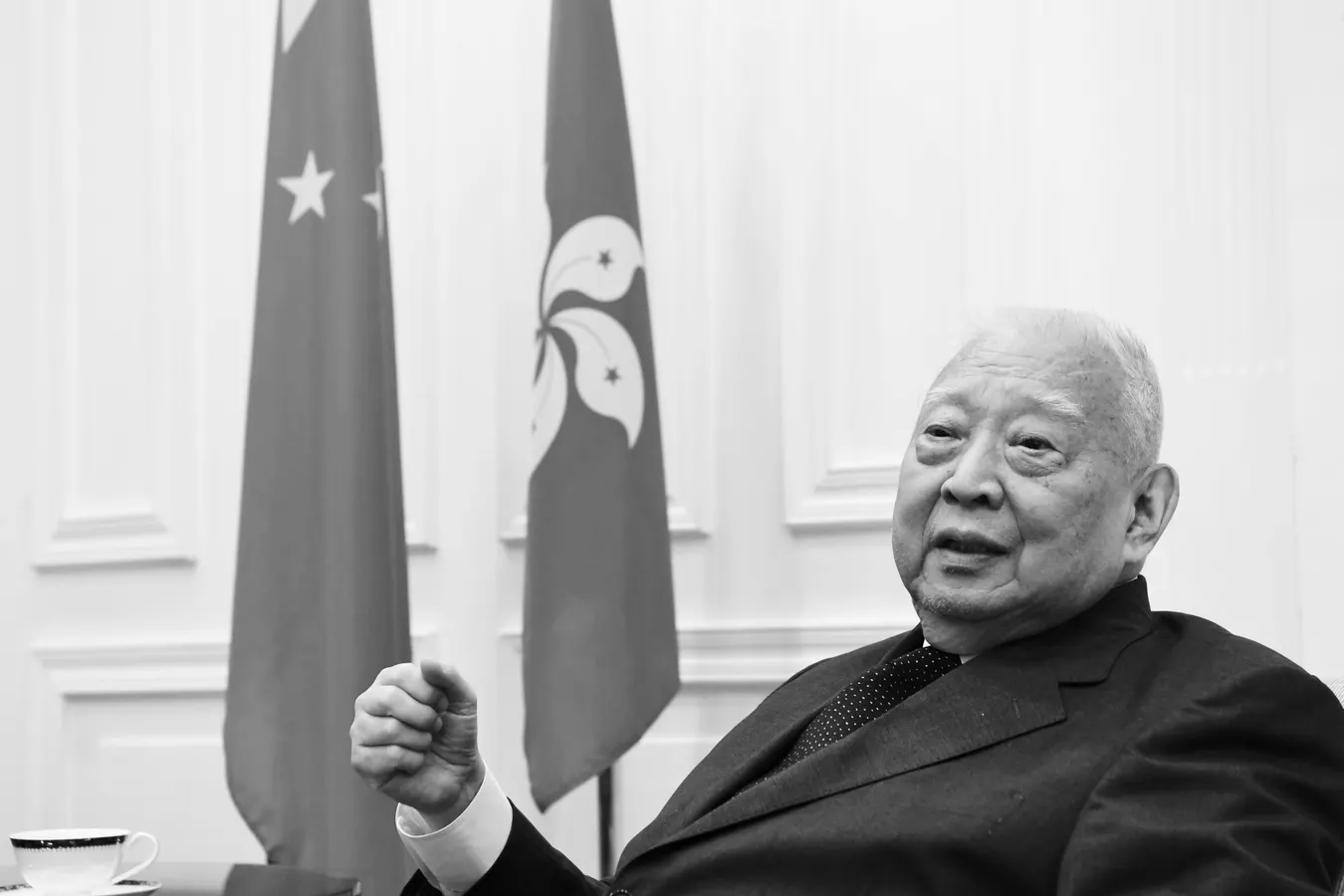
Tung Chee Hwa, former Orient Overseas chairman and Hong Kong’s first chief executive, passed away on September 8, 2026
Photo by Li Zhihua/China News Service via Getty Images
Tung Chee Hwa, the shipping tycoon who led Hong Kong as the city’s first post-colonial chief executive, died on Tuesday at the age of 89. He passed away peacefully surrounded by his family, Tung’s office said in a statement.
At the time of his death, Tung had a fortune of $3.2 billion, according to Forbes’ Real-Time Billionaires List. The bulk of his wealth stemmed from his family’s sale of their majority stake in shipping company Orient Overseas International to China’s state-owned Cosco Shipping Holdings in 2018. With a combined wealth of $7.5 billion, the Tung family ranked No.15 on Hong Kong’s 50 Richest list that was published by Forbes in February this year.
Born in Shanghai in 1937, Tung was the eldest son of influential shipping magnate Tung Chao Yung, who founded Orient Overseas, one of the world’s largest container shipping companies.
At age 10, Tung moved to Hong Kong with his family and attended school locally before going abroad to study marine engineering at the University of Liverpool in the U.K. After graduation, Tung worked as an engineer at General Electric in the U.S. He returned to Hong Kong to join his family’s shipping business in 1969.
In 1982, Tung took the helm of Orient Overseas after his father’s passing. The company, however, soon plunged into financial distress following an aggressive fleet expansion just as the global shipping industry went into a downturn. A $120 million bailout from late Hong Kong real estate tycoon Henry Fok and state-owned enterprises in the mid-1980s saved Orient Overseas from bankruptcy.
While steering Orient Overseas, Tung began taking on public service roles in the mid-1980s, paving the way for his rise in political power. In 1996, he stepped down as Orient Overseas chairman to run for Hong Kong’s chief executive election. That year, he defeated two other candidates, including property billionaire Peter Woo, to become the former British colony’s first leader after its return to Chinese rule.
As with his tenure at Orient Overseas, Tung’s political career wasn’t smooth sailing. His plan to build 85,000 homes annually was undercut by the Asian Financial Crisis, drawing severe backlash for worsening a property slump that left many homeowners in distress. Despite that, Tung was praised for defending the Hong Kong dollar peg to the U.S. dollar against a massive attack by global hedge funds during the Asian Financial Crisis.
In 2002, Tung secured a second term in an uncontested election. A year later, his administration faced criticism over its slow response to the severe acute respiratory syndrome (SARS) outbreak, which killed 299 in Hong Kong. Public discontent deepened when he pushed to enact an anti-subversion law, igniting a 500,000-strong protest over fears of eroding free speech. Tung was ultimately forced to shelve the bill.
With his waning popularity, Tung stepped down in 2005, two years before completing his second term, citing health reasons. He was then appointed vice chairman of the National Committee of the Chinese People’s Political Consultative Conference, a senior state-level advisory position, before stepping down in 2023.
“I have had the privilege to serve our country and the people of Hong Kong in the unique position of chief executive,” Tung said in his speech when he stepped down in 2005. “This is the greatest honor of my life.”











Leave a comment