


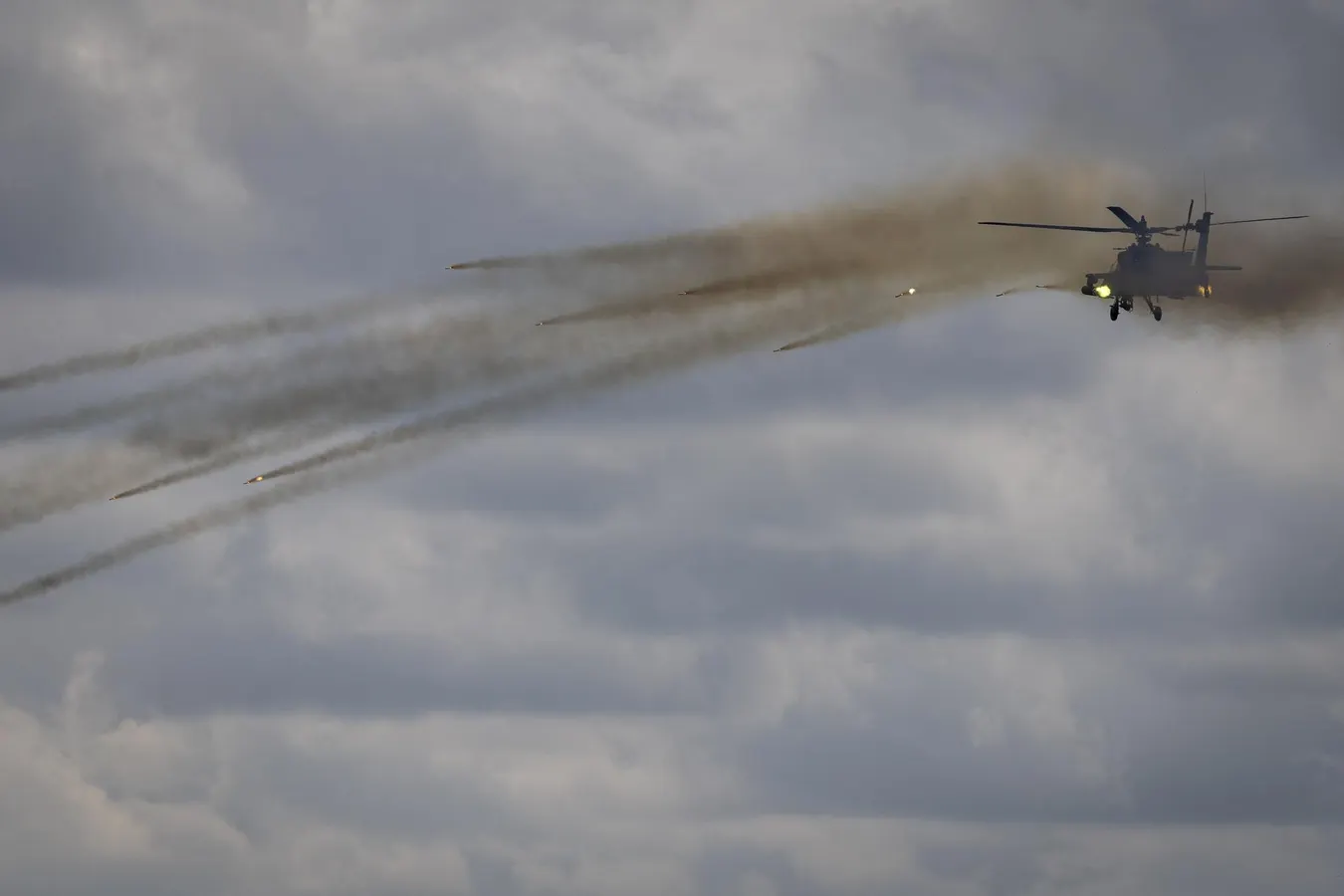

A US Army AH-64D Apache helicopter fires missiles during NATO exercises in Poland in September 2025. The Army recently fired rockets used on Apaches from a heavy-lift cargo drone, significantly expanding the flexibility of U.S. military firepower. (Photo by Wojtek RADWANSKI / AFP) (Photo by WOJTEK RADWANSKI/AFP via Getty Images)
AFP via Getty Images
The U.S. military has expanded the capabilities of attack helicopters by using drones to launch precision-guided rockets and accompany helicopters as loitering munitions. The close integration now occurring between drones and attack helicopters has opened a new chapter in warfare and marks a milestone in the widening the range of U.S. military firepower.
Last month, the U.S. Army mounted a three-shot rocket launcher called the Advanced Precision Kill Weapon System (APKWS) onto a TRV 150 drone and successfully fired it during a test at Fort Rucker, Alabama. Combining these two systems was an unprecedented move given their previously dissimilar uses.
Drones Firing Triple Rocket Pods
A TRV-150 carrying a triple 70 mm rocket launcher flies during a recent test at Fort Rucker, Ala. The drone successfully fired precision-guided rockets used by attack helicopters and fighter planes.
U.S. Army
The APKWS, manufactured by BAE Systems FalconWorks, is a laser-guided rocket system fielded by many elite attack helicopters, including the UH-60 Black Hawk, the AH-1Z Viper, and the MH-60R Seahawk. It is also used on fighter aircraft, including the F-16 Fighting Falcon and the F-18 Hornet. The TRV 150 drone made by Survice Engineering is a vertical takeoff and landing, or VTOL, drone used for resupply. The military has used it to haul cargo and deliver live blood for medical aid.
The exercise was the first time the TRV 150 launched a triple pack of laser-guided munitions. The drone has previously fired single rockets during tests. The Army used it to successfully strike targets in air-to-air and air-to-ground combat last May.
This most recent test at Fort Rucker is the start of something new. By equipping it with triple precision-guided rockets, U.S. forces can potentially use the cargo drone to perform strikes previously limited to attack helicopters and large fighter aircraft.
Helicopters As Drone Motherships
U.S. Marines launch an FPV drone from a moving utility helicopter during an exercise on May 13, 2026. Troops transferred control of the drone to a Viper attack helicopter miles away. (U.S. Marine Corps photo by Lance Cpl. Gracelyn Hanson)
U.S. Marine Corps
In addition to fielding the same firepower as attack helicopters, drones are also now flying beside U.S. military helicopters as loitering munition escorts. The U.S. Marine Corps used AH-1Z Viper and UH-1Y Venom attack helicopters as “motherships.”
The Marines tested small first person view drones to team as escorts with helicopters. They launched the the Neros Archer FPV drone, a system commonly used by both the Army and Marines, from a moving helicopter to gauge its abilities to perform as a partner.
After dropping the drone from the back of a Venom utility helicopter, the Marines transferred control of a drone to a Viper helicopter crew flying miles away. The Viper helicopter then served as a “flying command post” for the drone, according to the service.
Marines onboard the helicopter were able to summon the drone and wield it from their aircraft. The escorting drone served as an extra pair of eyes on the ground as well as an additional weapon to strike targets.
Drones As New Weapons For Assault Helicopters
An AH-64 Apache helicopter launches an Altius 700 Medium-Range Launched Effects (MR-LE) loitering munition during an exercise in March. The Apache’s launch of the Altius drone is part of a growing trend combining unmanned systems with military assault helicopter tactics.
U.S. Army
These tests signify how drones are continuously changing known concepts of airpower. Far from phasing out military attack helicopters, drones are showing enormous potential to augment them as loitering munitions, reconnaissance partners and as detached helicopter rocket launcher systems.
Having the ability to control drones equipped with advanced precision-guided rocket systems and fly them as auxiliaries in combat increases U.S. firepower while also decreasing the need for military service members to fly directly into danger to deliver effective strikes.
On a much larger scale, the U.S. Air Force has used Kratos XQ-58A Valkyrie drones as loyal wingmen to maneuver alongside fighter aircraft. The Army and Marines are now proving that smaller drones can function as wingmen or as detached weapons systems for assault helicopters in action. These developments have opened new doors for U.S. firepower as drones expand the reach of helicopters to support ground forces and carry out precision strikes.















Leave a comment